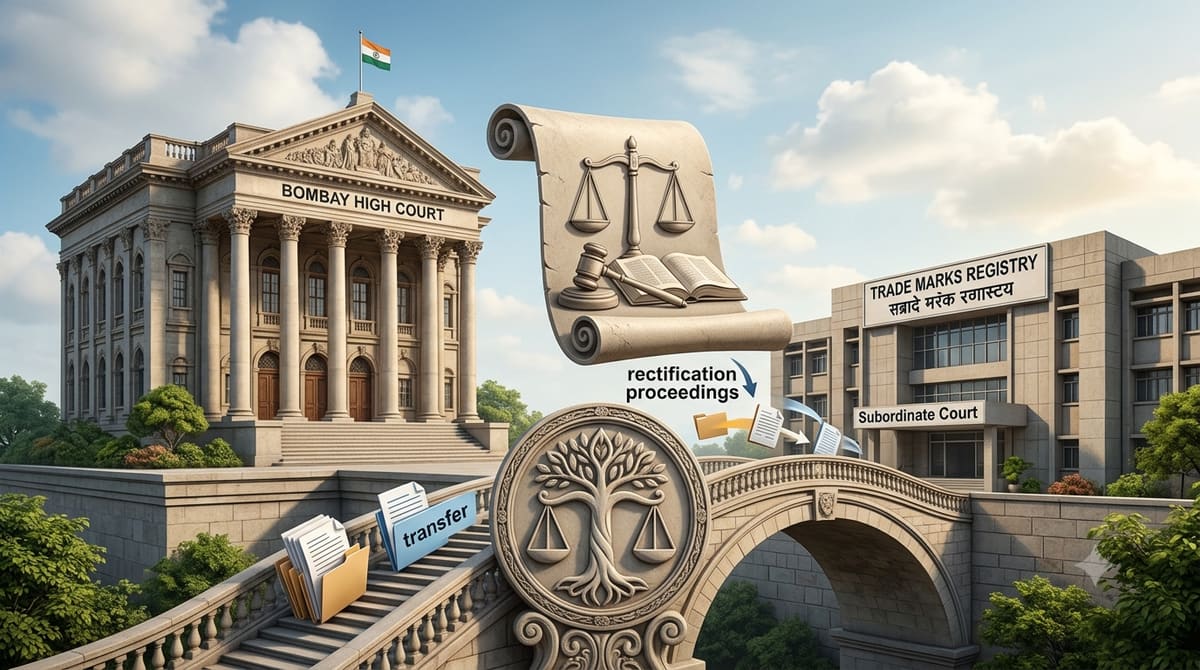
The Bombay High Court has clarified a critical jurisdictional question in intellectual property litigation: whether the Registrar of Trade Marks can be regarded as a 'Court' subordinate to the High Court for purposes of transferring proceedings under Section 24 of the Code of Civil Procedure, 1908. This judgment establishes that the Registrar, despite being a statutory tribunal, possesses sufficient trappings of a Court to enable consolidation of parallel rectification proceedings with infringement suits pending before the High Court.
Background & Facts
The Dispute
The dispute involves two trusts engaged in educational activities:
The Institute for Technology and Management Trust (ITM), the original plaintiff in Commercial IP Suit No. 102 of 2015, uses certain marks (ITM Marks).
The Samata Lok Sansthan Trust (Samata), a defendant in the suit, operates in Madhya Pradesh and is alleged to have infringed ITM’s marks.
Key Facts
14.09.2015: ITM filed the suit alleging infringement of its marks.
Between 27.05.2014 and 06.07.2015: ITM initiated three rectification proceedings before the Registrar of Trade Marks, Mumbai (ITM Rectification Proceedings), seeking cancellation of Samata’s registrations.
16.02.2016: Samata filed 17 rectification applications before the Intellectual Property Appellate Board (IPAB) against ITM’s registrations (Samata Rectification Proceedings).
Post-IPAB dissolution: The Samata Rectification Proceedings were transferred to the Bombay High Court and listed alongside the suit by order dated 02.01.2025.
Procedural History
14.09.2015: ITM files Commercial IP Suit No. 102 of 2015.
27.05.2014 - 06.07.2015: ITM files three rectification applications before the Registrar.
16.02.2016: Samata files 17 rectification applications before the IPAB.
02.01.2025: Bombay High Court orders Samata Rectification Proceedings to be heard alongside the suit.
2025: ITM files Interim Application No. 3128 of 2025 (Transfer Application) seeking transfer of the ITM Rectification Proceedings from the Registrar to the High Court for consolidation.
30.06.2026: Present judgment delivered.
The Parties' Positions
ITM contended that consolidating all proceedings before the High Court would prevent divergent outcomes and aligns with principles of forum conveniens.
Samata argued that the Registrar is not a 'Court' under Section 24 CPC, rendering the Transfer Application misconceived and jurisdictionally flawed.
Relief Sought
ITM sought transfer of the three ITM Rectification Proceedings pending before the Registrar to the Bombay High Court for consolidated adjudication alongside the suit and Samata Rectification Proceedings.
The Legal Issue
The central question was whether the Registrar of Trade Marks can be regarded as a 'Court' subordinate to the High Court under Section 24 of the CPC, enabling transfer of rectification proceedings for consolidated adjudication.
Arguments Presented
For the Applicant (ITM)
Efficiency and Convenience: Consolidation would prevent divergent outcomes across forums.
Jurisdictional Basis: The High Court has original jurisdiction under Sections 47 and 57 of the Trade Marks Act, 1999 to conduct rectification proceedings.
Precedents Cited:
Jumeirah Beach Resort LLC v. Designarch Infrastructure Pvt Ltd (Delhi High Court): Allowed transfer of rectification proceedings from the Registrar to the High Court.
Nippon Paint Holdings Co. Ltd. v. Suraj Sharma (Madras High Court): Supported consolidation of IPR proceedings.
Bhagwati Devi v. I.S. Goel (Supreme Court): Treated the Motor Accident Claims Tribunal as a 'Court' for Section 25 CPC.
Inherent Powers: Invoked Section 151 CPC to argue that the High Court’s inherent powers can be used to prevent abuse of process and ensure justice.
For the Respondent (Samata)
Registrar Not a Court: Argued that the Registrar is not a 'Court' under Section 24 CPC, citing:
Anglo French Drug Co. (Eastern) Private Ltd. v. R.D. Tinaikar (Bombay High Court): Held Registrar is not a Court.
Promoshirt SM SA v. Armassuisse (Delhi High Court): Endorsed Anglo French in the context of second appeals.
Procedural Flaws: Contended that the Transfer Application should have been filed as a Miscellaneous Application on the Appellate Side, not as an Interim Application in the suit.
Alternative Remedy: Argued that ITM should have filed an application under Section 125 of the TM Act before the Registrar, followed by a writ petition if rejected.
The Court's Analysis
Registrar’s Status Under Section 24 CPC
The Court examined Section 24(1) CPC, which empowers the High Court to transfer proceedings from a subordinate court. The term 'Court' is not defined in the CPC, requiring a contextual analysis:
“24. General power of transfer and withdrawal. - (1) On the application of any of the parties and after notice to the parties and after hearing such of them as desired to be heard, or of its own motion without such notice, the High Court or the District Court may at any stage -(a) transfer any suit, appeal or other proceeding pending before it for trial or disposal to any Court subordinate to it and competent to try or dispose of the same, or(b) withdraw any suit, appeal or other proceeding pending in any Court subordinate to it, and -(i) try or dispose of the same; or(ii) transfer the same for trial or disposal to any Court subordinate to it and competent to try or dispose of the same; or(iii) retransfer the same for trial or disposal to the Court from which it was withdrawn.”
The Court held that the Registrar possesses trappings of a Court under Section 127 of the TM Act, including powers to:
Receive evidence,
Administer oaths,
Enforce attendance of witnesses,
Compel discovery and production of documents,
Issue commissions for witness examination,
Impose costs executable as civil court decrees,
Review its own decisions.
Statutory Appeal Mechanism
Under Section 91(1) of the TM Act, appeals from the Registrar lie to the High Court:
“91. Appeals to High Court. - (1) Any person aggrieved by an order or decision of the Registrar under this Act, or the rules made thereunder may prefer an appeal to the High Court within three months from the date on which the order or decision sought to be appealed against is communicated to such person preferring the appeal.”
This appellate oversight establishes the Registrar as a subordinate forum to the High Court.
Contextual Interpretation
The Court rejected a universal application of the principle that the Registrar is not a Court, emphasizing that the determination depends on the legislative policy intent and the context in which the question arises:
Limitation Act Context: In Khoday Distilleries Ltd. v. Scotch Whisky Assn. and Sakura v. Tanaji, the Supreme Court held the Registrar is not a Court for limitation purposes. However, this was specific to the deadlines for filing rectification proceedings, not jurisdictional transfer.
Concurrent Jurisdiction: The Registrar and High Court share concurrent jurisdiction under Sections 47 and 57 of the TM Act. The Registrar’s findings bind the High Court under Section 124 of the TM Act, further justifying its treatment as a subordinate Court.
Precedents and Distinctions
Bhagwati Devi: The Supreme Court treated the Motor Accident Claims Tribunal as a Court for Section 25 CPC, supporting the argument that tribunals can be Courts in specific contexts.
Nahar Industrial Enterprises Ltd. v. Hongkong & Shanghai Banking Corp.: Distinguished the Debt Recovery Tribunal from the Registrar, as appeals from the DRT do not lie to the High Court, unlike the Registrar.
Promoshirt and Anglo French: Both cases were distinguished:
Promoshirt dealt with second appeals, not transfer of proceedings.
Anglo French involved the right of audience before the Registrar, not jurisdictional consolidation.
Inherent Powers Under Section 151 CPC
The Court invoked Section 151 CPC to fill perceived gaps in procedural rules, emphasizing that the absence of specific rules (akin to the Delhi High Court’s IPD Rules) does not erode the High Court’s inherent powers:
“151. Saving of inherent powers of Court. - Nothing in this Code shall be deemed to limit or otherwise affect the inherent power of the Court to make such orders as may be necessary for the ends of justice or to prevent abuse of the process of the Court.”
Procedural Compliance
Samata argued that the Transfer Application should have been filed as a Miscellaneous Application on the Appellate Side. The Court rejected this, holding:
Chapter XLV of the Original Side Rules governs trademark matters, and Rule 835 applies the CPC and Original Side Rules to proceedings under the TM Act.
Rule 830 deals with references from the Registrar, reinforcing the Original Side’s jurisdiction over such matters.
The Verdict
The Court allowed the Transfer Application, holding:
The Registrar of Trade Marks is a 'Court' subordinate to the High Court for purposes of Section 24 CPC.
The High Court’s powers under Section 24 read with Section 151 CPC enable transfer and consolidation of proceedings for efficient adjudication.
The three ITM Rectification Proceedings pending before the Registrar are transferred to the Bombay High Court and tagged with the suit and 17 Samata Rectification Proceedings.
The Registrar is directed to transmit the records of the ITM Rectification Proceedings to the High Court within six weeks.
All tagged proceedings are listed for hearing on 18.08.2026.
What This Means For Similar Cases
Tribunals Can Be Subordinate Courts for Transfer Purposes
Practitioners can argue that statutory tribunals with adjudicatory powers (e.g., Registrar of Trade Marks, MACT) may be treated as 'Courts' for Section 24 CPC if:
They possess trappings of a Court (e.g., evidence reception, oath administration, enforceable orders),
Their decisions are appealable to the High Court,
They share concurrent jurisdiction with the High Court.
Key Takeaway: The determination is context-specific and depends on the legislative scheme and policy intent underlying the tribunal’s creation.
Consolidation of Proceedings Is Favored for Efficiency
Courts are likely to favor consolidation of parallel proceedings involving:
The same parties,
The same subject matter,
Inextricably linked factual matrices.
Actionable Steps:
File transfer applications early to avoid fragmented litigation,
Cite Section 151 CPC to argue inherent powers where procedural rules are silent,
Highlight potential divergent outcomes as a ground for transfer.
Procedural Rules Do Not Limit Substantive Powers
The absence of specific procedural rules (e.g., Bombay High Court’s lack of IPD Rules) does not oust the High Court’s jurisdiction to transfer proceedings.
Precedent to Rely On: Delhi Science Forum v. Union of India (Supreme Court), which held that the absence of rules does not render a statutory power unenforceable.
Practical Implication: Parties can bypass hyper-technical objections by invoking inherent powers under Section 151 CPC or Section 24 CPC directly.