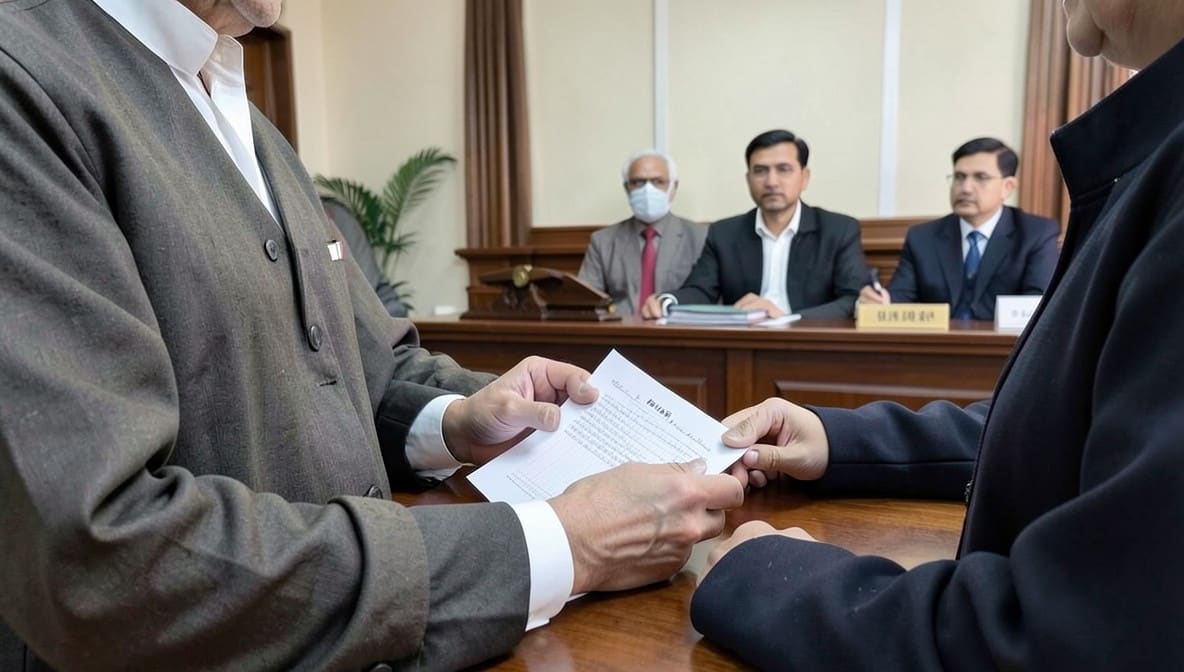
The Bombay High Court has delivered a critical judgment reinforcing the procedural safeguards under the Bharatiya Nagarik Suraksha Sanhita, 2023 (BNSS). The Court held that failure to communicate the grounds of arrest in writing to an accused before remand renders the arrest illegal, violating Articles 21 and 22 of the Constitution. This ruling underscores the mandatory nature of Section 47 BNSS and sets a precedent for strict compliance with arrest procedures, particularly in cases involving serious offences.
Background & Facts
The Dispute
The petitioner, Shankesh Prithviraj Sanghvi, was arrested in connection with FIR No. 226/2026 registered at Tardeo Police Station, Mumbai, for offences under Sections 64, 75, 76, 77, 78, 79, 308, 351(2), 352, and 115(2) of the Bharatiya Nyaya Sanhita, 2023, and Section 66E of the Information Technology Act, 2000. The FIR was lodged by the intervenor (the victim) on 21.05.2026, alleging that the petitioner had sexually exploited her over a period starting from August 2024, including taking obscene photos, making morphed images, and demanding a ransom of Rs. 50 lakhs to delete the material.
Key Facts
August 2024: The petitioner allegedly took obscene photos of the victim during a trip to London while she was under the influence of alcohol.
September 2024: The petitioner showed the photos to the victim and threatened to post them on social media if she complained.
21.05.2026: The victim filed a report at 20:08 hours, leading to the registration of the FIR.
21.05.2026: The petitioner was arrested at 22:29 hours on the same night.
The petitioner was produced before the Judicial Magistrate First Class (JMFC), 18th & 40th Court, Girgaon, Mumbai, on 22.05.2026 for police custody remand.
Procedural History
22.05.2026: The petitioner was produced before the JMFC for remand. His counsel objected to the police custody remand (PCR) on the ground that the petitioner was not communicated the grounds of arrest as required under Section 47(1) of BNSS. The JMFC rejected the objection and remanded the petitioner to police custody till 25.05.2026.
25.05.2026: The petitioner filed written submissions challenging the legality of his arrest and remand. The JMFC rejected the submissions and extended the police custody till 28.05.2026.
28.05.2026: The petitioner was produced again, and the JMFC remanded him to magisterial custody remand (MCR) till 11.06.2026.
Present Petition: The petitioner filed Criminal Writ Petition No. 2823 of 2026 under Section 528 BNSS and Article 227 of the Constitution, challenging the legality of his arrest and remand orders.
Relief Sought
The petitioner sought:
Quashing of the remand orders dated 22.05.2026, 25.05.2026, and 28.05.2026.
A declaration that his arrest was illegal and in violation of Articles 21 and 22 of the Constitution.
Immediate release from judicial custody.
The Legal Issue
The central questions before the Court were:
Whether the petitioner was communicated the grounds of arrest when he was apprehended or immediately thereafter?
If not, whether the arrest of the petitioner and his subsequent remand to police and judicial custody were illegal on that account?
Arguments Presented
For the Petitioner
The petitioner was not communicated the grounds of arrest in writing before or immediately after his arrest, as required under Section 47(1) of BNSS and Article 22(1) of the Constitution.
The Arrest Form and the communication under Section 35(1)(b) of BNSS merely stated generic reasons for arrest, not the specific grounds of arrest.
The failure to communicate the grounds of arrest vitiated the arrest and all subsequent remand orders.
Reliance was placed on precedents such as Prabir Purkayastha v. State (NCT of Delhi) (2024) 8 SCC 254, Vihaan Kumar v. State of Haryana (2025) 5 SCC 799, and Mihir Rajesh Shah v. State of Maharashtra (2026) 1 SCC 500.
For the Respondent/State
The petitioner was informed of the allegations against him immediately after the FIR was registered.
The communication under Section 47(1)(2) of BNSS sufficiently conveyed the grounds of arrest.
The petitioner did not demonstrate any prejudice caused by the alleged non-compliance with procedural requirements.
Reliance was placed on State of Karnataka v. Sri Darshan (2025 SCC OnLine SC 1702), which adopted a prejudice-oriented test for procedural lapses.
The Court's Analysis
The Court undertook a detailed examination of the legal requirements for arrest and communication of grounds under BNSS and the Constitution. Key observations included:
Distinction Between ‘Reasons for Arrest’ and ‘Grounds of Arrest’:
"There is a significant difference in the phrase ‘reasons for arrest’ and ‘grounds of arrest’. The ‘reasons for arrest’ as indicated in the arrest memo are purely formal parameters... whereas the ‘grounds of arrest’ would be required to contain all such details in hand of the Investigating Officer which necessitated the arrest of the accused. Simultaneously, the grounds of arrest informed in writing must convey to the arrested accused all basic facts on which he was being arrested so as to provide him an opportunity of defending himself against custodial remand and to seek bail."
(Prabir Purkayastha v. State (NCT of Delhi), (2024) 8 SCC 254)
The Court noted that the Arrest Form and the communication under Section 35(1)(b) of BNSS merely listed generic reasons for arrest, such as preventing the accused from tampering with evidence or absconding. These did not constitute the specific grounds of arrest as required by law.
Mandatory Nature of Communication of Grounds:The Court relied on Vihaan Kumar v. State of Haryana (2025) 5 SCC 799, which held:
"The requirement of informing a person arrested of grounds of arrest is a mandatory requirement of Article 22(1)... The information of the grounds of arrest must be provided to the arrested person in such a manner that sufficient knowledge of the basic facts constituting the grounds is imparted and communicated to the arrested person effectively in the language which he understands."
The Court emphasized that non-compliance with Article 22(1) vitiates the arrest and all subsequent remand orders, regardless of whether prejudice is demonstrated.
Role of the Magistrate:The Court criticized the JMFC’s remand orders for failing to ascertain whether the petitioner was sufficiently informed of the grounds of arrest. The JMFC’s reasoning - that the petitioner’s counsel had argued on merits, thereby fulfilling the purpose of legal aid - was held to be legally unsustainable.
Precedential Analysis:The Court distinguished the case from State of Karnataka v. Sri Darshan (2025 SCC OnLine SC 1702), which adopted a prejudice-oriented test. Instead, the Court aligned itself with Ahmed Mansoor v. State (2025 SCC Online SC 2650), which held that failure to communicate grounds of arrest in writing cannot be cured by subsequent explanations.
Constitutional Safeguards:The Court reiterated the principle laid down in State of West Bengal v. Anwar Ali Sarkar (1952) 1 SCC 1, that procedural safeguards are as sacrosanct as substantive rights and must be strictly complied with.
The Verdict
The Court allowed the petition and held:
The arrest of the petitioner was illegal as it violated Articles 21 and 22 of the Constitution and Section 47 of BNSS due to non-communication of the grounds of arrest in writing.
The remand orders dated 22.05.2026, 25.05.2026, and 28.05.2026 passed by the JMFC were quashed and set aside.
The petitioner was directed to be released forthwith from judicial custody.
Liberty was granted to the State to take recourse to law for arrest if a case was made out, subject to compliance with legal requirements.
The Court clarified that its observations were not comments on the merits of the case.
What This Means For Similar Cases
Strict Compliance with Section 47 BNSS Is Non-Negotiable
Investigating Officers must ensure that the grounds of arrest are communicated in writing to the accused before or immediately after arrest. Generic reasons for arrest (e.g., preventing tampering with evidence) are insufficient.
The Arrest Form must contain specific details of the allegations against the accused, enabling them to defend themselves effectively.
Magistrates must ascertain compliance with Section 47 BNSS before passing remand orders. Mere appearance of counsel does not cure procedural lapses.
Prejudice Is Not a Prerequisite for Invalidating Arrest
Unlike the prejudice-oriented test adopted in State of Karnataka v. Sri Darshan, this judgment reaffirms that non-compliance with constitutional safeguards vitiates the arrest, regardless of whether the accused suffered demonstrable prejudice.
Practitioners should argue that procedural lapses alone are sufficient to challenge the legality of arrest and remand, without needing to prove prejudice.
Practical Implications for Legal Practice
For Defence Counsel: Challenge arrests where the grounds of arrest are not communicated in writing. Rely on Prabir Purkayastha, Vihaan Kumar, and Ahmed Mansoor to argue that such lapses render the arrest illegal.
For Prosecution: Ensure strict adherence to Section 47 BNSS to avoid challenges to the legality of arrest. Document the communication of grounds in writing and serve them to the accused promptly.
For Magistrates: Scrutinize remand applications to confirm compliance with Article 22(1) and Section 47 BNSS. Reject remand orders where grounds of arrest are not adequately communicated.