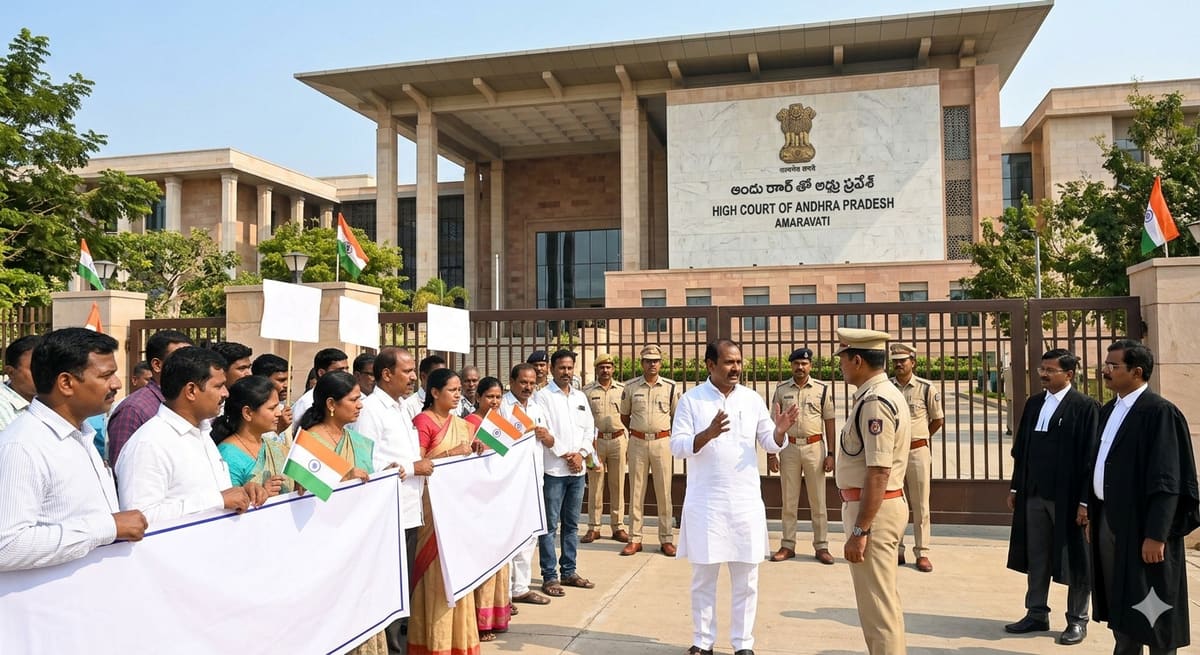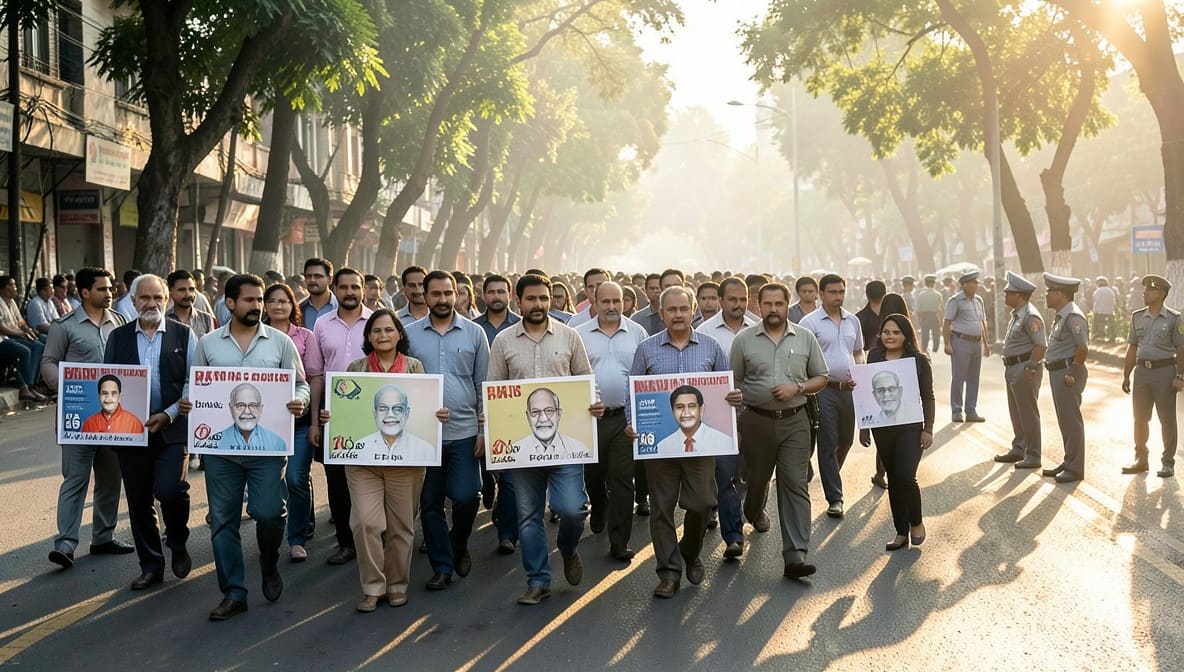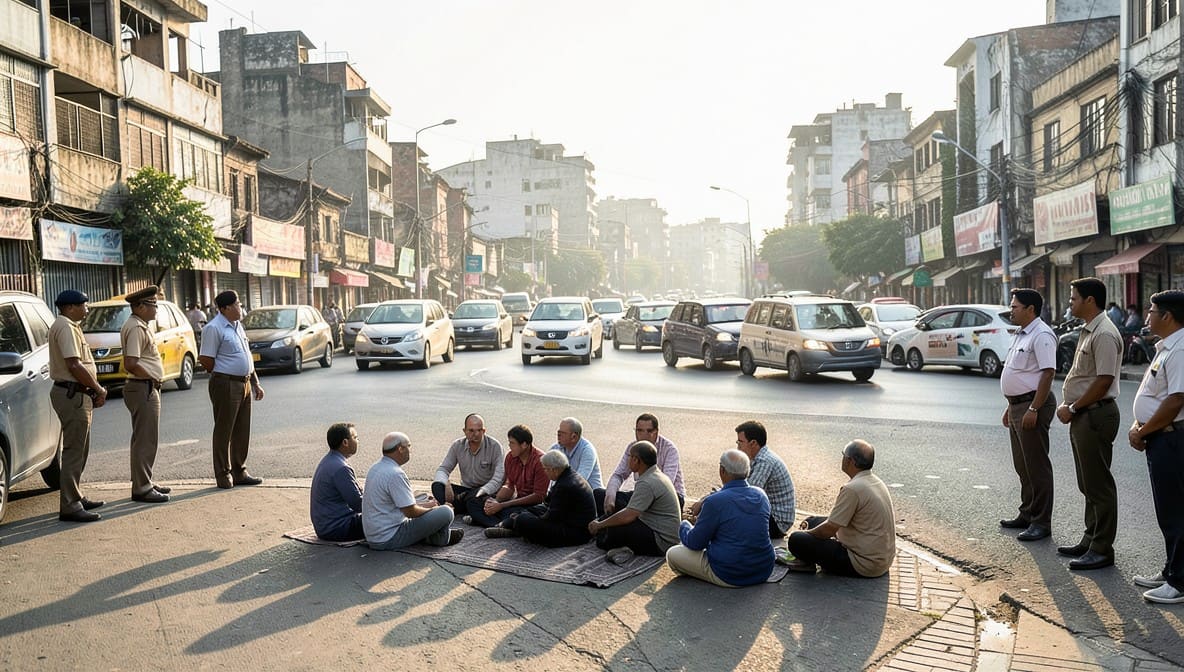
The Calcutta High Court has affirmed that the right to peaceful assembly under Article 19(1)(b) of the Constitution cannot be extinguished by administrative inaction or blanket prohibitions, even in high-traffic urban zones. The Court emphasized that reasonable restrictions must be narrowly tailored, and alternatives must be genuinely viable - not merely symbolic - to preserve the essence of fundamental rights.
Background & Facts
The Dispute
Sangrami Joutha Mancha, an organization of West Bengal State Government employees, sought permission to hold a sit-in demonstration and rally at Hazra More, Kolkata, on 12th April 2026. The proposed route extended from Hazra More to Harish Mukherjee Road, then to Debendra Ghosh Road, S.P. Mukherjee Road, and back to Hazra More. The event was planned to commence at 12:05 p.m. and conclude by 5:00 p.m., with an estimated participation of 3,000 individuals.
Key Facts
- The application for permission was submitted on 02.04.2026 to the Joint Commissioner of Police (HQ), Lalbazar, Kolkata.
- No response was received from the police authority within the stipulated timeframe.
- On 08.04.2026, the petitioner filed the present writ petition before the Calcutta High Court.
- On the same day (08.04.2026), the police authority responded via email, proposing three alternative venues for the event, but declined permission for Hazra More.
- The police cited Section 163 of the Bharatiya Nagarik Suraksha Sanhita, 2023, which imposed a prohibitory order on the proposed route.
- The proposed route passed through critical traffic corridors and near hospital zones, raising concerns about traffic congestion, public inconvenience, and disruption of essential services.
- The petitioner contended that similar assemblies by political parties and other organizations had been permitted at Hazra More in the past.
Procedural History
- 02.04.2026: Application submitted to Joint Commissioner of Police, Kolkata.
- 08.04.2026: Writ Petition (W.P.A. No. 8792 of 2026) filed before the Calcutta High Court.
- 08.04.2026: Police responded via email proposing three alternative venues.
- 10.04.2026: Hearing concluded; judgment delivered on the same day.
The Parties' Positions
For the Petitioners
- Argued that the right to assemble peacefully under Article 19(1)(b) is a fundamental constitutional right.
- Contended that the absence of any response to the application until filing of the writ petition amounted to constructive denial.
- Relied on the precedent set in Sankar Ghosh v. State of West Bengal (W.P.A. 736 of 2026), where a coordinate Bench permitted a similar sit-in demonstration near Nabanna, and the Division Bench had dismissed the appeal against it on 29.01.2026 (M.A.T. 67 of 2026).
- Asserted that the proposed alternative venues were not equivalent in accessibility or symbolic significance to Hazra More.
For the Respondents (State & ECI)
- Argued that the police had not denied permission outright but had proposed three alternative locations.
- Cited Section 163 of the Bharatiya Nagarik Suraksha Sanhita, 2023, as the legal basis for prohibiting the proposed route.
- Emphasized potential disruption to traffic, public order, and hospital operations.
- Relied on Himat Lal K. Shah v. Commissioner of Police, Ahmedabad (1973) 1 SCC 227, to argue that the right to assemble must be balanced against the collective interest of the public.
- Contended that the Court should not interfere where authorities have offered reasonable alternatives.
Relief Sought
The petitioners sought a direction permitting them to hold the sit-in demonstration and rally at Hazra More as originally proposed, on 12.04.2026, with the stated route and duration.
The Legal Issue
The central question was whether the State’s proposal of three alternative venues, while denying the originally requested location under a prohibitory order, constitutes a lawful regulation under Article 19(1)(b) or amounts to an unconstitutional infringement of the right to peaceful assembly.
Arguments Presented
For the Petitioner
The petitioners relied on Sankar Ghosh v. State of West Bengal to establish that courts have previously permitted sit-in demonstrations in proximity to sensitive public spaces, provided conditions are imposed to mitigate disruption. They argued that Hazra More was a historically recognized site for public gatherings and that denying access there while permitting others violated the principle of equal treatment under the Constitution. The absence of a timely response to the application was treated as a procedural failure, and the subsequent email offering alternatives was deemed an afterthought, not a genuine attempt at accommodation.
For the Respondent
The State contended that the proposed route fell within a legally imposed prohibitory zone under Section 163 of the Bharatiya Nagarik Suraksha Sanhita, 2023, which empowers authorities to restrict assemblies in areas critical to public safety. The State further argued that the three alternative venues proposed were geographically accessible and functionally equivalent. Citing Himat Lal K. Shah, the State maintained that the right to assemble is not absolute and must yield to the need for maintaining public order and essential services.
The Court's Analysis
The Court acknowledged the foundational nature of Article 19(1)(b) and the principle that restrictions must be reasonable, non-arbitrary, and narrowly tailored. It noted that the police had not issued a blanket refusal but had responded only after the writ petition was filed - an action that raised concerns about procedural fairness.
"The right to hold a peaceful assembly cannot be rendered illusory by the State’s delayed response and the offer of alternatives that lack equivalent public visibility or symbolic value."
The Court examined the precedent in Sankar Ghosh, which had been upheld by the Division Bench, and found it directly analogous: both cases involved peaceful demonstrations in urban centers with traffic and public service concerns. The Court held that the State’s reliance on Section 163 did not justify a complete denial of the chosen venue, particularly where the proposed location - Hazra More - was not itself within the prohibited zone but merely adjacent to it.
The Court further emphasized that the State’s duty under Article 19(2) is not to suppress assembly but to facilitate it with minimal intrusion. The proposed route’s passage through hospital zones and traffic corridors was acknowledged as a legitimate concern, but the Court found that this could be addressed through operational conditions rather than outright denial.
The Court rejected the argument that offering any alternative venue suffices as compliance with constitutional obligations. It held that the choice of venue must be meaningful and not merely a bureaucratic compromise that undermines the expressive purpose of the assembly.
The Verdict
The writ petition was allowed with specific conditions. The Court permitted the Sangrami Joutha Mancha to hold a sit-in demonstration at Hazra More (crossing) on 12.04.2026, subject to the following:
- No procession or rally shall be organized;
- Participation shall be limited to 1,000 (one thousand) participants at a time;
- The demonstration shall be held between 1:00 p.m. and 4:00 p.m.;
- Traffic flow at Hazra More shall not be obstructed;
- Participants shall adhere to all lawful norms and maintain peace;
- The police shall deploy adequate personnel to ensure order and prevent untoward incidents.
The petition is disposed of accordingly.
What This Means For Similar Cases
Assembly Rights Cannot Be Circumvented by Delayed Alternatives
- Practitioners must challenge administrative silence as a de facto denial of constitutional rights.
- Authorities cannot delay responses until litigation is initiated and then offer alternatives as a pretext to avoid scrutiny.
- Courts will examine whether alternatives are functionally equivalent in terms of visibility, accessibility, and symbolic relevance.
Conditions Are Permissible, But Not Substitution Without Justification
- The State may impose reasonable conditions on time, place, and manner of assembly, but cannot substitute the chosen venue without demonstrating a compelling public interest.
- Prohibitory orders under Section 163 of the Bharatiya Nagarik Suraksha Sanhita, 2023, must be narrowly applied and cannot blanketly override assembly rights.
- Demonstrations near hospitals or traffic corridors are not per se prohibited - mitigation through policing and scheduling is constitutionally sufficient.
Precedent from Coordinate Benches Is Binding in Absence of Overruling
- A coordinate Bench’s decision on a substantially similar factual matrix, if not overturned by a higher bench, must be followed.
- The Calcutta High Court’s refusal to interfere with Sankar Ghosh reinforces that consistent judicial treatment of assembly rights is required across similar cases.