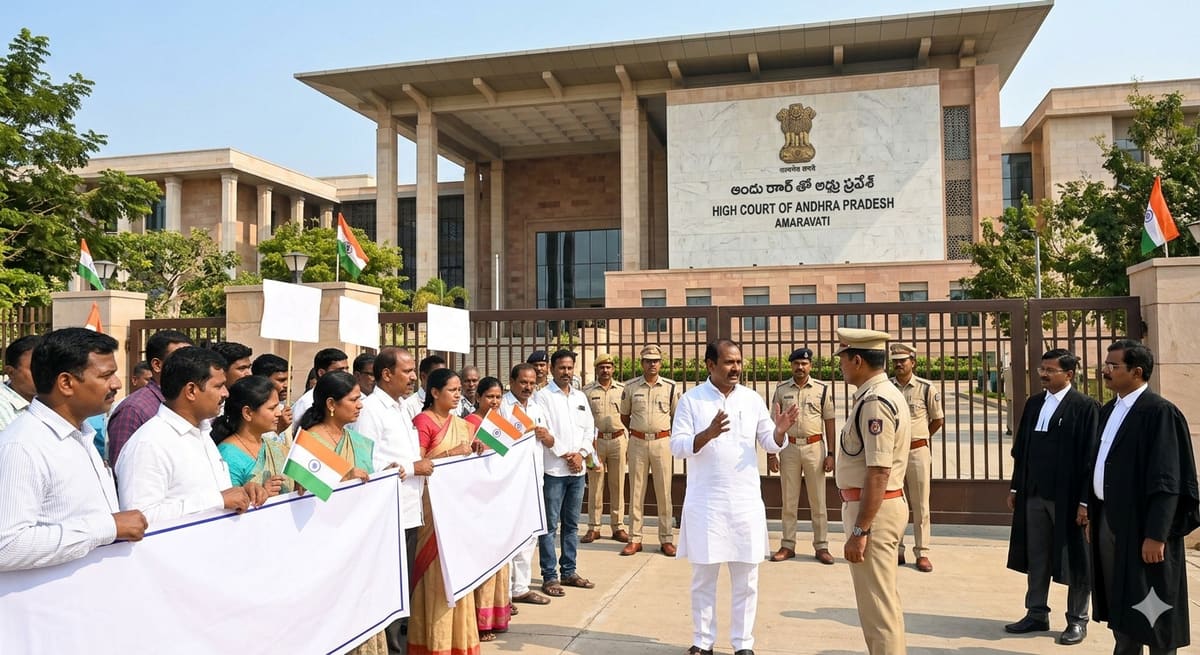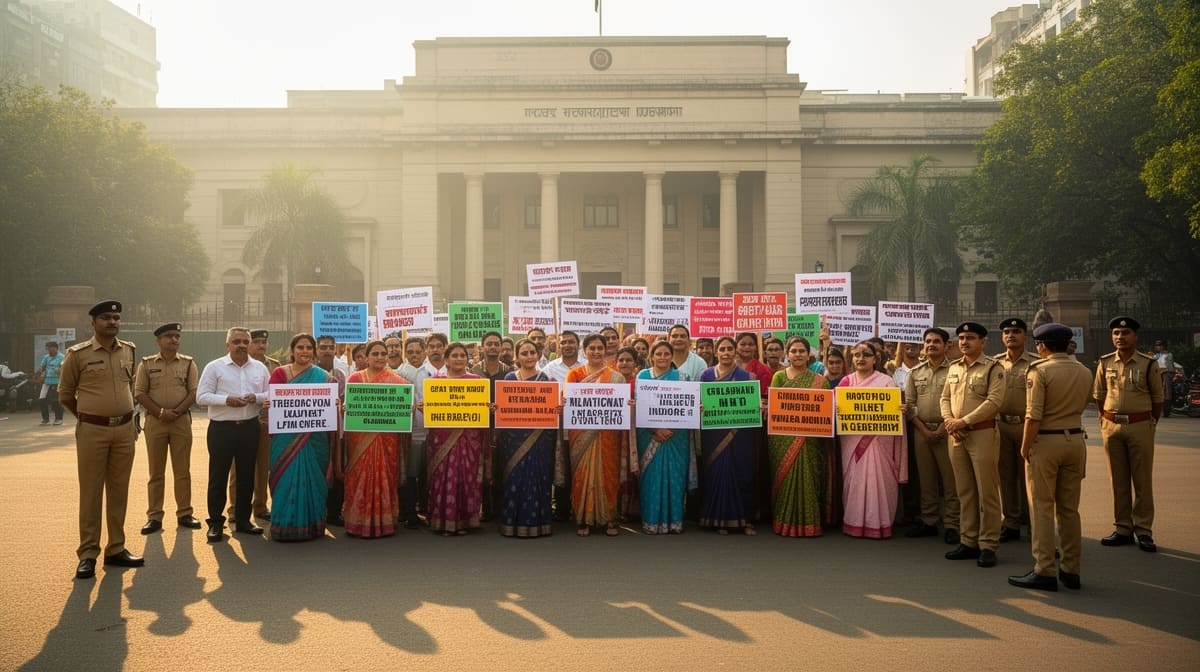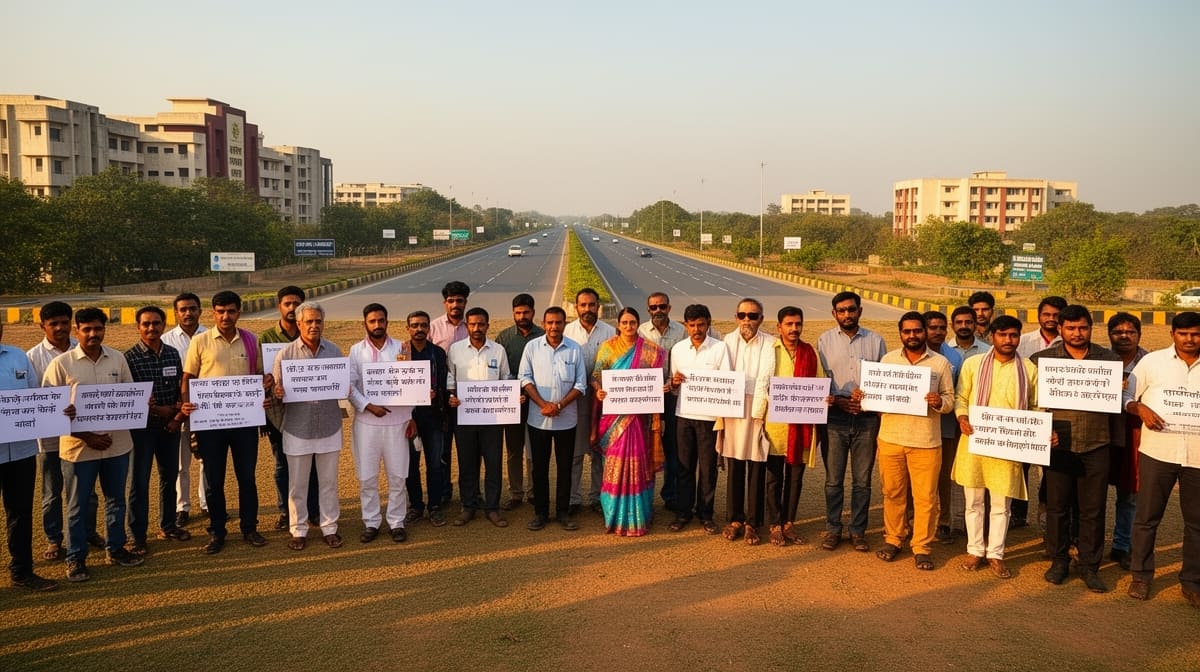
The High Court of Andhra Pradesh has reaffirmed that the fundamental right to peaceful assembly cannot be extinguished merely because a petitioner faces multiple pending criminal proceedings. In a significant ruling, the Court held that the State’s duty is to facilitate, not obstruct, constitutional rights - even when the speaker is controversial - provided reasonable conditions are imposed to maintain public order.
Background & Facts
The Dispute
The petitioner, Bode Ramachandra Yadav, President of the Bharatha Chaitanya Yuva Jana Party, sought permission to conduct a public meeting titled "BC Simha Garjana" on 22 February 2026 at the ground opposite Acharya Nagarjuna University in Mangalagiri. The meeting was intended to articulate political grievances and mobilize support among marginalized communities. He submitted three formal representations to the Superintendent of Police, Guntur District, on 5 February, 10 February, and 12 February 2026, detailing the venue, expected attendance of 10,000 to 12,000 persons, transportation arrangements, and security requirements.
Procedural History
- 5 February 2026: First representation submitted seeking permission and police deployment.
- 10 February 2026: Second representation submitted with updated logistics, including 50 buses, 500 cars, and 1,000 two-wheelers.
- 12 February 2026: Third representation reiterated the request.
- No formal response was issued by the Respondent Authorities prior to the filing of the writ petition.
- 19 February 2026: Writ Petition filed under Article 226 seeking mandamus to compel permission and security arrangements.
Relief Sought
The petitioner sought a writ of mandamus directing the State authorities to permit the meeting on the specified date and venue, and to make necessary police arrangements to ensure its peaceful conduct.
The Legal Issue
The central question was whether the State can deny permission for a public assembly under Article 19(1)(b) solely on the grounds that the petitioner faces 21 pending criminal cases, without demonstrating a concrete and imminent threat to public order.
Arguments Presented
For the Petitioner
The petitioner’s counsel, Sri Y.V. Ravi Prasad, relied on Kameshwar Prasad v. State of Bihar, Himant Lal K. Shah v. Commissioner of Police, Ahmedabad, and Mazdoor Kisan Shakti Sangathan v. Union of India to argue that the right to assemble peacefully is a core component of Article 19(1)(b) and cannot be curtailed merely due to the petitioner’s past conduct or pending litigation. He emphasized that the State’s obligation is to manage public order, not to preemptively suppress dissent. The representations were timely, detailed, and non-threatening in content.
For the Respondent
The Government Pleader contended that the petitioner’s history of causing law-and-order disturbances in prior gatherings, coupled with 21 pending criminal cases, rendered the proposed meeting inherently volatile. She argued that the State lacked sufficient police resources due to concurrent academic examinations and legislative sessions, and that the venue’s proximity to the National Highway posed unacceptable risks of traffic obstruction. She further asserted that granting permission without conditions would invite chaos.
The Court's Analysis
The Court undertook a rigorous examination of the constitutional framework governing the right to assembly. It held that pending criminal cases, by themselves, do not constitute a valid ground to deny Article 19(1)(b) rights. The State must demonstrate a direct, proximate, and imminent threat to public order - not speculative or generalized apprehensions.
"The State cannot be permitted to stifle the right of assembly merely because the petitioner is embroiled in litigation. The remedy for unlawful speech or conduct lies in prosecution, not pre-emptive prohibition."
The Court distinguished between the right to assemble and the manner of assembly. While the former is inviolable, the latter may be regulated. It cited Kaka Ramakrishna v. State of Andhra Pradesh to affirm that the State may impose reasonable conditions but cannot impose a de facto ban.
The Court rejected the argument that logistical constraints or resource limitations justify denial. It held that public order is a shared responsibility - the State must allocate resources to uphold constitutional rights, not use scarcity as an excuse to abrogate them.
The Court further emphasized that the petitioner’s representations were specific, timely, and non-incendiary. The absence of any written response from the authorities amounted to an arbitrary denial, violating the principles of natural justice and procedural fairness.
The Verdict
The petitioner succeeded. The Court held that the right to peaceful assembly under Article 19(1)(b) cannot be denied due to pending criminal cases and granted permission for the meeting subject to 14 specific, enforceable conditions designed to ensure public safety and order.
What This Means For Similar Cases
Pending Criminal Cases Do Not Justify Denial of Assembly
- Practitioners must now argue that pending charges are irrelevant to the assessment of public order risk under Article 19(1)(b).
- Authorities cannot rely on criminal history alone to refuse permission - there must be evidence of imminent, specific threat.
- Courts will treat blanket denials based on litigation status as arbitrary and unconstitutional.
Conditions Must Be Specific, Not Discretionary
- Any conditions imposed must be clear, measurable, and directly tied to public safety.
- Vague restrictions like "avoid disturbance" are insufficient; conditions must specify time, decibel limits, traffic protocols, and prohibited speech.
- The burden of compliance rests on the petitioner, but the burden of justification rests on the State.
State Must Proactively Facilitate, Not Prevent
- The State cannot invoke resource constraints as a defense for denying constitutional rights.
- Police deployment must be planned in advance; logistical challenges are not grounds for suppression.
- This ruling reinforces that constitutional rights are not privileges to be granted or withheld at official discretion.