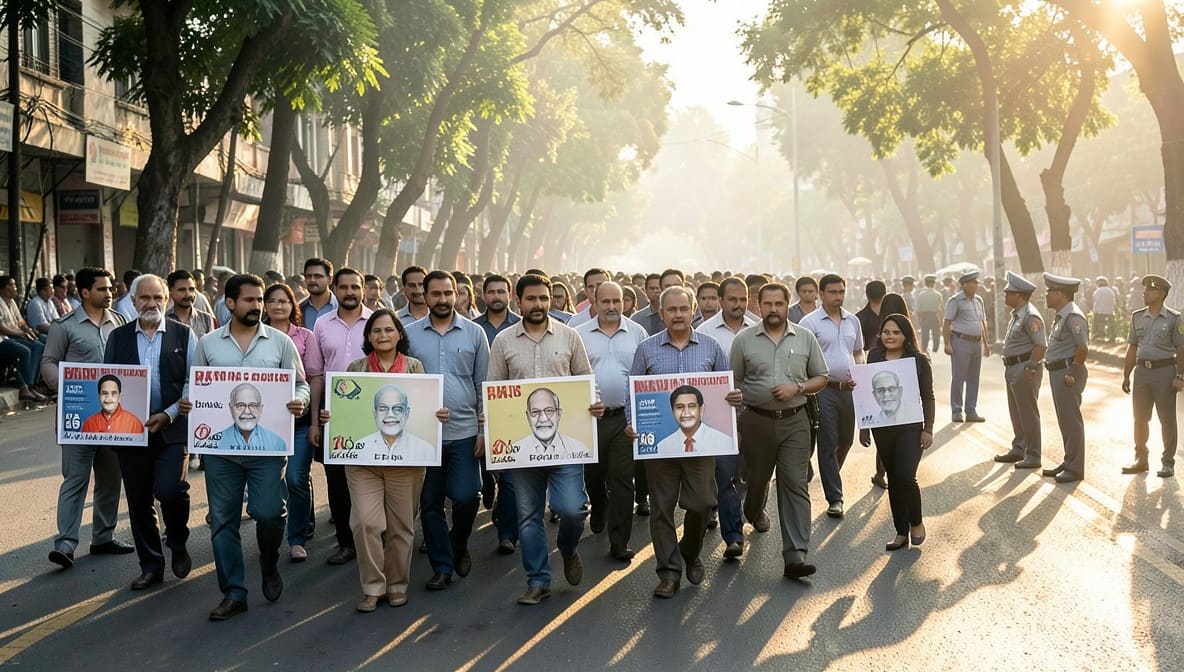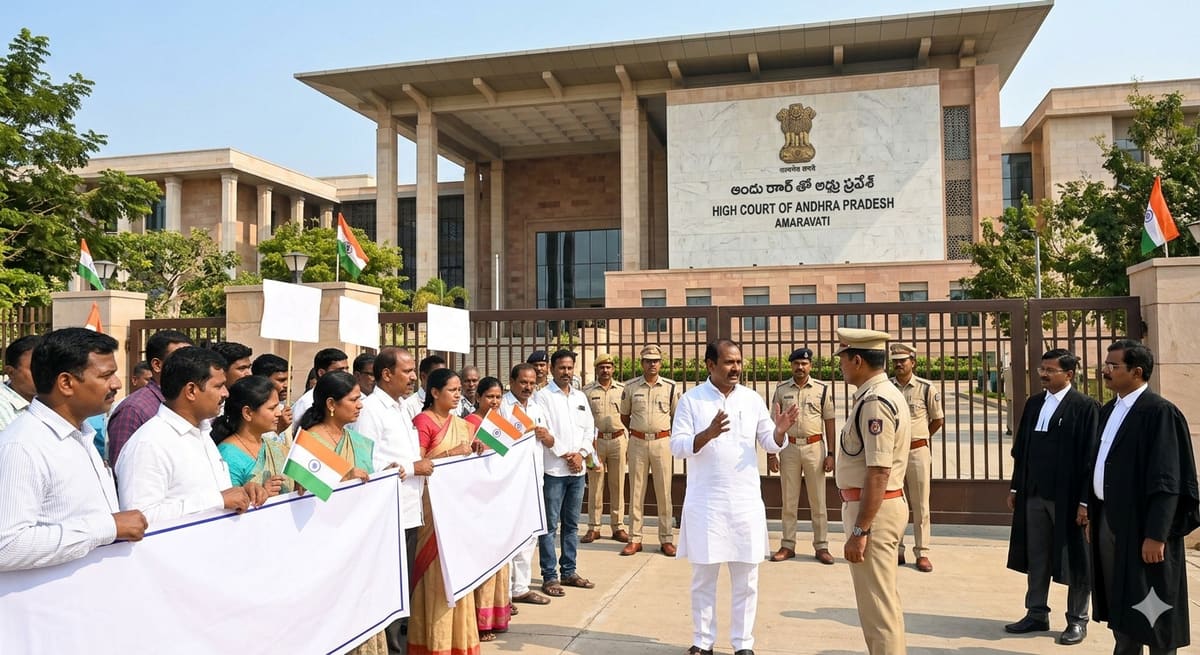
The Andhra Pradesh High Court recently disposed of a writ petition seeking a mandamus to direct authorities to consider and dispose of a representation for conducting a public meeting. The Court emphasized the constitutional right to peaceful assembly and directed the respondent authorities to dispose of the representation within two days, ensuring compliance with constitutional ethos.
Background & Facts
The Dispute
The petitioner, Palle Surendra, District President of Jaibheem Access Justice (West Godavari District Unit), sought permission from the Station House Officer, III Town Police Station, Eluru, to conduct a public meeting on 28.06.2026 from 4:00 PM to 9:00 PM at Xavier High School Grounds, Xavier Nagar, Eluru. The petitioner submitted a representation dated 01.06.2026 seeking permission, which was forwarded to the Dy Superintendent of Police, Eluru District, but remained pending as of the filing of the writ petition.
Key Facts
The petitioner is the District President of Jaibheem Access Justice, West Godavari District Unit.
A representation dated 01.06.2026 was submitted to respondent No. 4 (Station House Officer) seeking permission for a public meeting on 28.06.2026.
The representation was forwarded to respondent No. 3 (Dy Superintendent of Police) but was not disposed of.
The petitioner undertook to comply with all reasonable conditions, including security arrangements, venue, and parking.
Procedural History
01.06.2026: Petitioner submitted a representation to respondent No. 4 seeking permission for a public meeting.
01.06.2026 onwards: The representation was forwarded to respondent No. 3 but remained pending.
23.06.2026: Writ Petition No. 15499/2026 filed under Article 226 of the Constitution of India.
23.06.2026: The High Court disposed of the writ petition with directions to respondent No. 3.
Relief Sought
The petitioner sought:
A writ of mandamus declaring the respondents' inaction as illegal, arbitrary, and violative of Articles 14, 19(1)(a), 19(1)(b), and 21 of the Constitution.
Directions to the respondents to dispose of the representation dated 01.06.2026 and grant permission for the public meeting, subject to reasonable conditions.
The Legal Issue
The central question was whether the respondents' failure to dispose of the petitioner's representation seeking permission for a public meeting within a reasonable timeframe violated the petitioner's fundamental rights under Articles 14, 19(1)(a), 19(1)(b), and 21 of the Constitution of India, and whether a writ of mandamus could be issued to compel timely disposal.
Arguments Presented
For the Petitioner
The petitioner contended that the respondents' inaction in not disposing of the representation was arbitrary and violative of constitutional rights.
Reliance was placed on the Supreme Court's decision in Himat Lal K. Shah v. Commissioner of Police, Ahmedabad and a recent judgment of the Andhra Pradesh High Court in WP No. 4587 of 2026.
The petitioner undertook to comply with all reasonable conditions imposed by the authorities for conducting the public meeting.
For the Respondent
The learned Assistant Government Pleader for Home, basing on written instructions, did not dispute the receipt of the representation.
However, the respondents required additional information from the petitioner to consider the request.
The respondents fairly submitted that if the petitioner furnished the required information, they were willing to accord permission subject to lawful conditions.
The Court's Analysis
The Court observed that the petitioner's representation seeking permission for a public meeting had been pending without disposal. Relying on the constitutional ethos and the principles laid down in Himat Lal K. Shah v. Commissioner of Police, Ahmedabad, the Court emphasized the right to peaceful assembly under Article 19(1)(b) of the Constitution. The Court noted that while the authorities could impose reasonable restrictions, the undue delay in disposing of the representation amounted to a violation of the petitioner's fundamental rights.
"Considering the above facts and circumstances, coupled with the well-settled principle held by the Hon’ble Apex Court in Himat Lal K. Shah v. Commissioner of Police, Ahmedabad, and in view of the recent Judgment of this Court dated 19.02.2026 in WP No. 4587 of 2026, without expressing any opinion on merits of the case, respondent No. 3 is directed to dispose of the petitioner’s representation dated 01.06.2026, forthwith, within a period of two (02) days, from today, by considering the constitutional ethos in its true letter and spirit."
The Court refrained from expressing any opinion on the merits of the case but directed the respondent authorities to dispose of the representation expeditiously.
The Verdict
The Court disposed of the writ petition with the following directions:
Respondent No. 3 was directed to dispose of the petitioner's representation dated 01.06.2026 within two days from the date of the judgment (23.06.2026).
The disposal was to be in accordance with constitutional ethos and subject to reasonable conditions.
No order as to costs was passed.
All interlocutory applications, if any, were closed.
What This Means For Similar Cases
Timely Disposal of Representations Is Mandatory
The judgment reinforces that authorities must dispose of representations seeking permission for public meetings or assemblies within a reasonable timeframe.
Undue delay in disposal can be challenged under Article 226 as a violation of fundamental rights under Articles 14, 19(1)(a), 19(1)(b), and 21.
Constitutional Rights Prevail Over Procedural Delays
The Court emphasized that constitutional rights cannot be frustrated by procedural delays.
Authorities must balance public order concerns with individual freedoms, ensuring that restrictions are reasonable and not arbitrary.
Compliance with Reasonable Conditions
Petitioners seeking permission for public meetings must undertake to comply with reasonable conditions imposed by authorities, such as security arrangements, venue restrictions, and parking.
This judgment sets a precedent that authorities cannot indefinitely withhold permission without valid grounds.