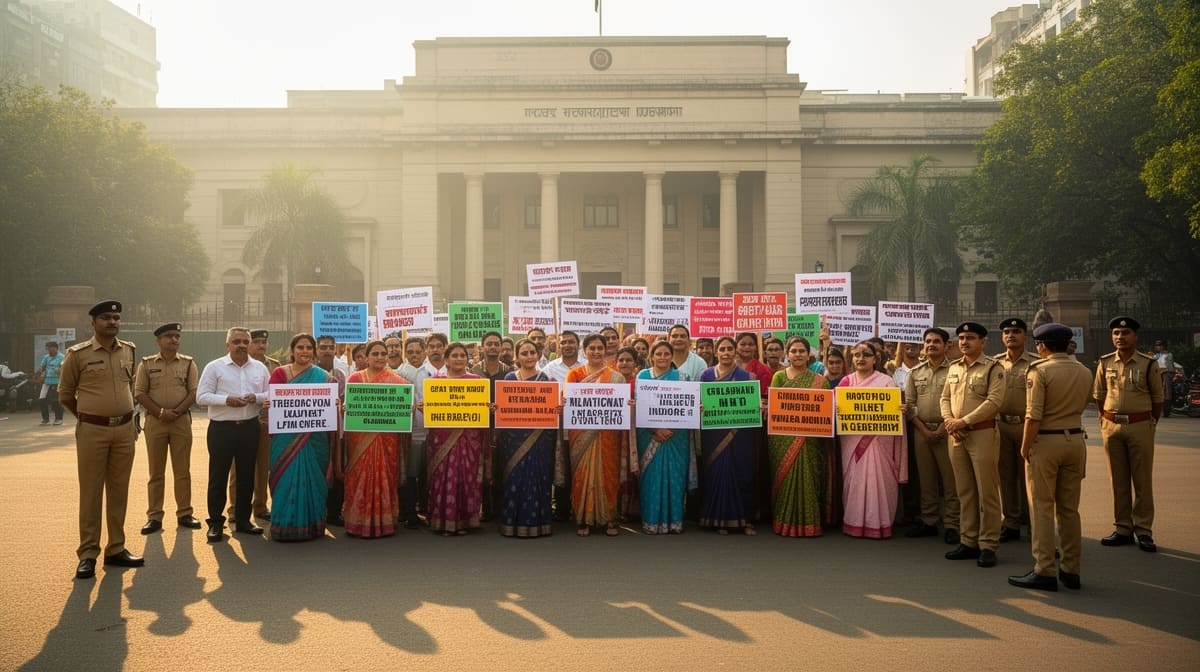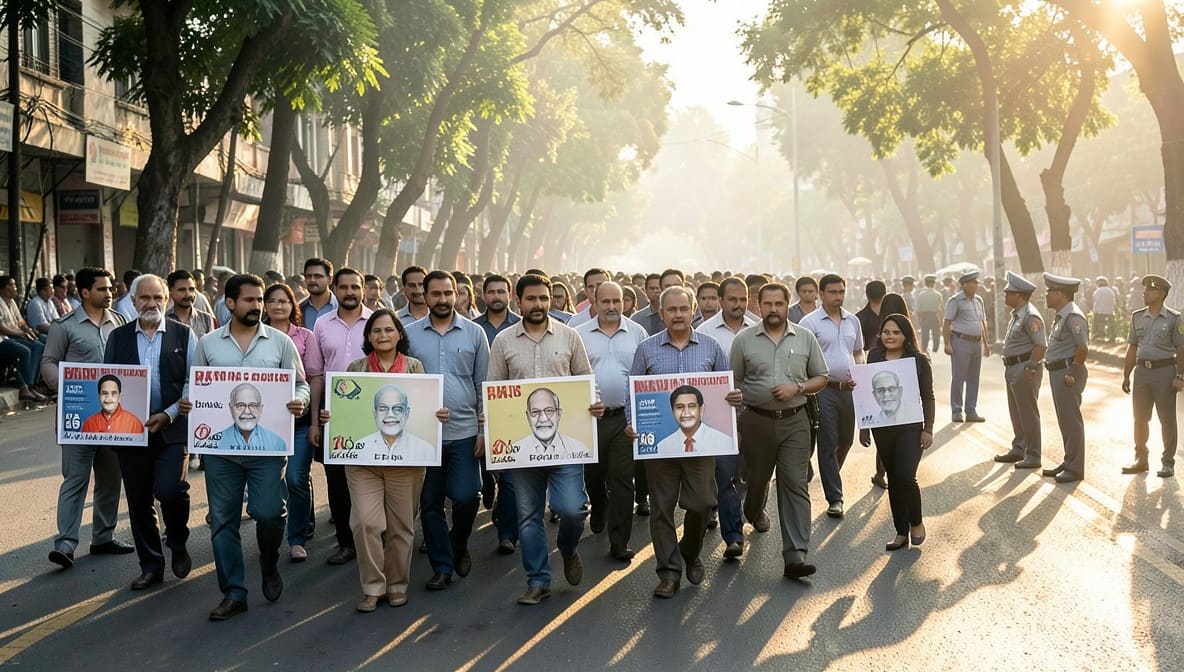
The Bombay High Court has reaffirmed that the state cannot arbitrarily deny the right to peaceful procession under Article 19(1)(b) of the Constitution merely on speculative concerns about law and order or administrative inconvenience. This judgment reinforces the principle that regulatory authority must be exercised through reasonable conditions, not blanket prohibitions.
Background & Facts
The Dispute
The petitioner, Vinodkumar S/o Gautam Tajane, is the Vice-President of the Bhimshakti Navyuvak Jayanti Utsav Mandal, a registered trust (Registration No. F-0012303 WSM) based in Anjankheda, Washim. The trust sought permission to organize a procession on 14 April 2026 to commemorate the 136th birth anniversary of Dr. B. R. Ambedkar. On 19 January 2026, the petitioner submitted a formal application to respondent No. 4, the Inspector/Police Station Officer (Rural), Washim, seeking approval for the procession.
Key Facts
- The trust was duly registered with the Assistant Charity Commissioner, Washim Division, on 30 July 2024 (Annexure-B, Record Page 21)
- The proposed procession route and timing were clearly specified in the application
- The petitioner offered to comply with all reasonable conditions imposed by authorities
- On 6 February 2026, respondent No. 4 rejected the application on three grounds: (i) shortage of police force, (ii) possibility of disturbance to law and order, and (iii) alleged criminal antecedents of three individuals associated with the trust
- The three individuals named - Mr. Deepak Subhash Ingole, Mr. Raju Subhash Ingole, and Mr. Devanand Vasanta Ingole - were reportedly involved in pending criminal cases
- On 30 April 2025, the Executive Body of the trust passed a resolution unanimously removing these three individuals from membership, over a year before the application was rejected
Procedural History
- 19 January 2026: Petitioner submits application for procession permission
- 6 February 2026: Police Station Officer (Rural), Washim, issues rejection order
- 9 April 2026: Writ Petition No. 1375 of 2026 filed before Bombay High Court, Nagpur Bench
- 9 April 2026: Court heard arguments and delivered oral judgment on the same day
Relief Sought
The petitioner sought quashing of the rejection order dated 6 February 2026 and a direction to grant permission for the procession on 14 April 2026, subject to reasonable conditions.
The Legal Issue
The central question was whether the denial of permission for a peaceful procession, based on vague concerns of law and order, administrative inconvenience, and outdated allegations of criminal antecedents, violates the fundamental right to assemble peacefully under Article 19(1)(b) of the Constitution.
Arguments Presented
For the Petitioner
Learned counsel argued that the rejection order was arbitrary and violative of Article 19(1)(b). She emphasized that the petitioner had no history of unlawful conduct and was willing to comply with any reasonable conditions. She submitted that the ground of criminal antecedents was rendered obsolete by the trust’s resolution dated 30 April 2025, which had removed the three individuals more than a year prior. She further contended that shortage of police personnel is a state obligation, not a justification to suppress constitutional rights.
For the Respondent/State
The Additional Government Pleader reiterated the grounds of rejection, citing administrative constraints and potential for public disorder. He argued that the police had a duty to prevent unrest and that the decision was within their discretionary powers under the Bombay Police Act. He submitted that the court should not interfere with operational decisions of law enforcement.
The Court's Analysis
The Court examined the nature of the right to peaceful assembly under Article 19(1)(b) and its limitations under Article 19(3). It held that while the state may impose reasonable restrictions in the interest of public order, such restrictions must be specific, proportionate, and based on concrete evidence - not speculative apprehensions.
"The ground of shortage of police force, in particular, cannot be a valid justification to deny the exercise of a fundamental right. It is the duty of the State to make appropriate arrangements to ensure that lawful activities are carried out in a peaceful manner."
The Court rejected the notion that vague fears of disturbance could override constitutional rights. It emphasized that the burden lies on the state to demonstrate a real and imminent threat, not to presume disorder.
Regarding the third ground - criminal antecedents - the Court noted that the trust had taken proactive remedial action by removing the individuals in question on 30 April 2025. The rejection order dated 6 February 2026 relied on outdated information, rendering this ground legally unsustainable.
The Court further held that the appropriate response to potential risks is not prohibition but regulation: imposing conditions to ensure order without stifling expression.
The Verdict
The writ petition was allowed. The impugned order dated 6 February 2026 was quashed. Permission for the procession on 14 April 2026 was granted, subject to the following conditions: (i) procession on approved route only; (ii) adherence to time limits and traffic regulations; (iii) no weapons or inflammatory speech; (iv) use of sound systems within legal limits; (v) deployment of volunteers for crowd control; (vi) submission of organizer details to police; (vii) liability for property damage; and (viii) police may impose additional reasonable conditions. The state was directed to make adequate bandobast to ensure peaceful conduct. No costs were awarded.
What This Means For Similar Cases
Reasonable Conditions, Not Blanket Prohibitions
- Practitioners must challenge denials of assembly permits that rely on generic phrases like "law and order concerns" without specific intelligence or past incidents
- Authorities must demonstrate a direct nexus between the proposed activity and a credible threat
- Courts will not uphold denials based on administrative convenience or resource constraints
Proactive Remediation Nullifies Past Allegations
- If an organization removes individuals with criminal records prior to applying for permission, such past associations cannot justify denial
- The timing of remedial action matters - removal more than a year prior was deemed sufficient to negate the ground
- Organizations should document such internal actions in writing and submit them with applications
Police Duty Is to Facilitate, Not Prevent
- Law enforcement’s role is to enable lawful expression through regulation, not to preemptively suppress it
- Conditions such as route restrictions, time limits, and no-weapons rules are valid; outright bans are not
- Petitioners should always offer to comply with conditions to strengthen their case