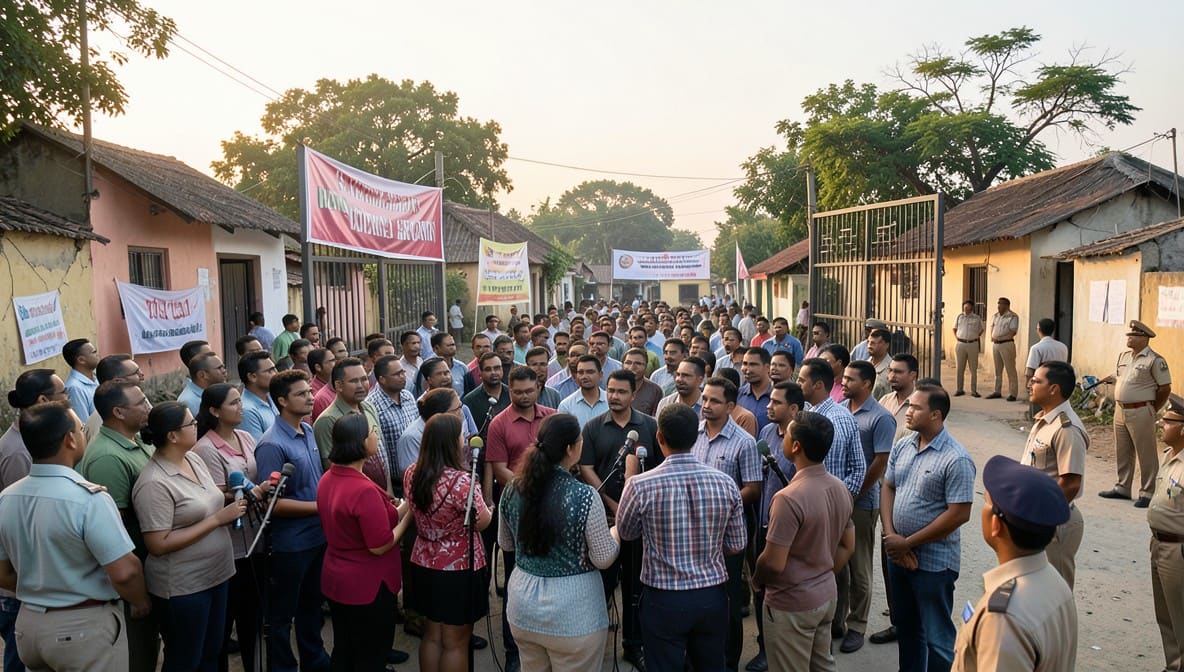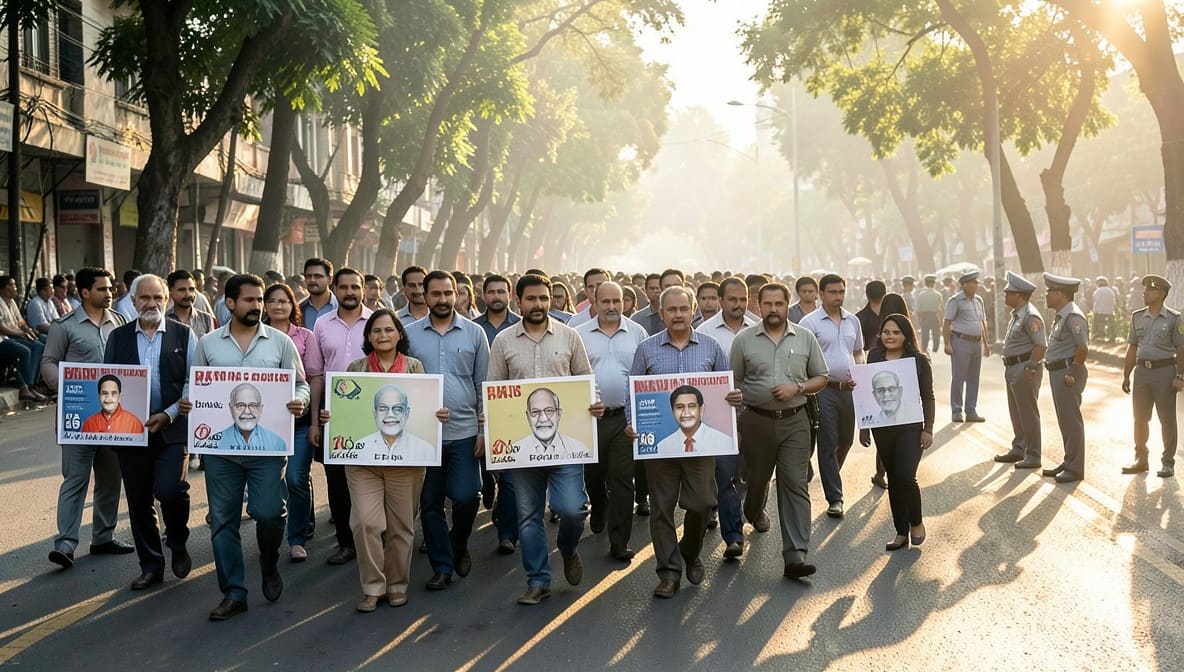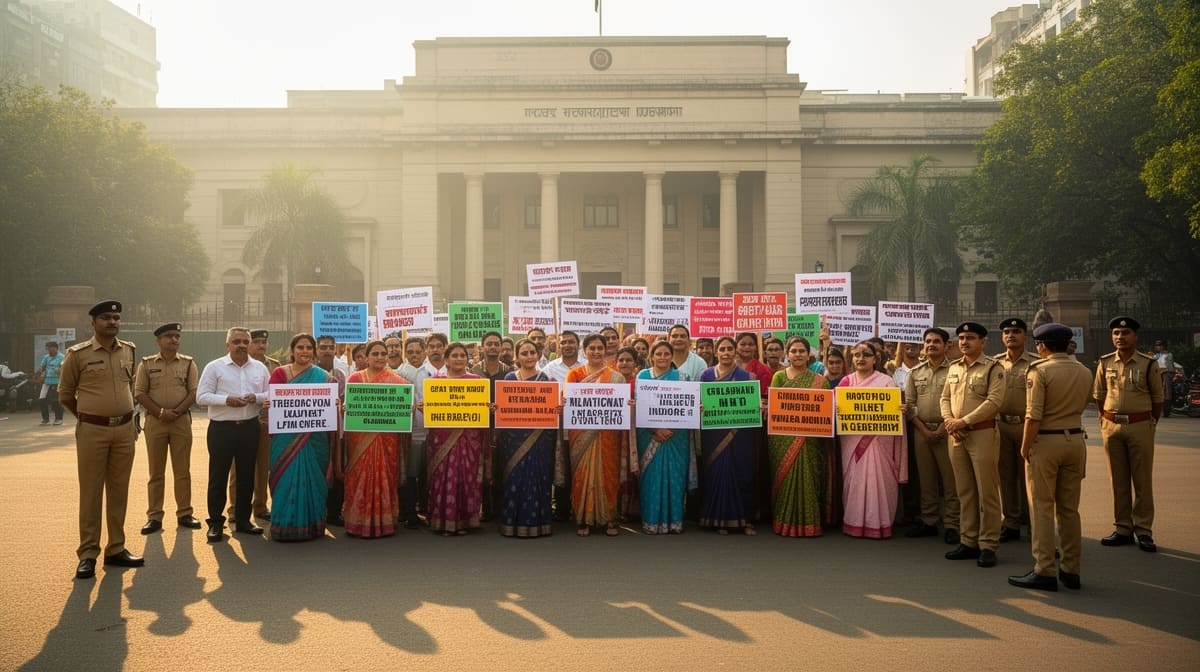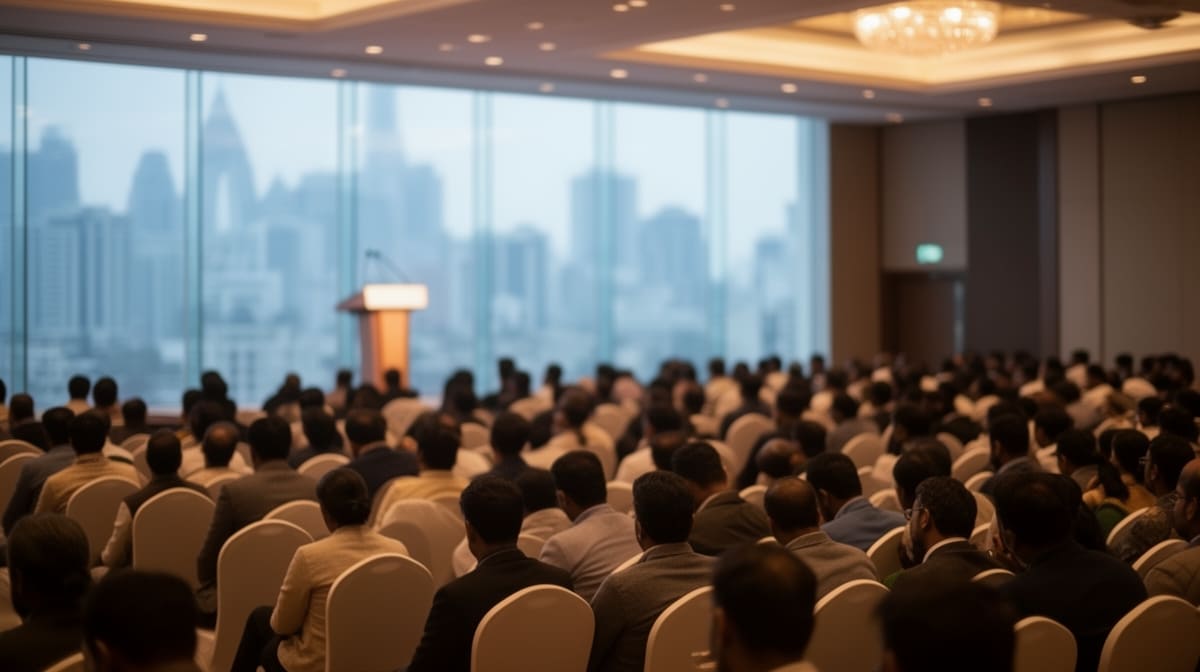
The Madras High Court has reaffirmed that the right to peaceful assembly under Article 19(1)(b) cannot be curtailed by administrative fiat without due process. In a significant ruling, the Court quashed a last-minute police order denying permission for a large political conference, emphasizing that denial must be grounded in objective, documented risk assessment - not speculative apprehension.
Background & Facts
The Dispute
The petitioner, as President of the Chennai North Zone Advocates Wing and State Conference 2026 Chief Working Committee of Indu Makkal Katchi-Tamilagam, sought permission to hold a State Conference on 15.03.2026 at the YMCA Royapettah Chandra Convention Centre. The event was planned to include religious rituals, discourses, cultural performances, a procession, and a public meeting with projected attendance of up to 4,000 persons and 1,000 vehicles.
Key Facts
- The petitioner submitted a formal representation on 11.02.2026 seeking permission for the event, including use of sound systems and police protection.
- The representation was received by the police on 12.02.2026.
- A reminder was sent on 18.02.2026; no response was received.
- On 25.02.2026, a separate application was made to the Fire and Rescue Department for safety support.
- On 17.02.2026 and 19.02.2026, the petitioner paid Rs. 1,00,000 as advance rent for the venue.
- Extensive preparatory work had commenced, including printing invitations, mobilizing volunteers, and arranging logistics.
- On 09.03.2026, at 11:40 p.m. - just six days before the event - the Joint Commissioner of Police (East Zone) issued an order rejecting the permission without any prior hearing, explanation, or opportunity to address concerns.
- The petitioner also sought permission for a procession, which was separately rejected and challenged in W.P.(Crl.) No. 559 of 2026.
Procedural History
- 11.02.2026: First application for event permission submitted to police.
- 12.02.2026: Application received by police authorities.
- 18.02.2026: Reminder sent to police.
- 25.02.2026: Fire safety application submitted.
- 17.02.2026 & 19.02.2026: Advance payments made for venue rental.
- 09.03.2026: Impugned order rejecting permission issued at 11:40 p.m.
- 09.03.2026: Separate order rejecting procession permission issued.
- 12.03.2026: Writ petition filed under Article 226.
- 12.03.2026: Court directed police to submit photographs and venue capacity details.
- 13.03.2026: Court heard arguments; petitioner withdrew challenge to procession rejection.
- 13.03.2026: Judgment delivered setting aside impugned order.
Relief Sought
The petitioner sought quashing of the 09.03.2026 order, issuance of a writ of mandamus directing police to grant permission for the conference, and provision of adequate police protection.
The Legal Issue
The central question was whether the police can lawfully reject permission for a peaceful public assembly under Section 30 of the Police Act, 1861 without providing a reasoned order, affording a hearing, or demonstrating a concrete threat to public order.
Arguments Presented
For the Petitioner
The petitioner’s counsel argued that the rejection was arbitrary, violative of Article 19(1)(b) and Article 14, and procedurally flawed. The delay in responding for over a month, followed by a last-minute rejection without notice or opportunity to respond, amounted to denial of natural justice. The petitioner had taken all reasonable steps to ensure safety, including financial commitments and voluntary undertakings to avoid noise pollution and traffic disruption. The venue’s proximity to a hospital was not sufficient grounds to deny permission outright, especially when mitigation measures could be imposed.
For the Respondent
The Additional Public Prosecutor contended that the venue was in a congested area with ongoing metro rail construction, limited parking (only 400 four-wheelers and 800 two-wheelers), and proximity to Royapettah Government Hospital. He argued that a gathering of 4,000 persons with 1,000 vehicles would obstruct ambulance access, disturb patients, and create unmanageable traffic. He claimed the Joint Commissioner’s apprehension of law and order issues was reasonable and within his statutory discretion.
The Court's Analysis
The Court examined the balance between the fundamental right to assemble and the state’s duty to maintain public order. It held that while police have the authority to impose reasonable restrictions under Section 30 of the Police Act, 1861, such restrictions must be proportionate, non-arbitrary, and procedurally fair.
"The rejection of permission without any opportunity to the petitioner to explain the safety measures taken, or to address the apprehensions raised, is a clear violation of the principles of natural justice."
The Court noted that the police had not conducted any site inspection, sought input from the petitioner, or evaluated the feasibility of mitigation measures such as restricted vehicle entry, controlled sound usage, or deployment of marshals. The mere existence of a hospital or ongoing construction did not, by itself, justify a blanket denial.
The Court further observed that the petitioner had already submitted an undertaking in the related writ petition (W.P.(Crl.) No. 559 of 2026) to refrain from raising provocative slogans, avoiding traffic obstruction, and complying with police instructions. This undertaking was accepted by the Court and deemed applicable to the present matter.
The Court emphasized that the state’s role is not to prevent lawful assembly but to facilitate it with adequate safeguards. The impugned order was therefore found to be mala fide in effect, if not in intent, and was set aside.
The Verdict
The writ petition is allowed. The impugned order dated 09.03.2026 rejecting permission for the conference is set aside. The Joint Commissioner of Police (East Zone) is directed to grant permission for the conference on 15.03.2026, subject to the following conditions: (1) the event must conclude by 06.00 p.m., not 08.00 p.m.; (2) no sound system shall be used outside the venue; (3) only two-wheelers and cars shall be permitted entry based on available parking; (4) cattle may enter for Ko-Pooja; (5) the petitioner shall submit a list of volunteers and in-charge personnel with contact details; (6) a team headed by a Deputy Commissioner of Police shall be deployed for on-site monitoring; and (7) the petitioner shall furnish a written undertaking to comply with all conditions. No costs are awarded.
What This Means For Similar Cases
Police Must Provide Reasoned Orders Before Denial
- Practitioners must now insist on written, reasoned orders whenever event permissions are denied.
- Blanket rejections based on vague "law and order concerns" without site assessment or dialogue are legally unsustainable.
- Courts will intervene where denial is last-minute and lacks procedural fairness.
Mitigation, Not Prohibition, Is the Standard
- Proximity to hospitals, schools, or construction zones does not automatically bar assemblies.
- Conditions such as restricted hours, noise control, vehicle segregation, and police deployment are valid alternatives to outright denial.
- Undertakings from organizers to comply with safety norms are binding and must be considered.
Procedural Compliance Is Non-Negotiable
- Failure to provide notice or hearing before denying permission renders the order voidable.
- Delayed responses followed by sudden rejections invite judicial scrutiny under Article 14 and Article 21.
- Organizers should document all communications and payments to establish good faith and financial reliance.