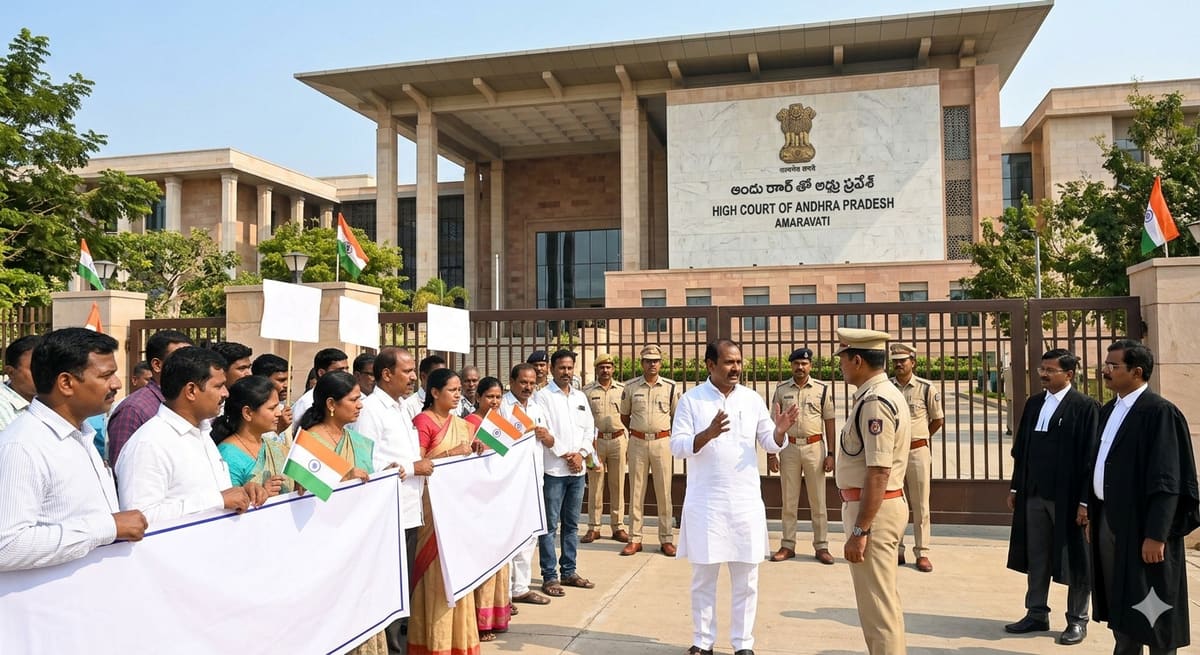
The Andhra Pradesh High Court has reaffirmed that the right to peaceful assembly under Article 19(1)(b) of the Constitution cannot be extinguished merely because the proposed venue is classified as municipal government land. In a timely intervention, the Court directed authorities to reconsider a petitioner’s alternative venue proposal for a public meeting, emphasizing that procedural inaction and blanket denials based on land ownership violate fundamental rights.
Background & Facts
The Dispute
The petitioner, an advocate from Unduru Village, West Godavari District, sought permission to conduct a public meeting on 01.06.2026 between 04:00 PM and 08:00 PM at the Lutheran High School Grounds in Bheemavaram. The proposed event included the use of a public address system with microphones. The petitioner submitted three successive representations to the local police authorities on 02.05.2026, 06.05.2026, and 12.05.2026, seeking formal approval. No response was rendered to any of these representations.
Key Facts
- The proposed venue, Lutheran High School Grounds, is located in Survey No. 423, Gunupudi Revenue Village, Bheemavaram
- The land measures 6.94 cents and is classified as government property under the Bhimavaram Municipality
- On 05.05.2026, the Municipal Commissioner issued Roc.No. 768/2026/G1 to the Deputy Superintendent of Police, stating that the Municipality had decided not to permit any events on the premises and requested that police refrain from granting permission
- The petitioner’s representations were neither acknowledged nor rejected by the Station House Officer or Subdivisional Police Officer
- The meeting was scheduled for 01.06.2026, leaving only days for administrative consideration
Procedural History
- 02.05.2026: First representation submitted to Station House Officer, Bheemavaram 1-Town PS
- 06.05.2026: Second representation submitted, reiterating request for permission and use of public address system
- 12.05.2026: Third representation submitted, highlighting urgency and constitutional rights
- 05.05.2026: Municipal Commissioner issued communication denying permission on land use grounds
- 14.05.2026: Petitioner filed Writ Petition No. 14917/2026 before the Andhra Pradesh High Court
- 28.05.2026: Hearing conducted before Justice Balaji Medamalli
The Parties' Positions
Petitioner: Argued that the silence of the authorities amounted to a de facto denial, violating the principles of natural justice and the right to freedom of speech and assembly under Articles 19(1)(a), 19(1)(b), and 21. He emphasized that the venue was a public ground used for community events and that no prior objections had been raised.
Respondents: Through the Assistant Government Pleader for Home, contended that the land was municipal government property and that the Municipality had explicitly prohibited any events on the premises. They asserted that police authorities were bound by the Municipality’s directive and could not override it.
Relief Sought
The petitioner sought:
- A writ of mandamus declaring the inaction of Respondents 2 to 4 as illegal and violative of constitutional rights
- A direction to immediately grant permission for the meeting on 01.06.2026 at the Lutheran High School Grounds
- Permission to use a public address system with microphones
- An interim order permitting the meeting pending final disposal
The Legal Issue
The central question was whether the refusal to consider a request for a public meeting, based solely on the classification of the venue as municipal government land and without applying the test of reasonableness under Article 19(2), constitutes a violation of the fundamental rights to freedom of speech and peaceful assembly under Articles 19(1)(a) and 19(1)(b).
Arguments Presented
For the Petitioner
The petitioner relied on Shreya Singhal v. Union of India and Kishore Kumar v. State of Haryana to argue that the right to assemble peacefully is a core democratic right that cannot be curtailed by administrative silence or blanket municipal prohibitions. He submitted that the Municipality’s communication was not a statutory order but an administrative preference, and that police authorities retained independent discretion under the Police Act and the Code of Criminal Procedure to impose reasonable conditions rather than outright denial. He further cited Anuradha Bhasin v. Union of India to emphasize that restrictions must be proportionate and time-bound.
For the Respondent/State
The State contended that the Municipal Commissioner’s communication under Roc.No. 768/2026/G1 was binding on police authorities, as the land was owned by the Municipality and not under police jurisdiction. It argued that permitting the meeting would violate municipal bylaws and risk unauthorized use of public property. The State did not dispute the petitioner’s right to assemble but claimed that the venue was legally ineligible.
The Court's Analysis
The Court observed that while municipal authorities may regulate land use, they cannot unilaterally extinguish constitutional rights by issuing non-statutory communications. The police, as custodians of public order, have a duty to balance the right to assemble with the need for regulation - not to abdicate responsibility based on third-party directives.
"The right to assemble peacefully is not contingent upon the ownership of the land but upon the reasonableness of the restrictions imposed. Administrative silence on representations, especially when a public meeting is imminent, amounts to a denial of natural justice."
The Court noted that the petitioner had submitted three representations over a span of ten days, and the authorities had failed to even acknowledge them. This inaction, the Court held, was arbitrary and violated Article 14. The Municipality’s communication, while relevant, did not constitute a legally enforceable prohibition under any statute. Police authorities were obligated to evaluate the proposal on its merits, assess potential public order concerns, and impose reasonable conditions if necessary - such as limiting decibel levels, restricting duration, or requiring security arrangements.
The Court further emphasized that the proposed date - 01.06.2026 - was not distant, and the petitioner had acted promptly. Denial without consideration was not merely procedural irregularity but a substantive infringement of constitutional rights.
The Verdict
The writ petition was disposed of with the following directions:
- The petitioner is permitted to submit an alternative venue proposal to the respondent authorities by 28.05.2026 itself
- The respondent authorities shall consider the proposal strictly in accordance with law, applying the principles of reasonableness, proportionality, and necessity under Article 19(2)
- The decision shall be communicated in writing within 24 hours of receipt of the proposal
- The entire exercise shall be completed by 29.05.2026
- No order as to costs
- Pending applications are closed
What This Means For Similar Cases
Administrative Silence Is Not a Valid Denial
- Practitioners must now treat non-response to public meeting applications as a de facto refusal, actionable under Article 226
- A three-day window for representation without reply creates a prima facie case of arbitrariness
- Courts will intervene where authorities fail to apply their minds, even if the venue is government-owned
Municipal Directives Cannot Override Constitutional Rights
- Municipal communications lacking statutory backing cannot serve as absolute bars to assembly
- Police must independently assess applications under the Police Act and CrPC, not defer to municipal preferences
- Reasonable conditions - such as noise limits, timing, or security - must be imposed, not blanket prohibitions
Procedural Fairness Is Non-Negotiable
- All applications for public gatherings must be formally acknowledged and decided within a reasonable timeframe
- Delayed or ignored applications, especially near the proposed date, will attract judicial intervention
- Petitioners should document all submissions via registered post or email to establish proof of representation