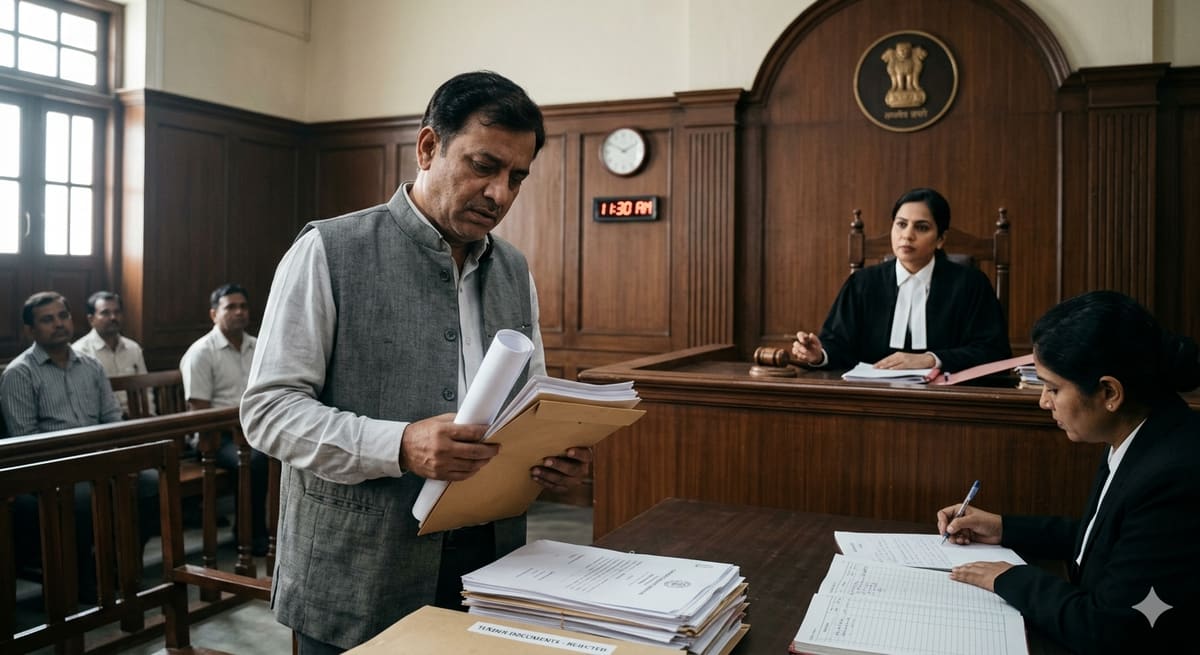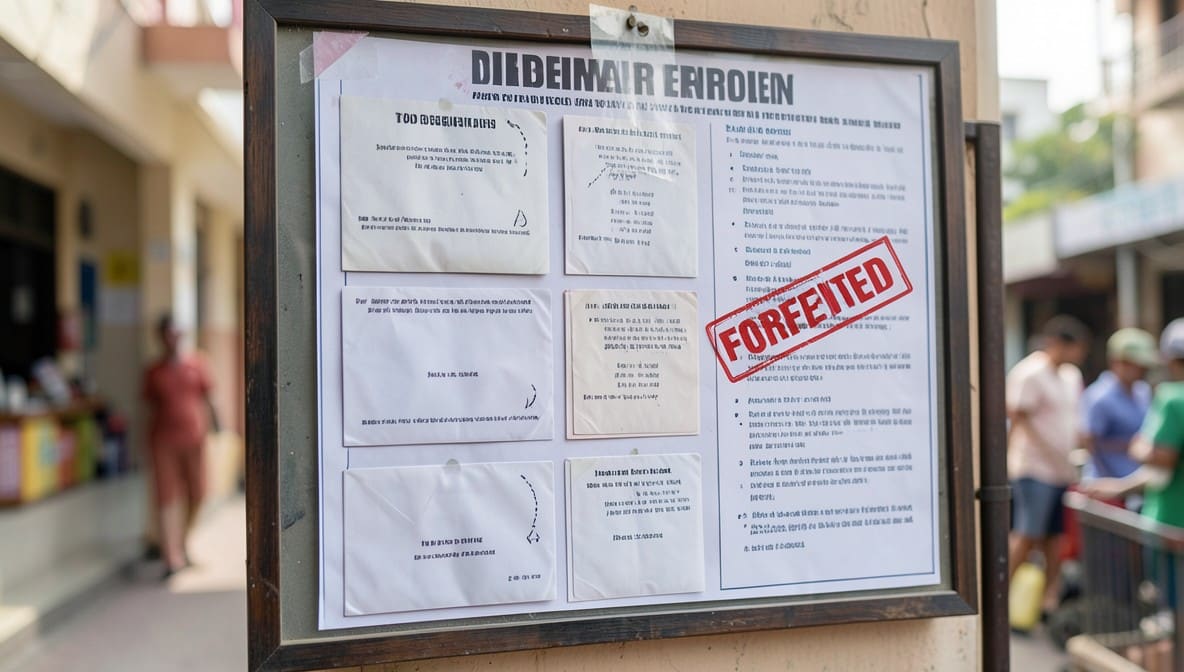
The Madhya Pradesh High Court has held that forfeiture of a bidder’s security due to non-compliance with tender conditions is unlawful when the delay is attributable to the authority’s own failure to clarify contradictory terms in the Letter of Acceptance. This judgment reinforces the principle that public authorities cannot penalize bidders for ambiguities they themselves created.
Background & Facts
The Dispute
The petitioner, SBC India Limited, a registered MSME and company incorporated under the Companies Act, 2013, participated in a public tender issued by the Public Works Department, Madhya Pradesh, for the construction of residential quarters at Central Jail, Ujjain. The tender, notified via NIT No.10/2025/Tender/G/Chief Engineer (B) Indore dated 30.06.2025, invited bids for construction of 81 units across four types (E, F, G, H). The petitioner submitted its bid online along with an FDR of Rs.10,00,000 as bid security.
Key Facts
- The petitioner was declared the successful bidder and received a Letter of Acceptance (LOA) dated 26.09.2025, communicated via email on 03.10.2025.
- The LOA required the petitioner to furnish:
- Performance Security of ₹62,89,289/-
- Additional Performance Guarantee of ₹1,22,88,622/-
- Execute the contract agreement within 15 days (i.e., by 17.10.2025).
- Clause 22.1 of the NIT and Annexure "M" required both securities to be submitted as Bank Guarantees.
- Clause 30.3 of the NIT stipulated that the Additional Performance Guarantee would be refunded upon satisfactory completion of work.
- The LOA, however, incorrectly mandated submission in the form of Term Deposit Receipts and extended the validity of the security to three months beyond the defects liability period - contradicting the NIT.
- No pre-bid meeting was conducted, leaving bidders without opportunity to seek clarification.
Procedural History
- 30.06.2025: NIT issued for construction work at Central Jail, Ujjain.
- 03.10.2025: LOA communicated to petitioner via email.
- 06.10.2025: Petitioner prepared letter seeking clarification on contradictions.
- 08.10.2025: Clarification request emailed to respondent No.1.
- 16.10.2025: Draft reply prepared by respondent No.1.
- 17.10.2025, 20:45 hrs: Reply sent to petitioner - after expiry of 15-day compliance window.
- 18.10.2025: Petitioner reiterated request for clarification.
- 24.10.2025: Respondent No.1 forwarded query to Respondent No.2.
- 27.10.2025: Executive Engineer recommended extension of time to Chief Engineer.
- 07.10.2025: Respondent issued fresh NIT - prior to impugned order.
- 31.10.2025: Respondent No.1 informed petitioner matter was referred to Respondent No.2.
- 10.11.2025: Impugned order issued cancelling tender and forfeiting Rs.10 lakh FDR.
- 12.11.2025: Writ Petition No.45286/2025 filed before Madhya Pradesh High Court.
- 12.03.2026: Judgment delivered.
Relief Sought
The petitioner sought quashing of the order dated 10.11.2025, restoration of the LOA, direction to execute the contract upon compliance, and refund of the forfeited FDR of Rs.10,00,000 with interest.
The Legal Issue
Can a public authority forfeit a bidder’s security and cancel a tender on grounds of non-compliance when the non-compliance arises solely due to the authority’s own failure to resolve material contradictions between the tender documents and the Letter of Acceptance?
Arguments Presented
For the Petitioner
Learned counsel argued that the LOA introduced material deviations from the NIT - specifically regarding the form of security (Term Deposit vs. Bank Guarantee) and validity period - creating ambiguity that rendered immediate compliance impossible. The petitioner acted promptly by seeking clarification within the compliance window and was denied timely response. The authority’s delay, not the petitioner’s inaction, caused the default. Reliance was placed on Tata Cellular v. Union of India and Jagdish Mandal v. State of Orissa to argue that arbitrary decision-making violates Article 14.
For the Respondent
The State contended that the petitioner failed to comply with the 15-day deadline stipulated in the LOA, which was clear and binding. The authority was entitled to cancel the tender and forfeit security under the terms of the NIT. Judicial interference under Article 226 in contractual matters is limited to procedural irregularity, and no such irregularity existed here.
The Court's Analysis
The Court examined the decision-making process under the lens of Tata Cellular v. Union of India and Central Coalfields Ltd. v. SLL-SML, reaffirming that courts may intervene only if the decision is arbitrary, irrational, or procedurally flawed - not merely because the court disagrees with the outcome.
"The petitioner had acted with diligence and bona fide intent to comply. The contradictions in the LOA were not minor clerical errors but substantive deviations that affected the nature and form of the security obligation. The authority’s failure to clarify within the stipulated period cannot be used to penalize the bidder."
The Court noted that the Executive Engineer had recommended an extension of time on 27.10.2025, yet the impugned order was passed on 10.11.2025 without addressing this recommendation. Further, the issuance of a fresh NIT on 07.10.2025 - before the impugned order - demonstrated that the authority itself recognized the need for a new process, undermining its claim of strict adherence to the original tender.
The Court held that the forfeiture of Rs.10,00,000 was disproportionate and punitive, lacking any nexus with the petitioner’s conduct. The authority’s silence and delayed response created a situation of induced non-compliance, which cannot be legally sustained.
The Verdict
The writ petition is allowed. The order dated 10.11.2025 cancelling the tender and forfeiting the FDR of Rs.10,00,000 is quashed. The petitioner is granted 10 days from the date of this judgment to deposit the Performance Security of ₹62,89,289 and Additional Performance Guarantee of ₹1,22,88,622 in the form of Bank Guarantees as stipulated in the original NIT. Upon compliance, the respondents shall execute the contract. The fresh NIT issued on 07.10.2025 stands nullified. The FDR of Rs.10,00,000 shall be refunded to the petitioner without interest.
What This Means For Similar Cases
Clarification Requests Within Deadline Are Protected
- Practitioners must document all clarification requests made within the compliance window, including timestamps and delivery proofs.
- Authorities cannot treat such requests as non-compliance; silence or delayed response shifts the burden to the authority.
Fresh NITs Invalidate Prior Forfeitures
- If a public authority issues a fresh tender while a writ petition is pending, it implicitly acknowledges the original process was flawed - rendering prior forfeitures legally unsustainable.
Form of Security Must Align with Tender Documents
-
Any deviation in the LOA from the NIT - especially regarding security type, validity, or refund terms - must be resolved before enforcement.
-
Courts will not uphold penalties based on contradictory or self-created ambiguities.
-
Always verify LOA terms against NIT before acting.
-
If contradictions exist, seek clarification in writing within the compliance period.
-
Retain all communication trails - emails, letters, delivery receipts - as evidence of diligence.