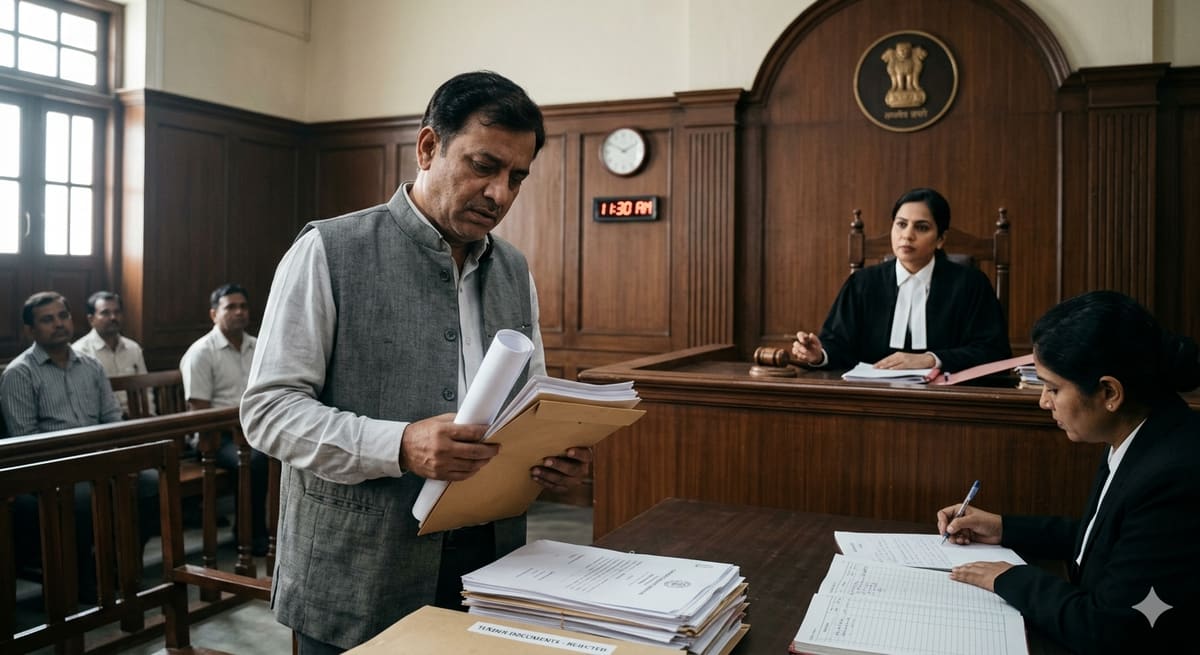
The Calcutta High Court has reaffirmed that government authorities cannot cancel competitive bidding processes on vague grounds, even if the underlying intent appears technically justified. The judgment underscores that procedural fairness and reasoned decision-making are non-negotiable in public procurement, regardless of whether a contract has been formally awarded.
Background & Facts
The Dispute
The petitioner, Greego Drive Private Limited, participated in an e-auction conducted by the Superintendent Engineer, Western Circle II, Irrigation and Waterways Directorate, Paschim Medinipur, for dredging, desilting, and removal of river bed materials from the Tamal River between Kontai and Sarai over a 15.00 km stretch. The auction was conducted on a "No Cost to State Exchequer" basis, meaning the contractor would pay the state for the extracted materials.
Key Facts
- The Request for Proposal (RFP) No. WBIW/SE/WC-II/RFP-41(e)/2025-26 was issued on 03.12.2025.
- The RFP specified a total estimated volume of river bed materials to be dredged as 1,48,75,832.80 cubic feet.
- The floor volume for bidders was set at 5% of the estimated volume, i.e., 7,43,791.64 cubic feet.
- Clause 7.3.2 of the RFP stated that the bidder quoting the highest share of volume (in cubic feet) would be declared the H1 bidder.
- The petitioner submitted a bid quoting 1,48,73,792 cubic feet, the highest among all bidders.
- The Auction Evaluation Summary Sheet was uploaded on 16.01.2026, declaring the petitioner as the H1 bidder.
- On 03.02.2026, the 5th respondent issued an order cancelling the auction citing "administrative reasons" without elaboration.
- On 02.03.2026, a new RFP (No. 47(e)/2025-26) was issued for the same work, but over a reduced length of 14.700 km and with a revised estimated volume of 1,45,86,783.06 cubic feet.
- The 5th respondent submitted a report dated 05.03.2026 claiming the cancellation was due to a 3,000 cubic feet calculation error in the original RFP.
Procedural History
- 03.12.2025: RFP No. 41(e)/2025-26 issued.
- 16.01.2026: Auction Evaluation Summary Sheet uploaded; petitioner declared H1 bidder.
- 03.02.2026: Cancellation order issued citing "administrative reasons".
- 02.03.2026: New RFP No. 47(e)/2025-26 issued with revised parameters.
- 05.03.2026: Report submitted by 5th respondent justifying cancellation due to alleged 3,000 cu.ft error.
- 23.03.2026: Petitioner filed supplementary affidavit challenging the new RFP.
- 23.03.2026: Hearing held before the Court.
- 09.04.2026: Judgment delivered.
The Parties' Positions
For the Petitioner
The petitioner argued that:
- Declaration as H1 bidder created a legitimate expectation and a vested right to receive the Letter of Intent (LOI) and work order.
- The cancellation order was non-speaking and failed to disclose any specific reason.
- The subsequent RFP demonstrated that the alleged "calculation error" was either fabricated or grossly misrepresented, as the volume reduction was nearly 2.9 lakh cubic feet - not 3,000 - as claimed.
- Relied on Mohinder Singh Gill v. Chief Election Commissioner to argue that reasons given in affidavits cannot supplement an unreasoned order.
- Relied on Tej Prakash Pathak v. Rajasthan High Court to assert that material terms of a procurement process cannot be altered mid-process.
For the Respondent
The State contended that:
- An inadvertent calculation mistake was discovered in the estimated volume of materials.
- The error necessitated cancellation to ensure transparency and accuracy.
- The new RFP was a corrective measure, not an arbitrary re-initiation.
- The cancellation was an administrative decision within the State’s contractual discretion.
Relief Sought
The petitioner sought:
- Setting aside of the cancellation order dated 03.02.2026.
- Directing the authorities to issue LOI and work order to the petitioner.
- Prohibition against further auctioning of the same work under a new RFP.
The Legal Issue
Can a government authority cancel a competitive bidding process after declaring a bidder as H1, based on an unreasoned order, and later justify it with new reasons in an affidavit or subsequent RFP?
Arguments Presented
For the Petitioner
The petitioner relied on Mohinder Singh Gill v. Chief Election Commissioner to argue that judicial review must assess the validity of an administrative order based solely on the reasons recorded at the time of its issuance. Supplementing the order with post-hoc justifications, even if factually accurate, violates the principles of natural justice and Article 14. The petitioner further invoked Tej Prakash Pathak to assert that altering the foundational parameters of a procurement process - such as estimated volume - after bids are submitted and evaluated constitutes arbitrariness. The petitioner emphasized that bidders had relied on the published RFP terms, and changing them post-evaluation undermines fair competition.
For the Respondent
The State argued that the cancellation was an internal administrative correction to rectify a technical error in the RFP’s estimated volume. It contended that the State retains the right to refuse any bid under its contractual powers, as affirmed in Tata Cellular v. Union of India. The submission was that the new RFP was a legitimate corrective step, and the 3,000 cu.ft discrepancy was a clerical oversight, not a substantive change.
The Court's Analysis
The Court began by acknowledging that while the State enjoys broad discretion in public procurement, such discretion is not unfettered. It must comply with the principles of Article 14 of the Constitution, which prohibits arbitrariness and mandates reasonableness and fairness. The Court cited Tata Cellular and Subodh Kumar Singh Rathour to affirm that judicial review applies even at the pre-contract stage when procedural impropriety or arbitrariness is evident.
The Court noted that the cancellation order dated 03.02.2026 contained no reasoning beyond the vague phrase "administrative reasons." It held that such an order is non-speaking and legally unsustainable. The Court then turned to the report dated 05.03.2026, which attempted to justify the cancellation by citing a 3,000 cu.ft error. However, the Court observed that the subsequent RFP revealed a reduction of nearly 2.9 lakh cubic feet - not 3,000 - as the actual change. This discrepancy demonstrated that the stated reason was either incorrect or pretextual.
"The reasons for cancellation stated in the Report cannot be taken into consideration in view of the decision in Mohinder Singh Gill’s case (supra)."
The Court further held that the subsequent RFP was not a new initiative but a continuation of the same work with minor modifications, indicating that the cancellation was not a genuine correction but a reversal of a binding outcome. The Court distinguished Tej Prakash Pathak, noting that while that case dealt with recruitment eligibility criteria, the underlying principle - that material terms cannot be altered mid-process - applies equally to procurement.
The Court concluded that the cancellation order suffered from arbitrariness and lack of application of mind. The failure to record reasons at the time of decision, coupled with the demonstrable misrepresentation of the factual basis for cancellation, rendered the order invalid under Article 14.
The Verdict
The Court set aside the cancellation order dated 03.02.2026 and quashed all subsequent steps taken pursuant to it, including the issuance of RFP No. 47(e)/2025-26. The respondent authorities were directed to take further steps in accordance with law, including re-evaluating the original RFP No. 41(e)/2025-26 in compliance with its terms. There shall be no order as to costs.
What This Means For Similar Cases
Non-Speaking Orders in Public Procurement Are Invalid
- Practitioners must challenge any cancellation order lacking specific, recorded reasons.
- Post-hoc affidavits or reports cannot cure a non-speaking order under Mohinder Singh Gill.
- Courts will scrutinize the factual basis of administrative justifications, especially when subsequent actions contradict them.
Material Changes After Bid Submission Are Arbitrary
- Altering estimated quantities, scope, or technical parameters after bids are submitted and evaluated constitutes arbitrariness.
- Even if the change appears beneficial or correct, it cannot be justified if not disclosed prior to bidding.
- Bidders’ reliance on published RFP terms is protected under Article 14.
Judicial Review Extends to Pre-Award Stages
- Government procurement decisions are subject to judicial review even before a contract is awarded.
- Procedural impropriety, lack of application of mind, or arbitrariness are sufficient grounds for intervention.
- Authorities must document reasoning at the time of decision, not after litigation begins.