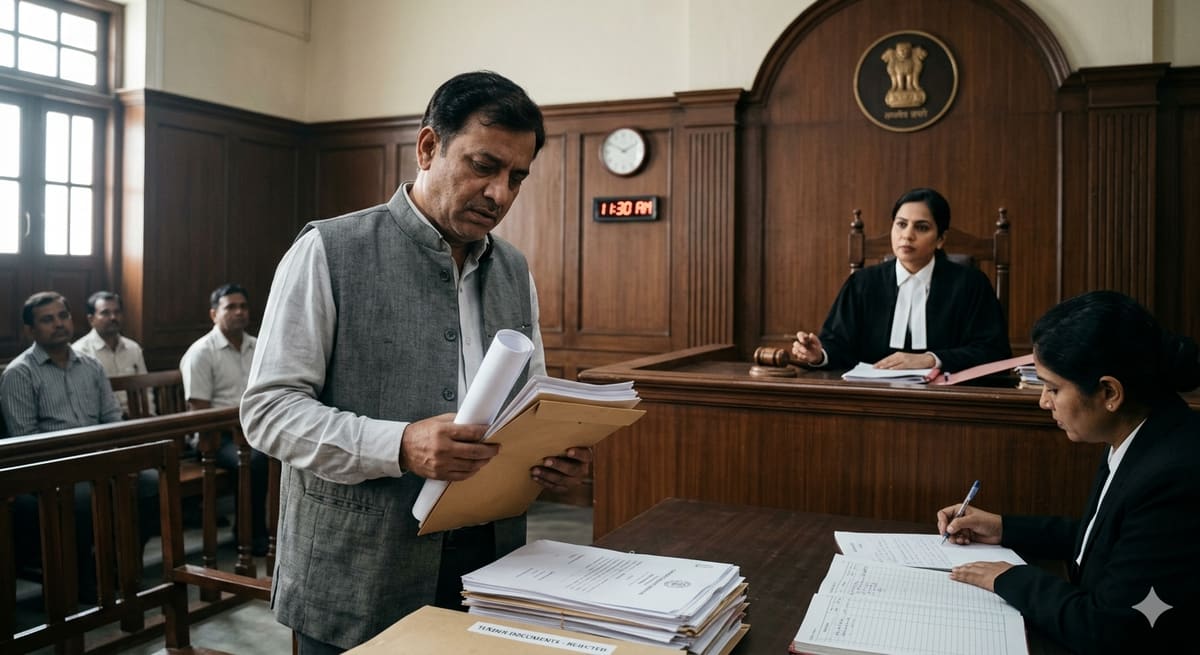
The Madhya Pradesh High Court has clarified that a bidder offering the highest or only bid above the reserve price in a public tender does not acquire an enforceable right to allotment. The judgment reinforces the principle that public authorities retain discretion to cancel tenders to ensure competitive bidding, even when a bid meets financial thresholds.
Background & Facts
The Dispute
The petitioner, Sarita Malviya, participated in a public tender conducted by Nagar Palika Parishad, Neemuch, for the allotment of Plot No.15 on a 30-year lease basis. The tender was issued on 01.09.2021 with a reserve price of Rs.20,00,000. The petitioner submitted a bid of Rs.25,87,115, which exceeded the reserve price. She deposited 25% of the bid amount as earnest money. However, her bid was rejected on 24.11.2021 on the ground that it was the only bid received, and the authority decided to cancel the tender and issue a fresh Notice Inviting Tenders (NIT).
Key Facts
- Tender notice issued on 01.09.2021 for allotment of Plot No.15
- Reserve price fixed at Rs.20,00,000
- Petitioner submitted bid of Rs.25,87,115 on or before the deadline
- Petitioner deposited 25% of bid amount (Rs.6,46,778.75) as earnest money
- Only one bid received - petitioner’s
- Impugned order dated 24.11.2021 rejecting bid and cancelling tender
- Fresh NIT issued subsequently with same reserve price
- In two adjacent commercial plots, single bids were also rejected and fresh auctions conducted, yielding bids double the original offers
Procedural History
- 01.09.2021: Tender notice issued by Nagar Palika Parishad, Neemuch
- 24.11.2021: Bid rejected and tender cancelled by respondents
- 27.11.2021: Writ Petition No.27190 of 2021 filed before the High Court of Madhya Pradesh, Indore
- 29.01.2026: Arguments concluded and matter reserved
- 20.04.2026: Judgment pronounced
The Parties' Positions
The petitioner contended that her bid was financially superior, technically compliant, and above reserve price, and therefore, rejection solely on the ground of being a single bid was arbitrary and violative of Article 14 of the Constitution. She relied on Subodh Kumar Singh Rathour v. Chief Executive Officer (2024) to argue that courts should uphold bids meeting all conditions.
The respondents argued that the tender documents explicitly reserved the right to cancel the process at any stage without assigning reasons. They emphasized that no concluded contract existed, no vested right was created, and cancellation was a legitimate exercise of administrative discretion to promote competition and maximize public revenue.
Relief Sought
The petitioner sought quashing of the order dated 24.11.2021, direction to accept her bid, and issuance of allotment letter. Alternatively, she sought compensation for loss of opportunity and return of earnest money with interest.
The Legal Issue
The central question was whether a public authority is legally bound to accept a single bid that exceeds the reserve price, or whether it retains the discretion to cancel the tender to encourage competition in the absence of adequate participation.
Arguments Presented
For the Petitioner
The petitioner’s counsel relied on Subodh Kumar Singh Rathour v. Chief Executive Officer (2024) to argue that where a bid satisfies all technical and financial conditions and exceeds the reserve price, rejection without reason violates principles of fairness and non-arbitrariness. He contended that depositing 25% of the bid amount created a legitimate expectation and that cancellation solely due to lack of competition was an abuse of power.
For the Respondent
The respondents’ counsel cited multiple precedents including Uttar Pradesh Avas Evam Vikas Parishad v. Om Prakash Sharma (2013), Rajasthan Housing Board v. G.S. Investments (2007), and State of Jharkhand v. CWE-SOMA Consortium (2016) to establish that no vested right arises until formal acceptance. They emphasized that the tender conditions permitted cancellation for lack of competition and that judicial interference is impermissible unless the decision is mala fide, arbitrary, or contrary to public interest.
The Court's Analysis
The Court undertook a detailed review of binding precedents on public procurement and tender law. It emphasized that the relationship between the tendering authority and the bidder remains contractual until formal acceptance, and no enforceable right is created merely by submission of a bid.
"The administration is best suited to take decision in the matter of contracts. Such decisions can be interfered with, when the same are shown to be arbitrary, malicious, against the public interest or hitting Wednesbury principles."
The Court noted that the State of Jharkhand v. CWE-SOMA Consortium (2016) decision explicitly upheld cancellation of a tender with only three bids, two of which were non-responsive, to promote competition. The Court held that the decision to cancel a single-bid tender is not arbitrary if it is aimed at securing better outcomes for the public exchequer.
It further relied on Rajasthan Housing Board v. G.S. Investments (2007), which held that even the highest bidder has no vested right until the competent authority formally accepts the offer. The Court observed that the petitioner’s deposit of 25% of the bid amount constituted only an offer, not an acceptance, and therefore no concluded contract existed.
The Court also took judicial notice of the fact that in two adjacent plots, similar single bids were rejected and fresh tenders issued, resulting in bids double the original offers. This demonstrated a consistent administrative policy aimed at maximizing public revenue and was not targeted or discriminatory.
The Court concluded that the cancellation was neither mala fide nor irrational, and that the authority acted within its rights under the tender conditions and established legal principles.
The Verdict
The petition was dismissed. The Court held that the respondents were fully entitled to cancel the tender due to lack of competition and issue a fresh NIT. No enforceable right was created in favor of the petitioner. The deposit of 25% of the bid amount shall be refunded without interest, as no contractual obligation arose. No compensation or direction for allotment was granted.
What This Means For Similar Cases
No Vested Right Until Formal Acceptance
- Practitioners must advise clients that submitting a bid, even if highest and above reserve price, does not create a legal right to allotment
- Authorities retain discretion to cancel tenders at any stage prior to issuance of letter of acceptance
- Legal challenges must focus on mala fides or arbitrariness, not mere dissatisfaction with rejection
Tender Conditions Are Paramount
- Any clause permitting cancellation for lack of competition or public interest must be strictly enforced
- Bidders should scrutinize tender documents for reservation of rights - failure to do so risks loss of investment
- Courts will not substitute their commercial judgment for that of the tendering authority
Judicial Restraint in Public Procurement
- Judicial review under Article 226 is limited to Wednesbury unreasonableness, mala fides, or violation of natural justice
- Absence of competition is a valid ground for cancellation - courts will not compel authorities to accept single bids
- Fresh tenders with same reserve price are lawful if aimed at enhancing competition