Topic

Intellectual Property Law

Intellectual Property Law in India governs the protection of creations like trademarks, copyrights, and designs under statutes such as the Trademarks Act, 1999, and the Copyright Act, 1957.

51 articlesLatest 6 days ago
Trade Marks Act Section 124 | Stay Refused Where Invalidity Not Pleaded in Written Statement & Rectification Filed Before Registrar : Bombay HC
Case Law Analysis

Trade Marks Act Section 124 | Stay Refused Where Invalidity Not Pleaded in Written Statement & Rectification Filed Before Registrar : Bombay HC

The Bombay High Court denied a stay under Section 124 of the Trade Marks Act because the defendants neither pleaded invalidity of the plaintiff's registered marks in their written statement nor filed rectification proceedings before the High Court, opting instead for the Registrar. The ruling clarifies that both procedural prerequisites are mandatory for a stay application.

SC Refers Section 134 TM Act vs Commercial Courts Act Conflict to Larger Bench | Jharkhand Civil Judge as Commercial Court : SC
Case Law Analysis
|Supreme Court of India

SC Refers Section 134 TM Act vs Commercial Courts Act Conflict to Larger Bench | Jharkhand Civil Judge as Commercial Court : SC

The Supreme Court referred to a Larger Bench the question whether Section 134 of the Trade Marks Act, which mandates infringement suits before a District Court, is rendered ineffective by Jharkhand’s notification treating Civil Judge (Senior Division) as a Commercial Court, and stayed the suit, affecting trademark litigants and clarifying IP-commercial court jurisdiction.

Copyright Act | Mobile Accessories Not 'Artistic Work'; TM Act Search Safeguards (Registrar Opinion, DSP Officer) Mandatory : Gujarat HC
|Gujarat High Court

Copyright Act | Mobile Accessories Not 'Artistic Work'; TM Act Search Safeguards (Registrar Opinion, DSP Officer) Mandatory : Gujarat HC

The court held that mobile phone accessories are functional commercial hardware, not 'artistic works' eligible for copyright protection, quashing an FIR filed under the Copyright Act. It further ruled that police searches for trademark violations require prior Registrar opinion and a DSP-rank officer under the Trade Marks Act, rendering the search and seizure procedurally invalid. The decision clarifies the copyright-trademark boundary and enforces statutory safeguards against misuse of criminal IP enforcement.

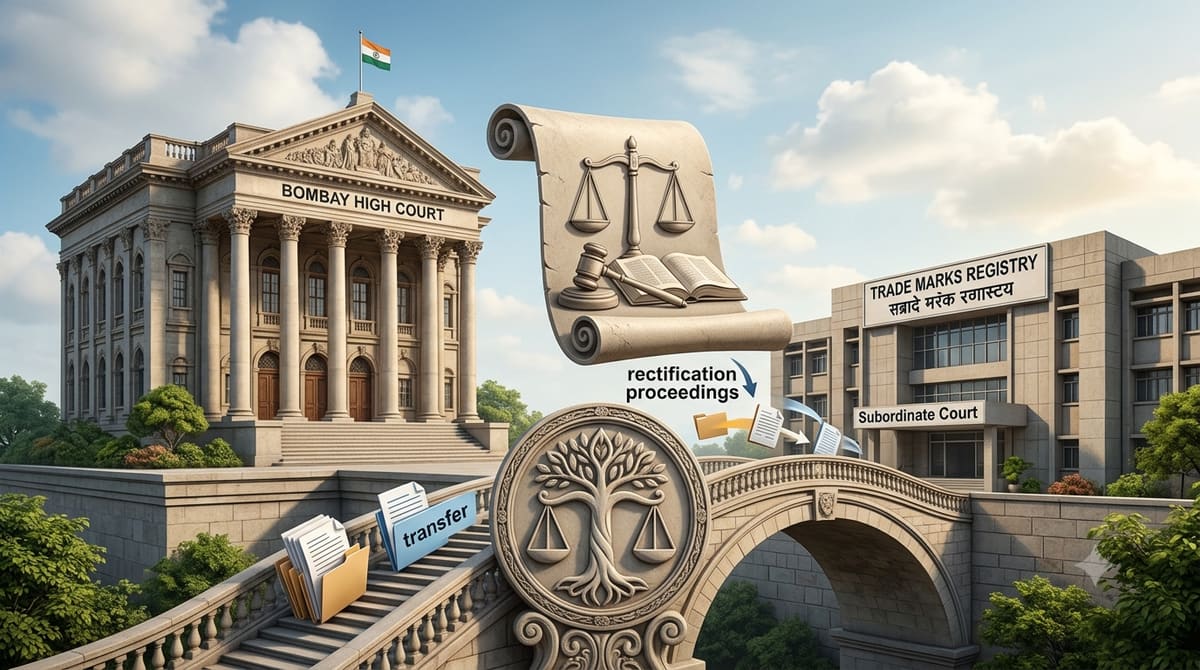
Section 24 CPC | Registrar of Trade Marks is a 'Subordinate Court' for Transfer of Rectification Proceedings : Bombay HC
Case Law Analysis
|Bombay High Court

Section 24 CPC | Registrar of Trade Marks is a 'Subordinate Court' for Transfer of Rectification Proceedings : Bombay HC

Bombay High Court holds that the Registrar of Trade Marks qualifies as a 'Court' under Section 24 CPC, enabling transfer of rectification proceedings to be consolidated with infringement suits. This ruling streamlines adjudication by preventing parallel litigation and reinforces the contextual interpretation of 'Court' under procedural laws, impacting trademark litigants and IP practitioners.

Section 22(4) Designs Act | Defence Challenging Design Validity Triggers Mandatory High Court Transfer : Kerala HC
Case Law Analysis
|Kerala High Court

Section 22(4) Designs Act | Defence Challenging Design Validity Triggers Mandatory High Court Transfer : Kerala HC

Kerala High Court rules that raising a defence under Section 22(4) of the Designs Act, 2000-challenging the validity of a registered design-automatically transfers the case to the High Court, bypassing lower court jurisdiction. This holding reinforces the exclusive jurisdiction of High Courts in design validity disputes, impacting litigants and practitioners in IP enforcement.

Rule 45 Trade Marks Rules 2017 | Two-Month Evidence Affidavit Deadline is Directory, Not Mandatory : Bombay HC
Case Law Analysis
|Bombay High Court

Rule 45 Trade Marks Rules 2017 | Two-Month Evidence Affidavit Deadline is Directory, Not Mandatory : Bombay HC

Bombay High Court holds that the two-month deadline for filing an Evidence Affidavit under Rule 45 of the Trade Marks Rules 2017 is directory, allowing extensions under Section 131 of the Trade Marks Act 1999 even after expiry. This ruling clarifies that procedural timelines in rectification proceedings may be relaxed where justice demands, offering relief to parties facing delays.

Patent Prosecution Remand | Controller Barred from Introducing New Objections or Prior Art Beyond Original Record Under Natural Justice : Bombay HC
Case Law Analysis
|Bombay High Court

Patent Prosecution Remand | Controller Barred from Introducing New Objections or Prior Art Beyond Original Record Under Natural Justice : Bombay HC

The Bombay High Court has ruled that a remand order issued to cure a breach of natural justice in patent examination cannot be used as a vehicle for the Controller to raise fresh objections or cite new prior art not present in the original file. This clarifies that remand is strictly procedural - meant to ensure fair hearing, not to restart prosecution with new grounds - protecting applicants from procedural ambush and reinforcing the integrity of patent examination.

Order XIV Rule 5 CPC | Plaintiff Bears Burden to Prove Trademark Infringement Even When Defendant Cites Industry Practice: Karnataka HC
Case Law Analysis
|Karnataka High Court

Order XIV Rule 5 CPC | Plaintiff Bears Burden to Prove Trademark Infringement Even When Defendant Cites Industry Practice: Karnataka HC

The Karnataka High Court clarified that defendants cannot shift the burden of proof by merely alleging industry-wide reuse of packaging; the plaintiff must still establish likelihood of confusion and prior rights. This reinforces that procedural defenses like trade practice are not admissions and do not alter the foundational burden in trademark suits, impacting brand owners and manufacturers relying on recycled packaging.

Copyright Protection for Trade Dress Survives Trademark Refusal | Slavish Reproduction of Artistic Label Constitutes Infringement : Bombay HC
Case Law Analysis
|Bombay High Court

Copyright Protection for Trade Dress Survives Trademark Refusal | Slavish Reproduction of Artistic Label Constitutes Infringement : Bombay HC

The Bombay High Court ruled that even when a trademark application is refused, the slavish copying of an original artistic label design triggers copyright infringement and passing off claims. This affirms that visual trade dress with creative expression is independently protected under copyright law, empowering brand owners to combat imitation regardless of trademark status.

Transborder Reputation Requires Local Market Presence | Bombay HC Rejects Passing Off Claim Based Solely on Website Access & Overseas Sales : Bombay HC
Case Law Analysis
|Bombay High Court

Transborder Reputation Requires Local Market Presence | Bombay HC Rejects Passing Off Claim Based Solely on Website Access & Overseas Sales : Bombay HC

The Bombay High Court held that mere website accessibility and overseas sales to Indian customers do not establish transborder reputation for trademark passing off claims, reinforcing that local market recognition is essential. However, interim relief was granted on copyright infringement grounds due to unauthorized use of distinctive logos, clarifying that IP rights can be enforced separately even when reputation claims fail.

Section 19 Designs Act 2000 | Prior Publication Must Be Proven by Documentary Evidence, Not Ocular Impression: Calcutta HC Remands for Fresh Adjudication
Case Law Analysis
|Intellectual Property Appellate Board

Section 19 Designs Act 2000 | Prior Publication Must Be Proven by Documentary Evidence, Not Ocular Impression: Calcutta HC Remands for Fresh Adjudication

Calcutta High Court sets aside a design registration order, ruling that novelty and prior publication under the Designs Act 2000 must be established through strict documentary proof and comparative analysis, not mere visual inspection. The case is remanded for re-adjudication, emphasizing the need for rigorous evidentiary standards in design cancellation proceedings.