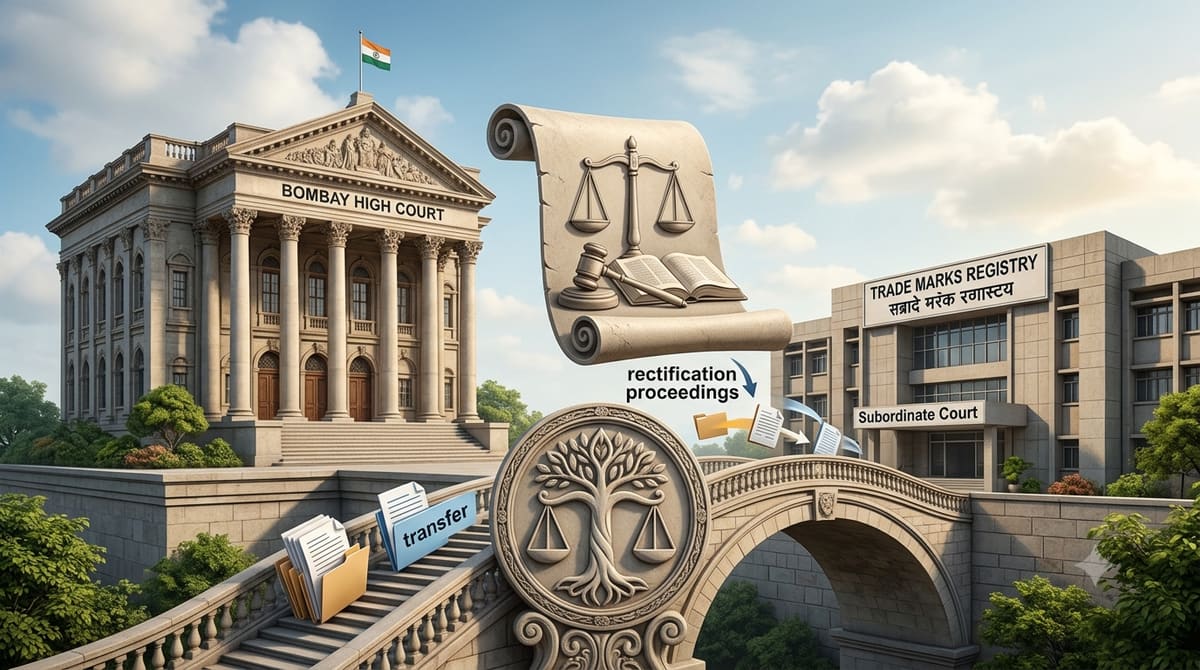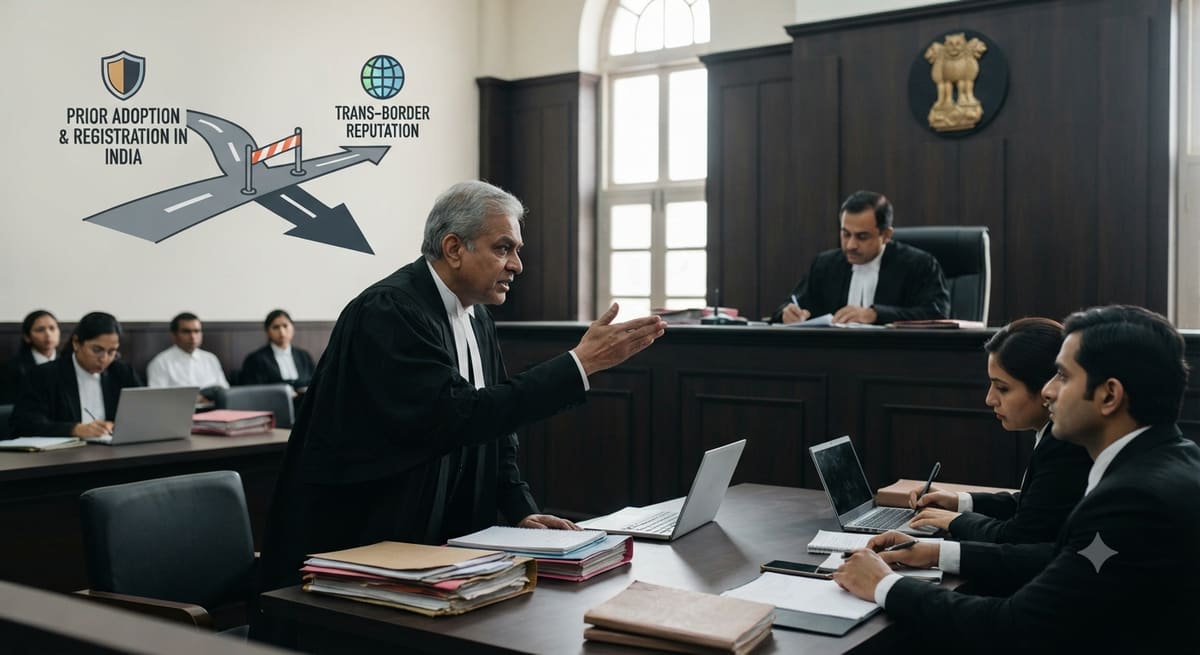
The Bombay High Court has rejected an interim application seeking stay of a trademark infringement suit under Section 124 of the Trade Marks Act, 1999, holding that the defendants neither raised a plea of invalidity of the plaintiffs' registered trademarks in their written statement nor filed rectification applications before the competent forum. The decision clarifies that a plea under the Press and Registration of Books Act, 1867 does not constitute a challenge to trademark validity under the Trade Marks Act, and that rectification applications pending before the Registrar - rather than the High Court - cannot ground a stay when a suit is pending.
Background & Facts
The Dispute
The plaintiffs - Metropolitan Media Company Ltd., Bennett Coleman and Company Limited, and Lexicon Media Private Limited - filed a commercial intellectual property suit on 27 January 2015 seeking permanent injunction restraining the defendants from using the trademarks "Pune Mirror" and "KM Kothrud Mirror" or any mark deceptively similar to the plaintiffs' registered trademarks "Pune Mirror" and "Sunday Pune Mirror". The plaintiffs also sought an injunction against use of any mark containing the word "Mirror" and claimed damages of Rs. 100,00,00,000 for alleged infringement.
Key Facts
- The plaintiffs claim rights in registered trademarks "Pune Mirror" and "Sunday Pune Mirror" as well as other "Mirror" formative marks including "Mumbai Mirror", "Sunday Mumbai Mirror", "Ahmedabad Mirror", "Bangalore Mirror on Saturday", and "Bangalore Mirror on Sunday"
- The plaintiffs claim a non-exclusive license to use the word "Mirror" per se for newspapers and related goods and services
- The plaintiffs allege they launched "Pune Mirror" on 7 April 2008 and "Sunday Pune Mirror" on 6 April 2008 in Pune
- The plaintiffs rely on trademark registration certificates dated 18 November 2008 for "Pune Mirror" and "Sunday Pune Mirror"
- The defendants claim to have been publishing a fortnightly newspaper named "Pune Mirror" from 1 October 2010
- The defendants rely on a certificate of registration issued on 14 December 2010 by the Registrar of Newspapers for India (RNI) under the Press and Registration of Books Act, 1867 (PRB Act)
- The defendants pleaded that the plaintiffs' title was deblocked by RNI for failure to complete registration formalities
- The defendants filed three rectification applications before the Registrar of Trade Marks:
- 16 March 2024 for "Pune Mirror" in Class 41
- 27 September 2023 for "Sunday Pune Mirror" in Class 16
- 22 July 2024 for "Sunday Pune Mirror" in Class 41
- All rectification applications were filed on the ground of no bona fide use for a continuous period of five years
Procedural History
- 27 January 2015: Commercial (IP) Suit No. 230 of 2015 filed
- 14 June 2019: Defendants filed written statement
- 24 November 2020: Issues framed
- 10 March 2022: Plaintiffs' affidavit of evidence taken on record
- 30 August 2023: Defendants' evidence affidavit filed
- 16 April 2024: Issues recast
- 30 April 2024: Defendants amended written statement
- 26 August 2025: Evidence of both parties closed
- 21 July 2026: Arguments reserved on interim application
- 21 October 2026: Judgment pronounced rejecting interim application
The Parties' Positions
The defendants contended that the plaintiffs had not used the trademarks continuously and exclusively, and that the defendants' continuous, exclusive, and uninterrupted use of "Pune Mirror" entitled them to prevail. They argued the plaintiffs' registration was ex facie invalid and sought stay under Section 124 based on pending rectification applications. The plaintiffs opposed the application as mala fide, filed at the fag end of final arguments, and submitted the defendants had abandoned any plea of invalidity by not raising it until the final hearing stage. The plaintiffs further argued the rectification applications were bad in law as they were filed before the Registrar rather than the High Court, and that the non-use allegations were unsupported by prima facie evidence.
Relief Sought
The defendants sought stay of further proceedings in the suit till final disposal of their rectification applications under Sections 47 and 57 of the Trade Marks Act. In the alternative, they prayed for framing an issue regarding invalidity of the plaintiffs' trademarks and deferring the suit for three months to enable them to apply to the appropriate forum for rectification.
The Legal Issue
The central questions were: (1) whether the defendants raised a plea of invalidity of the plaintiffs' registered trademarks in their written statement such that Section 124 of the Trade Marks Act could be invoked; (2) whether rectification applications filed before the Registrar of Trade Marks - rather than the High Court - are tenable grounds for stay when a suit for infringement is pending; and (3) whether the defendants made out even a low-threshold prima facie case of invalidity to warrant framing an issue and staying the suit.
Arguments Presented
For the Defendants
Learned counsel for the defendants relied on Franco India Pharmaceuticals Pvt. Ltd. v. Corona Remedies Pvt. Ltd. (2025 SCC OnLine Bom 1007) and Patel Field Marshal Agencies v. P.M. Diesels Ltd. (2018) 2 SCC 112 to argue that where a plea of invalidity is prima facie tenable, the court must frame an issue and stay the suit. Counsel submitted that the defendants' plea of non-use satisfied the low-threshold prima facie case test articulated in Franco India Pharmaceuticals. Counsel also relied on Cipla Ltd. v. Cipla Industries Pvt. Ltd. (2014 SCC OnLine Bom 5107) to argue that a plea of invalidity can be raised by affidavit and is not restricted to the written statement.
For the Plaintiffs
Learned counsel for the plaintiffs relied on Kanwar Singh Saini v. High Court of Delhi (2012) 4 SCC 307, Harshad Chiman Lal Modi v. DLF Universal Ltd. (2005) 7 SCC 791, Kiran Singh v. Chaman Paswan (1954) 1 SCC 710, M. Murali v. Sri Krishna Sweets Pvt. Ltd. (2020 SCC OnLine Mad 1070), Country Inn Pvt. Ltd. v. Country Inns and Suites by Carlson, Inc. (2018 SCC Online Del 8549), and Hardie Trading Ltd. v. Addisons Paint and Chemicals Ltd. (2003) 11 SCC 92. Counsel argued the application was mala fide and filed at the final arguments stage after evidence had closed. Counsel submitted the defendants had abandoned any plea of invalidity by not pressing for framing of an issue before trial. Counsel further argued the rectification applications were filed before an incompetent authority - the Registrar - when Section 125 mandates filing before the High Court where a suit is pending.
The Court's Analysis
The Court examined the legal position under Sections 124 and 125 of the Trade Marks Act, 1999, and the precedent established by the Supreme Court in Patel Field Marshal. The Court noted that Section 124 provides for stay of proceedings where a rectification application is pending, or where an issue of validity is raised and found prima facie tenable, in which case the suit is stayed for three months to enable the party to apply to the High Court for rectification.
"In Patel Field Marshal, the Apex Court held that Section 111 of the 1958 Act (Section 124 of the 1999 Act) specifically provides that if a proceeding for rectification of the register in relation to the trade mark of either the plaintiff or the defendant is pending before the Registrar or the High Court, as may be, and a suit for infringement is filed wherein the aforesaid plea is raised either by the defendant or by the plaintiff, the suit shall remain stayed."
The Court then analysed Franco India Pharmaceuticals, which held that the test under Section 124(1)(b)(ii) is a "low threshold prima facie case test" - lower than the prima facie case required for interim relief. However, the Court emphasised that this test applies only where the defendant has raised a specific plea regarding invalidity of the plaintiff's trademark registration in the pleadings.
The Court distinguished Cipla on the ground that it dealt with a pre-trial stage application, whereas the present application was filed at the final arguments stage after evidence had closed. The Court held that Cipla did not apply to a post-trial situation where no ground of invalidity was pleaded that could not have been raised in the written statement.
On the question of abandonment, the Court considered Country Inn Pvt. Ltd. but held that the abandonment principle applies only when an issue has been framed by the civil court and the defendant fails to file the rectification application within the time granted. Since no issue of invalidity was ever framed in this suit, the abandonment theory did not apply.
Crucially, the Court found that the defendants' written statement contained no plea of invalidity of the plaintiffs' registered trademarks under the Trade Marks Act. The defendants' pleadings concerned their own use of "Pune Mirror" and proceedings before the RNI under the PRB Act. The Court held:
"The PRB Act is a special statute governing publication of newspapers. Therefore, a plea raised regarding proceedings under the PRB Act would not ipso facto constitute a plea on the invalidity of the registered trade marks under the Trade Marks Act. Registration of title under the PRB Act would not itself constitute a ground to seek rectification of the register under the Trade Marks Act or raise a plea of invalidity of registered trade marks under the Trade Marks Act."
The Court further held that under Section 125, when a suit for infringement is pending and the defendant questions the validity of the plaintiff's trademark registration, the issue must be determined by an application before the High Court - not the Registrar. Therefore, the defendants' rectification applications before the Registrar were not tenable and could not ground a stay under Section 124.
The Verdict
The Court rejected the interim application as devoid of merit. The Court held that: (1) the defendants did not raise any plea of invalidity of the plaintiffs' registered trademarks in their written statement; (2) the rectification applications were filed before the Registrar, which is an incompetent authority under Section 125 when a suit is pending; (3) the defendants made out neither a low-threshold prima facie case nor any challenge to validity under the Trade Marks Act; and (4) the application was filed at the fag end of the suit during final arguments. The suit was directed to be listed for final arguments before the court having assignment.
What This Means For Similar Cases
Rectification Applications Must Be Filed Before the Competent Forum
- When a suit for trademark infringement is pending, any application for rectification challenging the validity of the plaintiff's registration must be filed before the High Court under Section 125, not before the Registrar
- Rectification applications pending before the Registrar cannot serve as a ground for stay under Section 124
- Practitioners must ensure rectification applications are filed before the correct forum to avoid procedural dismissal
Plea of Invalidity Must Be Specifically Pleaded Under the Trade Marks Act
- A defence based on registration under a different statute (such as the PRB Act for newspaper titles) does not constitute a plea of invalidity under the Trade Marks Act
- Invalidity must be pleaded with reference to the provisions and requirements of the Trade Marks Act, specifically on grounds such as non-bona fide use under Section 47
- Mere denial of infringement or assertion of concurrent use is insufficient to trigger Section 124
Timing of Section 124 Applications Matters
- Applications under Section 124 filed at the final arguments stage after evidence has closed face heightened scrutiny
- While Cipla permits raising a plea of invalidity by affidavit at pre-trial stage, this latitude does not extend to post-trial stages where the plea could have been raised earlier
- Practitioners should raise invalidity pleas at the earliest opportunity - ideally in the written statement or before framing of issues
Low-Threshold Prima Facie Test Still Requires a Pleaded Case
- The "low threshold prima facie case" test from Franco India Pharmaceuticals applies only where the defendant has raised a specific plea of invalidity in the pleadings
- The court will not frame an issue under Section 124 based solely on assertions made in the stay application itself, unconnected to the written statement
- The pleadings must first be examined to determine whether a specific plea of invalidity exists before the prima facie test is applied