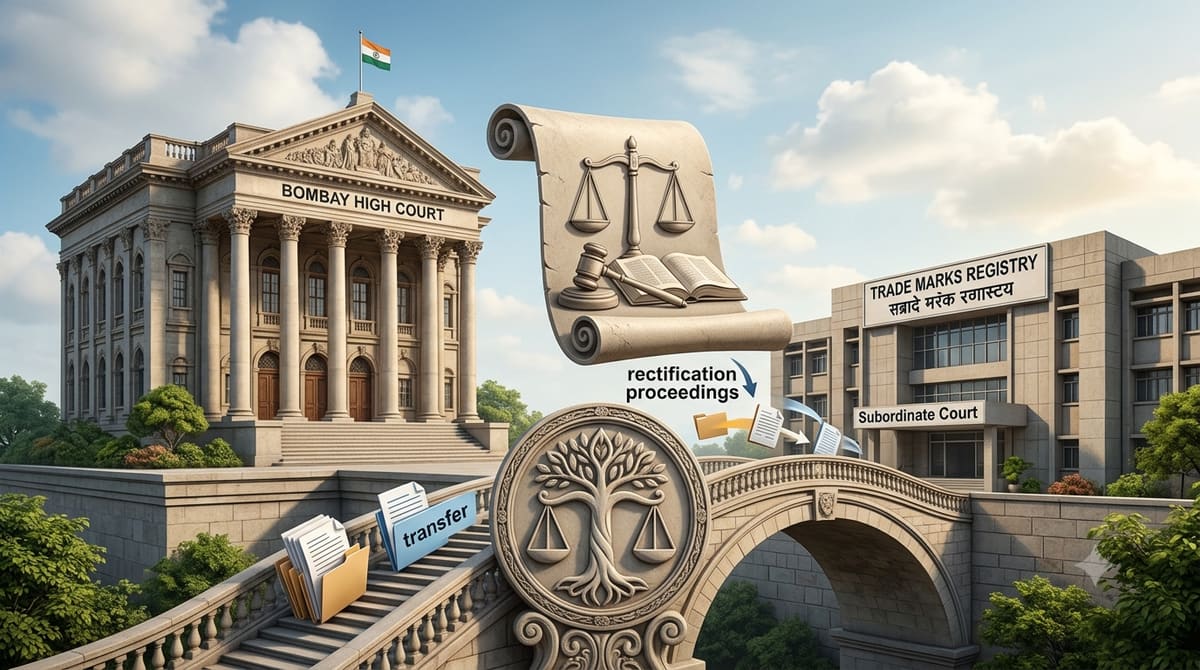
The Kerala High Court has clarified a critical jurisdictional threshold under the Designs Act, 2000: once a defendant raises a defence challenging the validity of a registered design, the Commercial Court loses all authority to proceed and must immediately transfer the suit to the High Court. This ruling resolves a long-standing conflict among High Courts and reinforces the statutory mandate that design validity disputes belong exclusively to the High Court.
Background & Facts
The Dispute
The respondent, Abdulla Mohammed Sali, filed a suit (CS No. 98 of 2025) before the Additional Sub Court, Ernakulam, alleging infringement and passing off of the registered design of an "IYO Bottle" under the Designs Act, 2000. The petitioners, Aines Food & Beverages and its partners, filed a written statement (Ext.P4) challenging the validity of the registered design, invoking grounds under Section 19 of the Act.
Key Facts
- The respondent’s design (IYO Bottle) was registered under the Designs Act, 2000
- The petitioners began manufacturing and selling bottles with a similar shape in 2024
- The respondent filed suit on 22.08.2025 seeking injunction and damages
- The petitioners filed their written statement on 10.11.2025 (Ext.P4), pleading that:
- The design was previously published in India and abroad
- The design is not new or original
- The design is not registrable under Section 2(d) of the Act
- The petitioners relied on S.D. Containers Indore v. Mold-Tek Packaging Ltd. (2021) to argue that Section 22(4) mandates transfer
- On 10.12.2025, the Commercial Court dismissed the petitioners’ application for transfer (Ext.P5), holding that prima facie satisfaction of validity challenge was required before transfer
- On 09.01.2026, the petitioners filed IA No. 1/2026 seeking transfer
- On 29.12.2025, the petitioners filed an appeal before the Commercial Appellate Court, which was dismissed
- On 25.11.2025, the petitioners filed a separate petition for cancellation of the design with the Controller of Designs
Procedural History
- 22.08.2025: Suit filed by respondent before Additional Sub Court, Ernakulam (CS No. 98 of 2025)
- 10.11.2025: Petitioners file Written Statement (Ext.P4) challenging design validity under Section 19 grounds
- 10.12.2025: Commercial Court dismisses transfer application (Ext.P5)
- 29.12.2025: Petitioners file appeal before Commercial Appellate Court (District Court)
- 07.01.2026: Petitioners file Not Press Memo before Appellate Court
- 09.01.2026: Petitioners file IA No. 1/2026 seeking transfer to High Court
- 13.02.2026: Original Petition (OP(C) No. 147 of 2026) heard before Kerala High Court
- 30.06.2026: Judgment delivered
Relief Sought
The petitioners sought:
- Setting aside of Ext.P5 order dated 10.12.2025
- Direction to the Commercial Court to immediately transfer CS No. 98 of 2025 to the High Court of Kerala
- Stay on all interlocutory applications (Ext.P8) pending transfer
The Legal Issue
The central question was whether Section 22(4) of the Designs Act, 2000 requires the Commercial Court to transfer a suit to the High Court immediately upon the filing of a written statement raising a defence under Section 19, or whether the Court must first determine whether a prima facie case of invalidity exists before transferring jurisdiction.
Arguments Presented
For the Petitioner
The petitioners relied on S.D. Containers Indore v. Mold-Tek Packaging Ltd. (2021) 3 SCC 289, where the Supreme Court upheld the view that once a defence under Section 19 is raised, Section 22(4) mandates automatic transfer. They argued that the statutory language - "notwithstanding anything contained in the second proviso to sub-section (2)" - leaves no discretion to the Commercial Court. They cited R.N. Gupta & Co. Ltd. v. Action Construction Equipments Ltd. (2016) and the Division Bench judgment in Standard Glass Beads Factory v. Dhar (1961) to show that the intent of the legislature was to centralize design validity disputes in the High Court.
For the Respondent
The respondent contended that the Commercial Court must first assess whether the defence raised is prima facie credible. They relied on M/s. Kadambukattil Exports v. M/s. Nilkamal Ltd. (2013) to argue that jurisdictional ouster cannot be inferred mechanically. They asserted that allowing automatic transfer would lead to abuse, as defendants could raise frivolous validity challenges to delay proceedings. They emphasized that Section 22(4) should be read in harmony with the Commercial Courts Act, which vests exclusive jurisdiction over design infringement suits in Commercial Courts.
The Court's Analysis
The Court undertook a detailed textual and contextual analysis of Section 22(4), which states: "Notwithstanding anything contained in the second proviso to sub-section (2), where any ground on which the registration of a design may be cancelled under Section 19 has been availed of as a ground of defence... the suit... shall be transferred by the Court... to the High Court for decision."
"The words used are unambiguous: once a defence under Section 19 is pleaded, the transfer is mandatory. There is no qualifying phrase such as 'if the Court is prima facie satisfied' or 'if the defence appears substantial'."
The Court rejected the Kadambukattil precedent, distinguishing it as a pre-S.D. Containers interpretation that had been overtaken by the Supreme Court’s authoritative ruling. It noted that the Supreme Court in S.D. Containers had expressly approved the view taken by the Allahabad, Karnataka, Jammu & Kashmir, and Bombay High Courts - all of which held that the transfer is automatic upon pleading.
The Court emphasized that Section 19 and Section 22 operate in tandem: Section 19 provides the grounds for cancellation, and Section 22(4) provides the procedural mechanism to channel any challenge to those grounds to the High Court. The legislative intent, as clarified by the Supreme Court, was to ensure that validity disputes - which involve complex questions of prior publication, novelty, and registrability - are decided by judges with higher expertise and authority.
The Commercial Court’s reliance on a prima facie assessment was held to be contrary to the plain language of the statute. The Court observed that the phrase "availed of as a ground of defence" does not require judicial evaluation of merit at the threshold - only the assertion of the ground.
The Verdict
The petition succeeded. The Court set aside Ext.P5 order dated 10.12.2025 as without jurisdiction. The Commercial Court was directed to immediately transfer CS No. 98 of 2025 to the High Court of Kerala. All interlocutory applications, including Ext.P8 and Ext.P9, were directed to remain in abeyance until the transfer is completed. The transfer must be effected within seven days of the judgment.
What This Means For Similar Cases
Transfer Is Automatic Upon Pleading
- Practitioners must file a transfer application immediately upon raising a Section 19 defence in the written statement
- No need to wait for a hearing or judicial assessment of the defence’s merit
- Any order passed by the Commercial Court after such a defence is filed is void ab initio
Strategic Implications for Design Litigation
- Plaintiffs must now anticipate that any challenge to design validity will trigger immediate transfer
- Defendants should draft written statements to explicitly invoke Section 19 grounds (publication, novelty, registrability) to trigger transfer
- Separate cancellation petitions before the Controller should be filed promptly to strengthen the defence
Jurisdictional Clarity for Commercial Courts
- Commercial Courts retain jurisdiction over infringement claims only if no Section 19 defence is raised
- Once a validity challenge is pleaded, the Commercial Court must cease all proceedings and transfer without delay
- Delay in transfer may render subsequent orders liable to be set aside