The Bombay High Court has invalidated a Rs.52.80 crore penalty imposed by the Mumbai Metropolitan Region Development Authority (MMRDA) on a developer for delayed construction, holding that a supplementary lease deed explicitly removing time limits for additional built-up area renders such demand arbitrary and violative of Article 14 of the Constitution. The judgment underscores the primacy of contractual amendments over rigid statutory clauses when they reflect the parties' subsequent intent.
Background & Facts
The Dispute
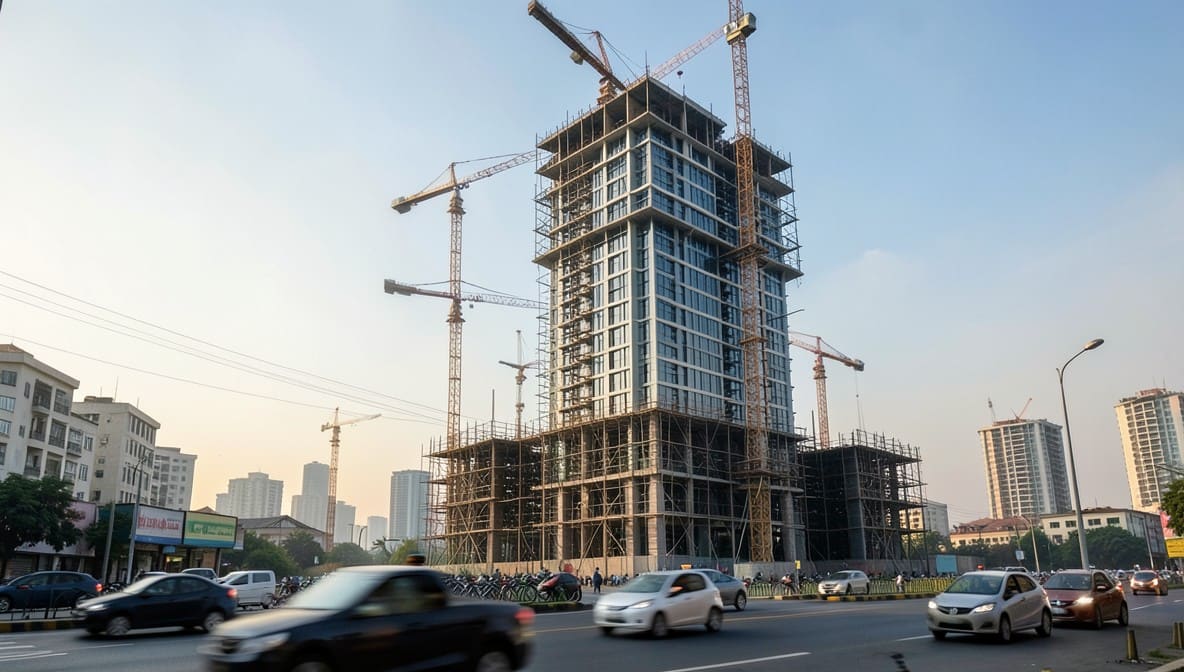
The dispute arose from the imposition of an additional premium of Rs.52,80,98,641/- by MMRDA on Sunteck Realty Limited (formerly Starlight Systems) for alleged delay in completing construction on Plot Nos. R-1.2 and R-1.3 in Bandra-Kurla Complex. MMRDA claimed the delay breached Article 2(d) of the original Lease Deed dated 27.07.2006, which mandated completion within four years. However, Sunteck contended that the delay was caused by undisclosed site conditions and statutory approval delays, and that Article 5 of the Supplementary Lease Deed dated 05.11.2015 had expressly removed any time limit for construction using the additional built-up area.
Key Facts
- On 30.12.2005, the Petitioner bid Rs.136.90 crore for two plots totaling 7,066.67 sq. mtrs.
- Lease Deed executed on 27.07.2006 granted 80-year lease with initial built-up area (BUA) of 14,100 sq. mtrs.
- Possession handed over on 03.08.2006.
- On 13.08.2007, Commencement Certificate (CC) issued for initial BUA.
- During excavation, pre-existing RCC piles from a prior abandoned project were discovered - undisclosed by MMRDA.
- Petitioner had to switch from pile to open foundation, causing significant delay.
- On 02.05.2008, Government of Maharashtra increased FSI in G-Block from 2.00 to 4.00.
- On 29.08.2008, Petitioner submitted amended plans to utilize additional FSI.
- On 04.12.2008, MMRDA allotted additional BUA of 14,100 sq. mtrs. for Rs.92.07 crore.
- On 25.11.2009, further additional BUA of 14,000 sq. mtrs. allotted for Rs.91.42 crore.
- Total additional BUA: 28,100 sq. mtrs., increasing total permissible BUA to 42,200 sq. mtrs.
- Revised CC issued on 11.06.2009 for composite construction.
- Environmental clearance granted on 14.06.2011; height clearance on 07.12.2010; High-Rise Committee clearance on 05.03.2014.
- Construction of initial BUA (7 floors) completed on 18.02.2014.
- Supplementary Lease Deed executed on 05.11.2015, incorporating Article 5: "there is no time limit for construction of the said additional built up area."
- On 04.09.2014, Petitioner deposited Rs.52.80 crore under protest.
- On 09.09.2014, MMRDA issued Demand Notice (Exhibit-S) adjusting the deposit as penalty for delay from 27.06.2011 to 06.06.2014.
- Part Occupation Certificate issued on 17.10.2014; Full Occupation Certificate on 09.11.2015.
- Representation dated 20.02.2018 seeking refund went unanswered.
- Writ Petition filed on 2018.
Procedural History
- 27.07.2006: Original Lease Deed executed.
- 03.08.2006: Possession handed over.
- 13.08.2007: Initial CC issued.
- 02.05.2008: FSI increased to 4.00.
- 04.12.2008: First additional BUA allotted.
- 25.11.2009: Second additional BUA allotted.
- 11.06.2009: Revised CC issued for composite construction.
- 18.02.2014: Construction of initial BUA completed.
- 05.11.2015: Supplementary Lease Deed executed with Article 5.
- 04.09.2014: Petitioner deposits Rs.52.80 crore under protest.
- 09.09.2014: MMRDA issues Demand Notice (Exhibit-S).
- 20.02.2018: Petitioner’s representation for refund.
- 2018: Writ Petition No. 2377 of 2018 filed.
- 22.01.2026: Judgment reserved.
- 08.04.2026: Judgment pronounced.
The Parties' Positions
Petitioner (Sunteck Realty Limited): Argued that the delay was caused by MMRDA’s failure to disclose pre-existing piles, delays in statutory approvals, and the very nature of composite construction. Emphasized that Article 5 of the Supplementary Lease Deed extinguished the time limit for the additional BUA, making the penalty arbitrary and violative of Article 14. Relied on Raghuleela Builders Pvt. Ltd. v. MMRDA.
Respondents (MMRDA): Contended that the penalty was contractual under Article 2(d) and (e) of the original Lease Deed, enforceable under Form ‘D’ of the MMRDA (Disposal of Land) Regulations, 1977. Argued that the Supplementary Lease Deed did not override the original terms, and that the Petitioner had voluntarily deposited the amount and sought extension, thereby waiving its right to challenge.
Relief Sought
The Petitioner sought quashing of the Demand Notice dated 09.09.2014 and refund of Rs.52,80,98,641/- with interest, along with costs.
The Legal Issue
The central question was whether Article 5 of the Supplementary Lease Deed, which explicitly removes any time limit for construction of additional built-up area, nullifies the applicability of Article 2(d) of the original Lease Deed requiring completion within four years, and whether the imposition of penalty under such circumstances violates Article 14 of the Constitution.
Arguments Presented
For the Petitioner
The Petitioner relied on Raghuleela Builders Pvt. Ltd. v. MMRDA (2019 SCC OnLine Bom 4529), where the same Court held that imposing penalties for delay in construction after allotment of additional BUA was arbitrary and discriminatory. It argued that Article 5 of the Supplementary Lease Deed was a clear, unambiguous modification of the original contract, rendering the four-year deadline inapplicable to the composite project. The Petitioner emphasized that the delay was caused by MMRDA’s non-disclosure of underground piles and delays in statutory clearances - factors beyond its control. It further contended that the deposit of Rs.52.80 crore was made under duress and protest, and thus could not constitute waiver or estoppel. The Petitioner invoked the doctrine of preventio and contra proferentum, asserting that ambiguity in the contract must be construed against the drafter (MMRDA).
For the Respondent
The Respondents argued that the Lease Deed was in Form ‘D’ under statutory regulations, and thus the terms were binding as if enacted by law. They contended that Article 5 did not extinguish Article 2(d), but merely provided flexibility for the additional area, without affecting the original obligation. They relied on precedents like Bank of Baroda v. MMRDA and Goetze (India) Ltd. v. ESIC to argue that contractual obligations cannot be circumvented without challenging the underlying statutory framework. They also claimed the Petitioner had acquiesced by depositing the amount and seeking extension, and that the Writ Petition was barred by delay and laches.
The Court's Analysis
The Court undertook a meticulous analysis of the contractual framework, statutory context, and constitutional principles. It began by affirming that the Lease Deed and Supplementary Lease Deed were valid contracts under Section 10 of the Indian Contract Act, 1872, and that the latter reflected the parties’ subsequent intent.
"Article 5 of the Supplementary Lease Deed makes it clear that after the allotment of the additional Built up Area, it was not the intention of the parties to continue with the original time line as contemplated under Article 2(d) in as much as Article 5 is a specific stipulation completely dispensing with the time restriction for completing the construction of the building."
The Court held that the construction was a single, composite project on a unified plot, and that the additional BUA was not severable from the original. Therefore, applying a separate timeline to the original and additional areas was impractical and irrational. The Court rejected MMRDA’s argument that Article 5 was merely permissive, noting that its unqualified language - "there is no time limit" - left no room for ambiguity.
The Court further applied the doctrine of contra proferentum, observing that since MMRDA drafted the original Lease Deed and the Supplementary Lease Deed, any ambiguity must be construed against it. The Court noted that MMRDA had ample opportunity to insert a qualifying clause in the Supplementary Lease Deed to preserve Article 2(d) but chose not to.
The Court also found that MMRDA’s failure to disclose pre-existing underground piles violated Section 108(a) of the Transfer of Property Act, 1882, which imposes a duty on the lessor to disclose material defects. This failure directly caused the delay, and under the doctrine of preventio, a party cannot benefit from its own wrong.
The Court emphasized that the penalty was imposed without any show-cause notice, without opportunity to be heard, and after the amount had already been forcibly adjusted - clearly violating principles of natural justice. The deposit under protest, coupled with the threat of lease termination, rendered the payment involuntary and recoverable under Section 72 of the Indian Contract Act.
The Court also held that MMRDA’s policy of granting six-year extension only to leases executed after 26.08.2015 was arbitrary and discriminatory under Article 14, as the same factual conditions applied to all lessees in BKC. The Raghuleela Builders precedent was binding on this coordinate Bench, and MMRDA’s attempt to distinguish it was rejected.
The Verdict
The Petitioner succeeded. The Court quashed the Demand Notice dated 09.09.2014 and directed MMRDA to refund Rs.52,80,98,641/- to the Petitioner within 90 days from the date of receipt of the certified copy of this order. In the event of delay, the amount shall carry interest at 14% per annum, calculated from the date of this order until actual refund. Parties to bear their own costs.
What This Means For Similar Cases
Supplementary Contracts Override Original Time Limits
- Practitioners must now argue that any supplementary agreement explicitly removing time constraints for construction - especially when tied to additional FSI - supersedes original deadlines.
- MMRDA and similar authorities cannot enforce time-bound clauses in original leases when a supplementary deed expressly negates them.
Non-Disclosure of Site Defects Invalidates Penalty Claims
- Where authorities fail to disclose pre-existing structures or subsurface conditions, any penalty for delay becomes legally unsustainable.
- Section 108(a) of the Transfer of Property Act imposes a non-waivable duty of disclosure; breach thereof bars invocation of penalty clauses.
Deposit Under Protest Is Not Waiver
- Payments made under protest, especially under threat of termination or denial of occupancy certificates, cannot be treated as voluntary or as acquiescence.
- Section 72 of the Indian Contract Act and precedents like Ram Kishen Singh v. Dooli Chand provide clear grounds for recovery.
Discriminatory Policy Violates Article 14
- Authorities cannot grant benefits to post-policy lessees while denying them to pre-policy lessees under identical circumstances.
- Classification based solely on lease execution date, without rational nexus to objective, is arbitrary and unconstitutional.
Procedural Fairness Is Non-Negotiable
- No penalty can be levied without a show-cause notice, opportunity of hearing, or reasoned order.
- Adjustment of amounts before formal communication of decision violates natural justice.