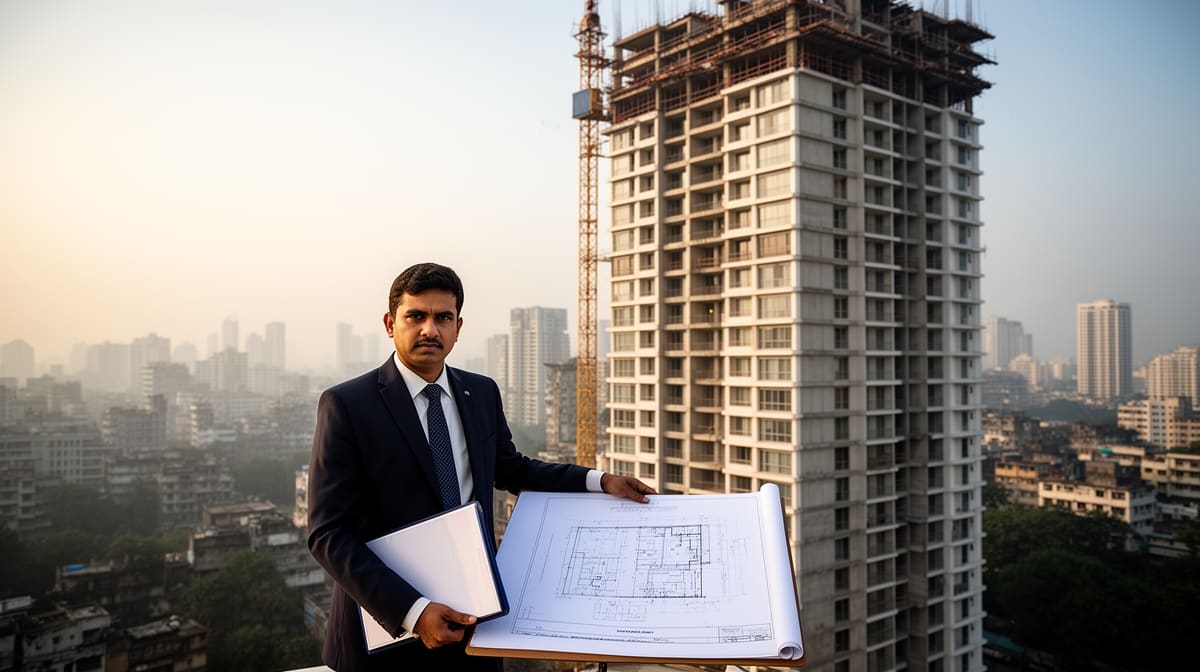
The Bombay High Court has reinforced that procedural fairness is non-negotiable in slum rehabilitation declarations that directly affect landowners' proprietary rights. In a significant interim order, the Court stayed two impugned orders after finding a prima facie breach of natural justice due to the failure to hear affected parties before declaring their land as a rehabilitation area.
Background & Facts
The Dispute
The present Writ Petition challenges two orders: (i) an order dated 20.08.2020 passed by the Chief Executive Officer of the Slum Rehabilitation Authority (CEO/SRA), declaring an additional 143.52 square metres of land as a slum rehabilitation area under Section 3C(1) of the Maharashtra Slum (Improvement, Clearance and Redevelopment) Act, 1971; and (ii) an order dated 30.10.2024 by the Apex Grievance Redressal Committee (AGRC), confirming the declaration. The land in question forms part of CTS No. 610A/1A/IA (part), Malad (East), Borivali.
Key Facts
- The declaration was initiated following an application dated 19.12.2019 by the Chief Promoter of Respondent No. 4-Society.
- A prior declaration dated 26.11.2018 had already covered 1055.50 square metres of the same CTS number, now challenged in Writ Petition No. 4764 of 2024.
- A demarcation survey by the City Survey Officer determined the total area as 1199.02 square metres, leading to the proposal to include an additional 143.52 square metres.
- Public Notices were published on 12.03.2020 and 14.03.2020 in two newspapers inviting objections.
- Petitioner No. 1 claims ownership of approximately 650 square metres; Petitioners Nos. 2 to 6 claim ownership of approximately 600 square metres, both forming part of the declared area.
- On 16.03.2020, the Petitioners’ Advocate sent a letter to the Deputy Collector, SRA, objecting to the proposed declaration, asserting ownership, submitting documents, and specifically requesting a personal hearing. The letter was acknowledged by the Authority.
- Despite this, the CEO/SRA’s order dated 20.08.2020 recorded that "no complaints or objections were received within the prescribed period."
- The Petitioners appealed to the AGRC, filing Written Submissions dated 24.06.2024, reiterating the denial of hearing.
- The AGRC’s order dated 30.10.2024 falsely claimed that objections were received and a personal hearing was granted.
Procedural History
- 19.12.2019: Application filed by Respondent No. 4-Society seeking declaration of additional area.
- 12.03.2020 & 14.03.2020: Public Notices published.
- 16.03.2020: Petitioners’ objection letter submitted and acknowledged by SRA.
- 20.08.2020: CEO/SRA issues declaration without hearing or consideration of objections.
- 24.06.2024: Petitioners file Written Submissions before AGRC.
- 30.10.2024: AGRC confirms declaration, falsely asserting hearing was granted.
- 16.10.2024: Writ Petition No. 5465 of 2024 filed before Bombay High Court.
- 28.01.2026: Court directs CEO/SRA to file affidavit in reply by 12.02.2026.
- 20.02.2026: Matter not taken up for hearing.
- 30.03.2026: Court hears matter on supplementary board; no affidavits filed by any Respondent.
The Parties' Positions
- Petitioners: Assert ownership, claim they submitted objections and requested a hearing, contend the orders were passed without compliance with natural justice, and that the authorities misrepresented the record.
- Respondents (CEO/SRA, AGRC, Society): Argue that no prejudice was caused, ownership is unproven, slum conditions exist, and the High Court’s discretionary jurisdiction under Article 226 should not be invoked.
Relief Sought
The Petitioners seek urgent ad-interim relief in the form of a stay on the operation and implementation of both impugned orders until final disposal of the Writ Petition.
The Legal Issue
Does the failure to afford a hearing to landowners who have clearly raised objections and requested an opportunity to be heard before declaring their property as a slum rehabilitation area constitute a violation of the principles of natural justice, warranting interim protection?
Arguments Presented
For the Petitioner
The Petitioners relied on Allan Sebastian D'Souza v. Maharashtra Slum Areas Tribunal to argue that a declaration under Section 3C(1) of the Slums Act has serious civil consequences affecting title and development rights, and therefore mandates compliance with natural justice. They submitted that their letter dated 16.03.2020, acknowledged by the Authority, constituted a clear assertion of rights and request for hearing. The subsequent recording in the impugned order that "no objections were received" was factually incorrect and amounted to a fraud on the process. They emphasized that denial of hearing is a jurisdictional defect, not merely a procedural irregularity.
For the Respondent
The Respondents contended that the Petitioners failed to establish absence of slum conditions or conclusive ownership. They relied on M.S. Sanjay v. Indian Bank to argue that Article 226 jurisdiction is discretionary and should not be exercised where interference does not advance substantial justice. They also cited Dharampal Satyapal Ltd. v. Deputy Commissioner of Central Excise and Veekayal Investment Co. v. State of Maharashtra to argue that breach of natural justice does not automatically invalidate an order unless prejudice is demonstrated. They further claimed that the Petitioners had not suffered any actual prejudice.
The Court's Analysis
The Court clarified that at the ad-interim stage, it was not required to adjudicate disputed questions of ownership or the existence of slum conditions. The sole issue was whether the Petitioners had made out a prima facie case warranting interim protection.
The Court noted that the Petitioners’ letter dated 16.03.2020, acknowledged by the SRA, clearly raised objections, asserted ownership, submitted documents, and requested a personal hearing. Yet, the CEO/SRA’s order dated 20.08.2020 falsely stated that no objections were received. This discrepancy, coupled with the complete failure of all Respondents to file affidavits despite a specific court direction dated 28.01.2026, left the Petitioners’ grievance unaddressed.
"A declaration under Section 3C(1) of the Slums Act is not merely administrative in nature. Such a declaration carries civil consequences and directly impacts the proprietary rights, development potential, and incidents of ownership attached to the land concerned."
The Court held that Allan Sebastian D'Souza established that such declarations require compliance with natural justice. The failure to hear affected persons before making a declaration that alters land use and development rights is a fundamental jurisdictional flaw. The Court rejected the Respondents’ reliance on Dharampal Satyapal and Veekayal Investment, noting that in those cases, prejudice was absent because hearings were held. Here, no hearing was afforded at all.
"A party cannot be expected to establish factual contentions before an authority which, according to the prima facie case made out, did not hear them at all."
The Court further held that the mere assertion of ownership, supported by documents, is sufficient to confer standing to challenge the declaration. Whether the claim ultimately succeeds is a matter for final adjudication. The denial of hearing itself constitutes substantial prejudice.
The Court also dismissed the argument that Article 226 jurisdiction is discretionary in a manner that permits ignoring procedural violations. Discretion must serve fairness, and permitting the consequences of an order made without hearing to continue would defeat the very purpose of judicial review.
The Verdict
The Petitioners succeeded in obtaining ad-interim relief. The Court stayed the operation and implementation of both the impugned orders: (i) the CEO/SRA order dated 20.08.2020 and (ii) the AGRC order dated 30.10.2024. The Respondents are directed to file affidavits in reply within two weeks. The Petitioners may file a rejoinder within two weeks thereafter. The matter is to be taken up for final hearing as expeditiously as possible, preferably at the admission stage.
What This Means For Similar Cases
Hearing Is Mandatory Before Slum Declaration
- Practitioners must now argue that any declaration under Section 3C(1) of the Slums Act that affects proprietary rights requires a pre-decisional hearing.
- Public notices alone are insufficient; affected owners must be given a meaningful opportunity to present their case.
- Authorities cannot rely on silence or non-response if objections were submitted and acknowledged.
Failure to File Affidavits Is Fatal to the State’s Case
- Courts will draw adverse inferences when statutory authorities fail to file affidavits despite specific directions.
- The absence of a reply from the decision-making body strengthens the petitioner’s prima facie case.
- This creates a strong tactical advantage for petitioners in administrative law challenges.
Ownership Need Not Be Proven at Interim Stage
- Claiming a proprietary interest, supported by documents, is sufficient to establish locus standi.
- The burden to prove ownership lies at the final hearing; at the interim stage, the focus is on procedural fairness.
- Courts will not require petitioners to prove their title before being heard.
Prejudice Is Inherent in Denial of Hearing
- The deprivation of a hearing in matters affecting land rights is itself a form of irreparable prejudice.
- Authorities cannot later argue that no harm was done because the petitioner failed to prove facts they were never allowed to present.
- This principle applies equally to other statutory declarations affecting property rights, such as land acquisition or zoning changes.