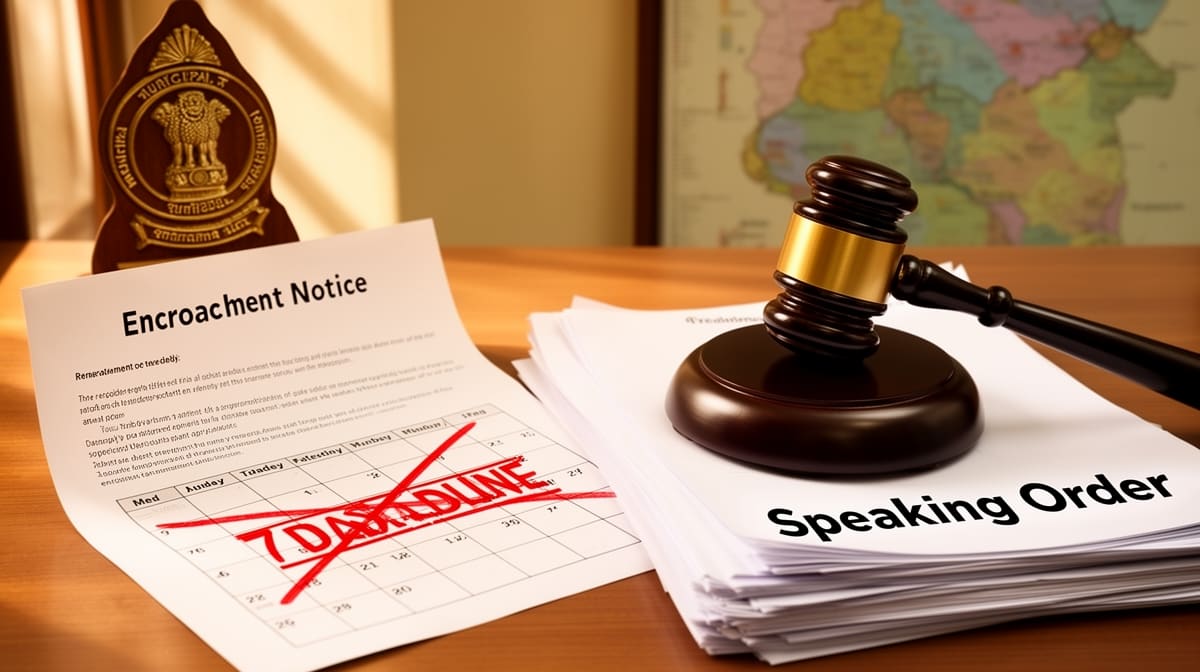
The Andhra Pradesh High Court has underscored the importance of natural justice in administrative proceedings by holding that a mere seven-day period to respond to an encroachment notice is inadequate. The judgment mandates a three-week window for explanation and a subsequent three-week period for a speaking order, reinforcing procedural fairness in municipal actions.
Background & Facts
The Dispute
The petitioner, Akula V S Srinivasa Rao, challenged a notice issued by the Eluru Municipal Corporation alleging illegal encroachment on municipal land. The impugned notice, dated 02.03.2026, granted only seven days to submit a written explanation, failing which coercive action was threatened.
Procedural History
- The petitioner filed Writ Petition No. 7048/2026 directly before the Andhra Pradesh High Court under Article 226 of the Constitution.
- No prior statutory appeal or administrative remedy was exhausted, as the notice itself was challenged for violating principles of natural justice.
Relief Sought
The petitioner sought:
- Quashing of the impugned notice for being arbitrary and procedurally unfair.
- A direction to the respondents to grant reasonable time for submitting an explanation.
- An interim stay on any coercive action pending disposal of the writ petition.
The Legal Issue
The central question was whether a seven-day period to respond to an encroachment notice satisfies the minimum standards of natural justice, particularly the right to a fair hearing under Article 14 of the Constitution.
Arguments Presented
For the Petitioner
- The impugned notice violated principles of natural justice by granting an unreasonably short period for reply.
- Cited Maneka Gandhi v. Union of India to argue that procedural fairness is a fundamental right under Article 14.
- Emphasized that the burden of proof lies with the municipal authority to establish encroachment, which requires adequate time for the petitioner to gather evidence.
For the Respondents
- The Assistant Government Pleader and counsel for the Municipal Corporation argued that the notice was issued in accordance with municipal laws and that seven days was sufficient for a reply.
- Contended that the petitioner had waived his right to challenge by not availing alternative remedies under the Andhra Pradesh Municipal Corporation Act, 1955.
The Court's Analysis
The Court critically examined the adequacy of time granted in the impugned notice and held:
"The impugned Notice dated 02.03.2026 grants only seven days to the petitioner to submit a written explanation. This Court finds that such a short period is grossly inadequate to enable the petitioner to gather material documents and present a meaningful defense. The principles of natural justice demand that a party must be given reasonable opportunity to be heard, which includes adequate time to respond."
The Court relied on the following legal principles:
- Right to Fair Hearing: Under Maneka Gandhi v. Union of India, the right to a fair hearing is an integral part of Article 14.
- Procedural Fairness: Administrative actions must comply with minimum procedural safeguards, including reasonable time for reply.
- Speaking Order Requirement: The Court emphasized that any order passed after an enquiry must be a speaking order, detailing reasons for the decision.
The Court distinguished the present case from routine administrative notices, noting that encroachment disputes involve complex factual determinations requiring documentary evidence and cross-examination, which cannot be completed in seven days.
The Verdict
The High Court disposed of the writ petition with the following directions:
- The petitioner shall be granted three weeks from the date of the order to submit a written explanation along with supporting documents.
- The respondents shall conduct an enquiry and, if requested, provide a personal hearing to the petitioner.
- The respondents shall pass a speaking order within three weeks from the date of receiving the petitioner's explanation.
- No coercive action shall be taken against the petitioner for two weeks from the date of the speaking order.
What This Means For Similar Cases
Adequate Time for Reply Is Non-Negotiable
- Practitioners must argue that short notice periods (e.g., less than 15 days) violate natural justice and Article 14.
- Municipal authorities cannot issue mechanical notices without considering the complexity of the dispute and the time required for a meaningful response.
Speaking Orders Are Mandatory
- Administrative bodies must pass speaking orders, detailing reasons for their decisions. Failure to do so renders the order arbitrary and liable to be quashed.
- Key Takeaway: Always demand a speaking order in encroachment or eviction cases.
Coercive Action Without Fair Hearing Is Illegal
- Municipal corporations cannot initiate coercive steps (e.g., demolition, eviction) without:
- Granting reasonable time for reply.
- Conducting a fair enquiry with an opportunity for hearing.
- Passing a speaking order based on evidence.
- Practical Tip: File a writ petition immediately if coercive action is threatened without compliance with these steps.