The Allahabad High Court has underscored that administrative action involving land resumption must be grounded in due diligence, not blind reliance on subordinate reports. Even where an illegal order is later cancelled, the failure to verify land classification before acting constitutes a serious breach of public duty.
Background & Facts
The Dispute
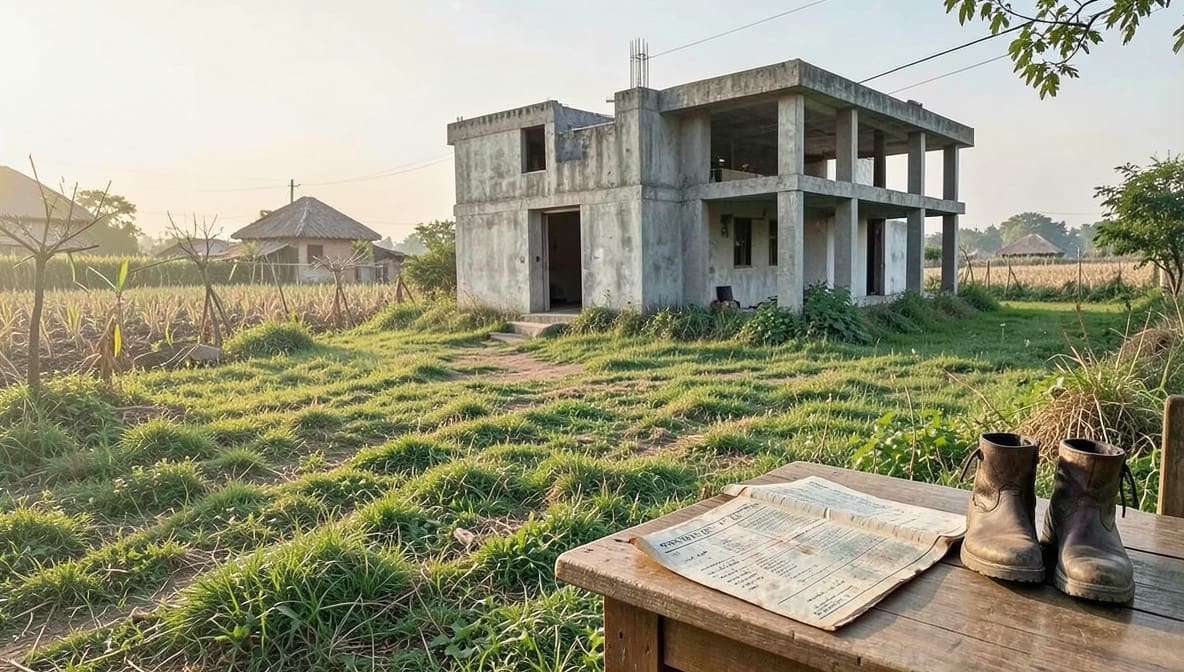
The petitioners, residents of Village Akolahee, Tahsil Sadar, District Gorakhpur, raised concerns over the construction of a new Panchayat Bhawan on Plot No. 237, which is recorded in revenue records as Pasture Land. The petitioners contended that such construction violates Section 77 of the U.P. Revenue Code, 2006, which prohibits change of land use without proper authorization, particularly for protected categories like pasture land.
Key Facts
- Plot No. 237, measuring 4.302 hectares, is classified as Pasture Land in the revenue records of Village Akolahee
- The Land Management Committee, acting under the authority of the District Magistrate, initiated construction of a new Panchayat Bhawan on this plot
- A prior Panchayat Bhawan already existed on the village premises, making the new construction unnecessary
- On 21.02.2026, the District Magistrate, Gorakhpur, issued an order resuming 0.056 hectare of Plot No. 237 for public use
- The order was passed solely on the basis of a report from the District Panchayat Raj Officer, without verification of land classification or spot inspection
- On 29.04.2026, after being informed that the land was classified as Pasture Land under Section 77 of the U.P. Revenue Code, 2006, the District Magistrate cancelled the resumption order dated 21.02.2026
- No prior public notice, consultation, or environmental or land-use compliance was undertaken
Procedural History
- 07.04.2026: PIL No. 863 of 2026 filed before the Allahabad High Court seeking stay on construction and quashing of the resumption order
- 07.04.2026: Court issued notice to respondents, granting two weeks to obtain instructions
- 11.05.2026: Deputy District Magistrate, Sadar, Gorakhpur, submitted instructions confirming the resumption and subsequent cancellation
- 11.05.2026: Court took on record the official correspondence and heard final submissions
Relief Sought
The petitioners sought:
- Immediate halt to construction on Plot No. 237
- Quashing of the resumption order dated 21.02.2026
- Direction to the authorities to conduct proper land classification verification before any future resumption
- Accountability of officials who recommended the illegal resumption
The Parties' Positions
- Petitioners: Argued that the resumption was illegal, arbitrary, and violated statutory protections for pasture land under the U.P. Revenue Code. They emphasized that administrative convenience cannot override statutory safeguards.
- Respondents (State & Gaon Sabha): Did not contest the illegality of the resumption order but submitted that it had already been cancelled, rendering the petition infructuous.
The Legal Issue
The central question was whether the cancellation of an illegal land resumption order absolves the authorities of their duty to investigate and verify land classification before acting, and whether administrative negligence in such matters warrants judicial censure even in the absence of ongoing harm.
Arguments Presented
For the Petitioner
The petitioner’s counsel relied on the principle that public land cannot be diverted without strict compliance with statutory safeguards, particularly under Section 77 of the U.P. Revenue Code, 2006, which prohibits alteration of land use without due process. He argued that the District Magistrate’s failure to consult revenue records or conduct a spot inspection before issuing the resumption order amounted to a violation of Article 14 and Article 21 of the Constitution, as it exposed public resources to arbitrary executive action. He cited M.C. Mehta v. Union of India to emphasize that environmental and land-use protections are not procedural formalities but substantive rights.
For the Respondent
The State and Gaon Sabha conceded that the resumption order was issued in error and had been duly cancelled. They contended that since the illegal order was revoked and no construction had progressed beyond initial groundwork, the petition had become infructuous. They argued that judicial intervention was unnecessary once the error was self-corrected.
The Court's Analysis
The Court acknowledged that the grievance had been technically redressed by the cancellation of the resumption order. However, it emphasized that the mere reversal of an illegal act does not absolve the authorities of their duty to act with due care. The Court observed:
"The callous approach of the district authorities in passing the order of resumption without even going through the revenue records and making spot inspection, cannot be ignored."
It further noted that the District Magistrate, as the highest revenue authority at the district level, is statutorily obligated to personally verify the nature of land before authorizing its resumption. The reliance on subordinate reports without independent scrutiny constitutes a dereliction of duty under Section 77 and the principles of natural justice.
The Court rejected the notion that cancellation of the order is a sufficient remedy. It held that such negligence, if left unaddressed, invites systemic abuse and erodes public trust in administrative governance. The Court stressed that public interest litigation serves not merely to resolve individual grievances but to correct institutional failures.
The Verdict
The petition was disposed of as infructuous, since the illegal resumption order had been cancelled. However, the Court directed the District Magistrate, Gorakhpur, to initiate departmental proceedings against the officials responsible for misleading him into issuing the resumption order dated 21.02.2026. The Court mandated that such proceedings be concluded within 8 weeks and a report submitted to the High Court. No monetary relief or injunction was granted, as the construction had been halted.
What This Means For Similar Cases
Administrative Due Diligence Is Non-Negotiable
- Practitioners must now argue that any resumption or land-use change order lacking verification of revenue records is void ab initio, regardless of subsequent cancellation
- The burden shifts to the state to prove that a senior officer personally reviewed land records before approving resumption
Public Interest Litigation as a Tool for Institutional Accountability
- PILs are not merely for immediate relief but can be used to compel systemic reform in land administration
- Courts will not hesitate to direct departmental action even when the immediate grievance is resolved
Revenue Records Are Conclusive Evidence
-
In disputes over land classification, revenue records under the U.P. Revenue Code, 2006 are the primary and conclusive evidence
-
Oral testimony or subordinate reports cannot override recorded land use
-
Always verify land classification from the Jamabandi or Khasra before filing any challenge or application
-
Demand production of the District Magistrate’s verification memo in any land resumption case
-
File PILs not just to stop construction, but to trigger accountability mechanisms against negligent officials