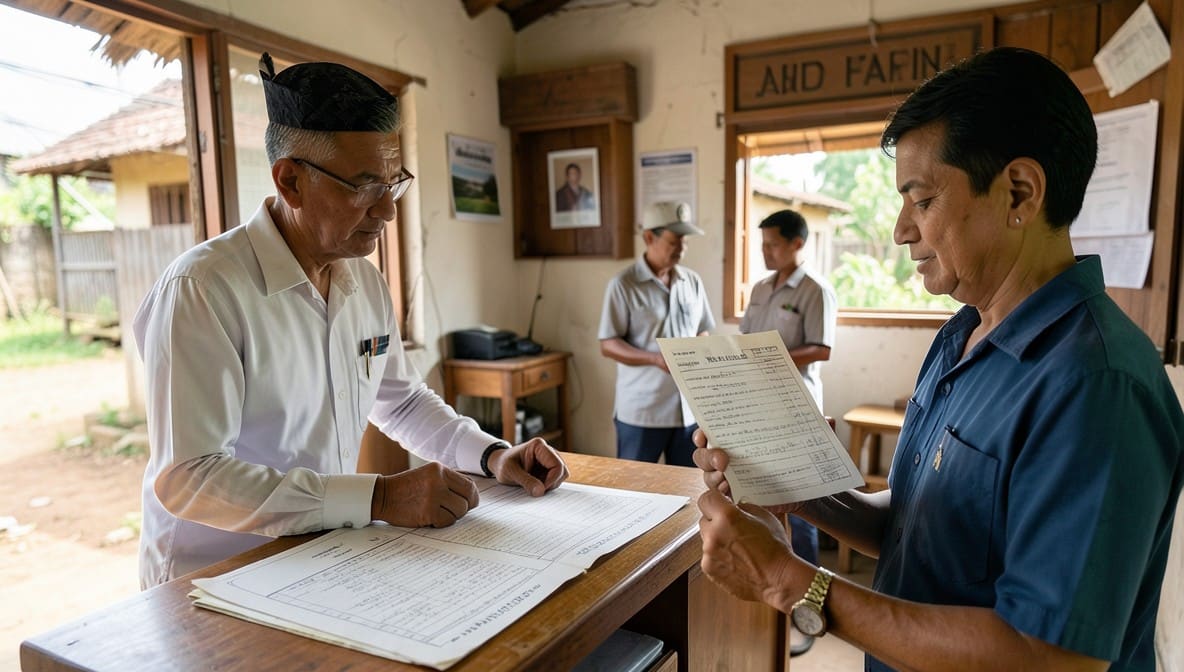
The Allahabad High Court has reaffirmed that even in summary revenue proceedings, the principles of natural justice are non-negotiable. The quashing of orders expunging a legal heir’s name from revenue records without notice or hearing underscores a critical safeguard against arbitrary state action in land administration.
Background & Facts
The Dispute
The dispute centers on the ownership and recording of Plot No. 1924, measuring 9.7130 hectares, in the revenue records of Tehsil Sadar, District Maharajganj. The land was originally held by Jangi, the father-in-law of the petitioner, Syed Shahabuddin. Upon Jangi’s death, his daughter Smt. Usha, the petitioner’s wife, inherited the land and was duly recorded as the bhumidhari tenure holder in the revenue records.
Key Facts
- The land was previously recorded in the name of the Seed Medication Farm, an agricultural department entity, as per a 1961 decision by the Land Acquisition Officer in Case No. 221/326.
- Smt. Usha’s name was entered in the Khatauni for Fasli Years 1413-1418 following a High Court order dated 20.02.2003, which directed the Registrar Kanoongo to implement the Collector’s order dated 23.12.2001 expunging the Seed Medication Farm’s entry.
- Smt. Usha died on 29.08.2009, leaving behind her husband, the petitioner, and two sons, who later became substituted petitioners by order dated 18.03.2026.
- After her death, the legal heirs sought mutation of their names in the revenue records.
- The Seed Medication Farm initiated proceedings under Section 33/39 of the U.P. Land Revenue Act, 1901, seeking to expunge Smt. Usha’s name.
- On 15.10.2012, the Sub-Divisional Officer (Respondent No. 3) passed an ex parte order expunging Smt. Usha’s name without notice to the legal heirs.
- The petitioner filed a revision before the Additional Commissioner (Respondent No. 2), which was dismissed on 28.02.2018 without addressing the core grievance of violation of natural justice.
- Concurrently, the Seed Medication Farm had filed a title declaration suit under Section 229-B of the U.P. Zamindari Abolition and Land Reforms Act, 1950 (Suit No. 131 of 2012), which was withdrawn on 18.10.2012.
Procedural History
- 13.12.1961: Land Acquisition Officer, Gorakhpur, records Seed Medication Farm as tenure holder in Arazi No. 237.
- 23.12.2001: Collector, Maharajganj, expunges Seed Medication Farm’s entry and records Smt. Usha’s name.
- 20.02.2003: High Court disposes of Writ Petition No. 8341 of 2003, directing Registrar Kanoongo to implement the 2001 order.
- 29.08.2009: Death of Smt. Usha.
- 15.10.2012: Sub-Divisional Officer expunges Smt. Usha’s name in proceedings under Section 33/39, without notice.
- 17.11.2012: Petitioner files revision before Additional Commissioner.
- 18.10.2012: Declaration suit (Suit No. 131 of 2012) filed by Seed Medication Farm is withdrawn.
- 28.02.2018: Additional Commissioner dismisses revision without addressing natural justice or merits.
- 16.04.2018: Writ Petition No. 16876 of 2018 filed before Allahabad High Court.
- 18.03.2026: Legal heirs of Smt. Usha substituted as petitioners.
- 12.06.2026: Judgment delivered by the High Court.
The Parties' Positions
Petitioner: Argued that the expungement order was ex parte, violated principles of natural justice, and was an abuse of process since a title suit had been withdrawn. Emphasized that Section 33/39 is for clerical correction, not title adjudication.
Respondents (State): Relied on Board of Revenue’s 1991 instruction in Ramashankar v. State, claiming that where entries are based on forged records, notice is not mandatory. Contended that the Seed Medication Farm’s original claim was valid and the 2001 order was erroneous.
Relief Sought
The petitioner sought quashing of the orders dated 15.10.2012 and 28.02.2018, restoration of Smt. Usha’s name in the revenue records, and direction to the Sub-Divisional Officer to pass a fresh order after providing a fair hearing.
The Legal Issue
The central question was whether Section 33/39 of the U.P. Land Revenue Act, 1901 permits the expungement of a long-standing revenue entry without affording notice and hearing to the affected party, particularly when the entry was previously validated by a High Court order.
Arguments Presented
For the Petitioner
The petitioner relied on the settled principle that Section 33/39 proceedings are limited to rectifying clerical or arithmetical errors, not determining title. He cited the High Court’s 2003 order, which had already validated Smt. Usha’s name, and argued that the 2012 order was an attempt to circumvent judicial finality. He emphasized that the absence of notice violated natural justice, a fundamental requirement under Article 14 and Article 21 of the Constitution. He further contended that the withdrawal of the title suit under Section 229-B rendered the subsequent revenue expungement unjust and legally unsustainable.
For the Respondent
The State relied on the Board of Revenue’s 1991 instruction in Ramashankar v. State, asserting that where an entry is based on a forged document, the revenue authority may act summarily without notice. It argued that the Seed Medication Farm’s original claim dated back to 1961 and that the 2001 order was erroneous. It maintained that the revisional authority was not obligated to re-examine the merits if the lower order was procedurally valid.
The Court's Analysis
The Court examined the nature of proceedings under Section 33/39 of the U.P. Land Revenue Act, 1901, noting that these are meant for correction of clerical mistakes, not adjudication of title. The Court observed that the entry of Smt. Usha’s name had been confirmed by a binding High Court order dated 20.02.2003, which had been implemented in the revenue records.
"The order dated 23.12.2001 was implemented pursuant to this Court’s direction, and the Khatauni was duly updated. To expunge such an entry without notice, especially after a judicial validation, amounts to an abuse of process."
The Court rejected the State’s reliance on the Board of Revenue’s 1991 instruction, holding that such administrative guidelines cannot override constitutional principles of natural justice. It emphasized that even in summary proceedings, the right to be heard is indispensable when rights to property are at stake.
The Court further noted that the revisional authority, Respondent No. 2, had completely ignored the petitioner’s specific ground of violation of natural justice. Instead of remanding the matter for a fresh hearing, the revisional order dismissed the appeal summarily, which was legally untenable.
The Court also highlighted the procedural inconsistency: the Seed Medication Farm had initiated a title suit under Section 229-B, which was withdrawn. A party cannot simultaneously litigate title in a civil court and seek to override it through summary revenue proceedings. The Court held that the withdrawal of the suit rendered the revenue expungement order legally baseless.
The Verdict
The writ petition is allowed. The orders dated 15.10.2012 and 28.02.2018 are quashed. The Sub-Divisional Officer is directed to pass a fresh order after providing a reasonable opportunity of hearing to all parties concerned, most expeditiously and preferably within three months from the date of presentation of the certified copy of this order. Till then, the status quo as on today shall be maintained. The legal heirs of Smt. Usha shall retain their current position in the revenue records pending the fresh order.
What This Means For Similar Cases
Natural Justice Is Non-Negotiable in Revenue Proceedings
- Practitioners must challenge any revenue order expunging a name without notice, regardless of whether the proceeding is labeled as summary.
- Administrative instructions cannot override constitutional guarantees under Article 14 and Article 21.
- Even if an entry appears erroneous, due process must precede its removal.
Title Disputes Cannot Be Settled Through Section 33/39
- Section 33/39 is not a substitute for a declaration suit under Section 229-B of the U.P.Z.A. & L.R. Act.
- If a party files a title suit and later withdraws it, they cannot rely on a parallel revenue proceeding to achieve the same result.
- Revenue authorities must decline to entertain expungement applications where title is genuinely disputed.
Revisional Authorities Must Address Grounds Raised
- Revisional courts cannot dismiss appeals on technical grounds while ignoring substantive allegations of natural justice violation.
- If a ground of procedural illegality is raised, the revisional authority must either correct it or remand the matter.
- Failure to do so renders the revisional order liable to be set aside.