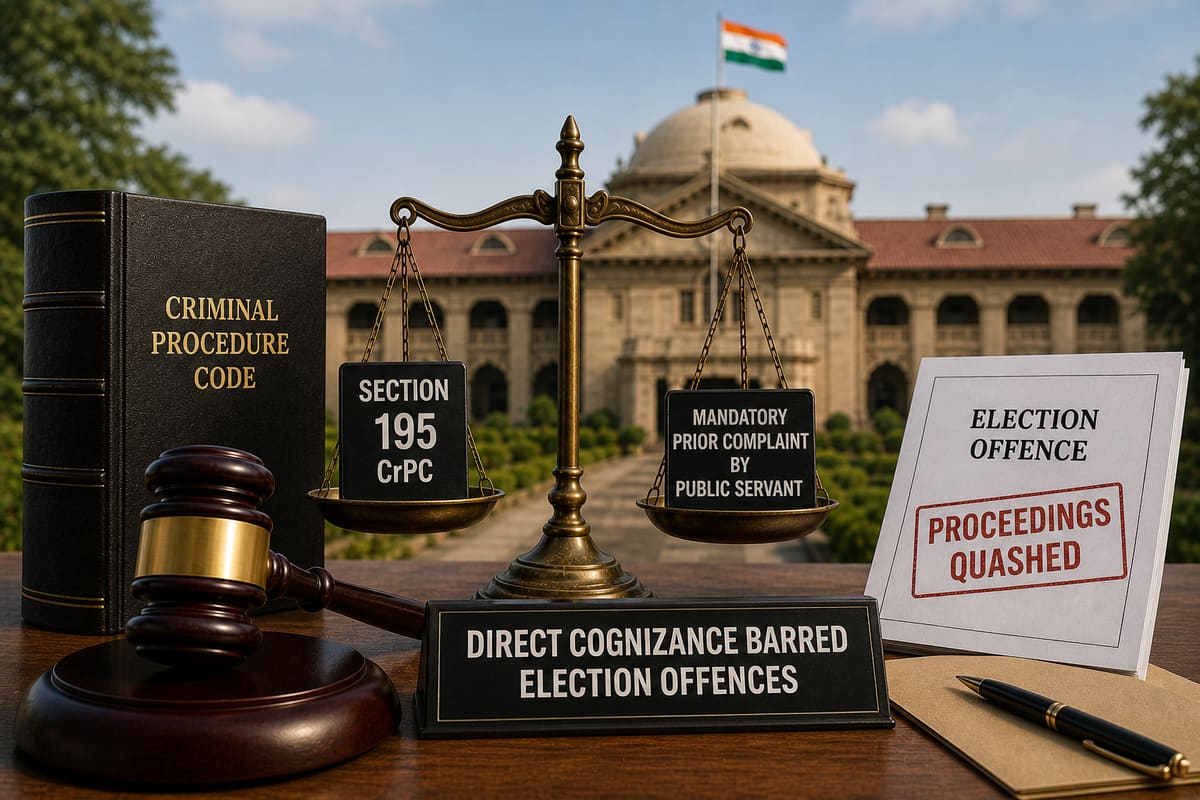
The Allahabad High Court has clarified that criminal proceedings for election-related offences under Sections 171H and 188 IPC cannot be initiated without a prior complaint under Section 195 CrPC. This ruling reinforces a long-standing procedural safeguard against arbitrary prosecution in electoral disputes, ensuring that only authorized complainants - typically election authorities - can trigger such cases.
Background & Facts
The Dispute
The applicant, Smt. Rajani Jatav, was named as an accused in Criminal Case No. 6011 of 2021, arising from Case Crime No. 740 of 2015 registered at Police Station Muradnagar, Ghaziabad. The case alleged violations of Sections 171H (undue influence at election) and 188 IPC (disobedience to order duly promulgated) in connection with a public election. The prosecution did not file a formal complaint under Section 195 CrPC, but instead initiated proceedings directly through a police report.
Key Facts
The alleged offences pertained to conduct during a local election for public representative
No complaint was filed by the Election Commission or any authorized officer under Section 195 CrPC
The case was registered as a regular FIR under Section 154 CrPC on 12.05.2015
Chargesheet was filed on 18.03.2021
Cognizance was taken by the ACJ (SD)/ACJM, Ghaziabad, on 07.12.2025
Discharge application under Section 239 CrPC was rejected on 15.05.2025
Criminal Revision No. 324 of 2025 was filed before the Sessions Judge, Ghaziabad, and dismissed on 23.01.2026
Procedural History
12.05.2015: FIR No. 740 of 2015 registered at PS Muradnagar
18.03.2021: Chargesheet filed in Criminal Case No. 6011 of 2021
07.12.2025: Cognizance and summoning order issued by ACJ (SD)/ACJM, Ghaziabad
15.05.2025: Discharge application under Section 239 CrPC rejected
23.01.2026: Sessions Judge affirmed the order in Criminal Revision No. 324 of 2025
2026: Application under Section 528 BNSS filed before Allahabad High Court seeking quashing
Relief Sought
The applicant sought quashing of all proceedings in Criminal Case No. 6011 of 2021, including the cognizance order dated 07.12.2025, the discharge rejection order dated 15.05.2025, and the Sessions Court’s order dated 23.01.2026, on the ground that the prosecution violated mandatory procedure under Section 195 CrPC.
The Legal Issue
The central question was whether Section 195 CrPC mandates a prior complaint by an authorized authority before a court can take cognizance of offences under Sections 171H and 188 IPC in the context of election-related misconduct.
Arguments Presented
For the Applicant
Learned counsel for the applicant relied on three co-ordinate Bench judgments of the Allahabad High Court: Ashutosh Verma v. State of U.P. (17.06.2022), Sukhiya Devi v. State of U.P. (15.10.2024), and Satya Narayan Rajbhar v. State of U.P. (24.07.2025). He argued that Sections 171H and 188 IPC are exclusively triable under Section 195 CrPC, which requires a written complaint from a competent authority - typically the Election Commission or its designated officer. Direct registration of FIR and initiation of proceedings by police without such complaint renders the entire prosecution void ab initio.
For the Respondent
The Additional Government Advocate did not dispute the applicability of Section 195 CrPC or the precedents cited. He conceded that the procedure prescribed under Section 195 CrPC was not followed but offered no legal justification for the deviation.
The Court's Analysis
The Court observed that the nature of offences under Sections 171H and 188 IPC, when committed in relation to elections, falls squarely within the ambit of Section 195 CrPC. This provision mandates that no court shall take cognizance of such offences except upon a complaint in writing made by the appropriate authority. The Court emphasized that this is not a mere procedural formality but a substantive statutory bar designed to prevent misuse of criminal process in politically sensitive contexts.
"The requirement of a prior complaint under Section 195 CrPC is mandatory and not directory. Any cognizance taken without such complaint is legally unsustainable and liable to be quashed."
The Court noted that the precedents cited by the applicant were directly on point and had been consistently applied by co-ordinate Benches. The State did not attempt to distinguish these judgments or argue against their binding nature. The Court held that the absence of a complaint under Section 195 CrPC rendered the entire chain of proceedings - from FIR to cognizance to discharge rejection - invalid.
The Verdict
The applicant succeeded. The Court quashed the entire proceedings in Criminal Case No. 6011 of 2021, including the cognizance order dated 07.12.2025, the discharge rejection order dated 15.05.2025, and the Sessions Court’s order dated 23.01.2026. All proceedings arising from Case Crime No. 740 of 2015 under Sections 171H and 188 IPC are hereby set aside. No costs were awarded.
What This Means For Similar Cases
Prior Complaint Is Non-Negotiable
Practitioners must verify whether any election-related charge under Sections 171H or 188 IPC was preceded by a written complaint under Section 195 CrPC
If no such complaint exists, a quashing petition under Section 482 CrPC or Section 528 BNSS is immediately maintainable
Police cannot initiate investigation or file chargesheets in such cases without prior authorization
Prosecution Cannot Rely on General FIRs
FIRs registered under Section 154 CrPC for election offences under Sections 171H/188 IPC are legally defective
Courts must reject cognizance orders in such cases at the earliest stage
Defence counsel should raise this as a preliminary objection before any evidence is recorded
Judicial Precedents Are Binding
Co-ordinate Bench rulings from the Allahabad High Court are binding unless overruled by a larger Bench
This judgment reinforces the principle that procedural mandates in CrPC are not optional
Practitioners should cite Ashutosh Verma, Sukhiya Devi, and Satya Narayan Rajbhar as controlling authority in all similar matters