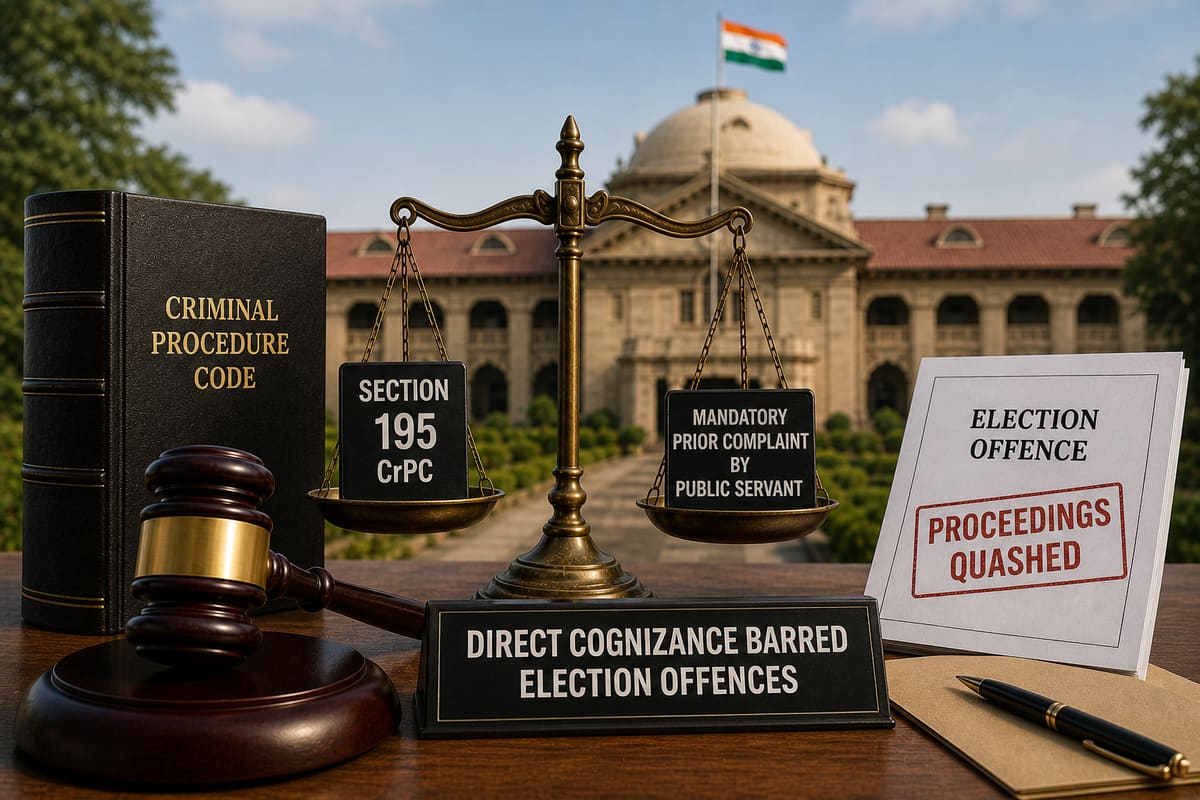
The Allahabad High Court has reaffirmed a foundational procedural safeguard in criminal law: cognizance cannot be taken against a public servant for offences allegedly committed in the discharge of official duties without prior sanction under Section 195(1)(a)(i) of the CrPC. This judgment clarifies the non-negotiable nature of this requirement and sets aside proceedings initiated in violation of this statutory bar.
Background & Facts
The Dispute
The applicants, including Zaid Ahmad @ Ahmad Zaid and three others, are accused in Criminal Case No. 4793 of 2024, arising from Case Crime No. 107 of 2023, registered at Police Station Tanda, District Ambedkar Nagar. The case involves allegations under Section 188 (disobedience to order duly promulgated by public servant) and Section 171-H (punishment for illegal canvassing) of the Indian Penal Code. The allegations stem from conduct during a local election, where the applicants are accused of obstructing a public servant in the performance of official duties.
Key Facts
- The alleged offence occurred on 15.02.2023 during the conduct of local body elections
- A complaint was lodged by a Returning Officer, a public servant under the Representation of the People Act, 1951
- The police registered Case Crime No. 107 of 2023 on 17.02.2023
- The complaint did not seek or obtain prior sanction from the competent authority under Section 195(1)(a)(i) CrPC
- The Magistrate took cognizance of the offence on 12.04.2024 and issued summoning orders to the applicants
- No application for sanction was filed before the Magistrate at any stage prior to cognizance
Procedural History
- 15.02.2023: Alleged incident during election duties
- 17.02.2023: FIR registered at P.S. Tanda, District Ambedkar Nagar
- 12.04.2024: Chief Judicial Magistrate, Ambedkar Nagar, took cognizance under Sections 188 and 171-H IPC and issued summoning orders
- 20.04.2024: Applicants filed Application U/s 482 CrPC before the High Court seeking quashing
- 15.05.2026: Hearing concluded before the Hon’ble Shree Prakash Singh, J.
The Parties' Positions
For the Applicants
The applicants contended that the Magistrate acted without jurisdiction by taking cognizance under Sections 188 and 171-H IPC without the mandatory prior sanction under Section 195(1)(a)(i) CrPC. They relied on settled judicial precedents holding that offences against public servants in the course of duty require sanction, and that failure to obtain it renders the entire proceeding void ab initio.
For the Respondent/State
The Additional Government Advocate conceded that no sanction had been obtained but argued that the nature of the offences did not strictly require sanction, and that the Magistrate had discretion to proceed. However, no legal authority or precedent was cited to support this contention.
Relief Sought
The applicants sought quashing of the summoning order dated 12.04.2024 and all subsequent proceedings in Criminal Case No. 4793 of 2024, on the ground that the cognizance was legally impermissible.
The Legal Issue
Whether the Magistrate could lawfully take cognizance of offences under Section 188 and Section 171-H of the Indian Penal Code against the applicants without prior sanction under Section 195(1)(a)(i) of the Code of Criminal Procedure.
Arguments Presented
For the Appellant/Petitioner
Learned counsel for the applicants relied on the settled legal position that Section 195(1)(a)(i) CrPC mandates prior sanction for initiating proceedings against a public servant for offences committed in the discharge of official duties. They cited State of Punjab v. Baldev Singh and Rajesh Kumar v. State of U.P. to establish that the requirement is mandatory and jurisdictional. They argued that Sections 188 and 171-H IPC are specifically designed to protect public servants in the exercise of their official functions, and therefore fall squarely within the ambit of Section 195(1)(a)(i). The absence of sanction, they submitted, rendered the cognizance and summoning order legally void.
For the Respondent/State
The Additional Government Advocate did not dispute that no sanction had been obtained. However, he contended that the offences were not directly connected to the discharge of official duties and that the Magistrate had the inherent power to proceed. He cited no case law or statutory provision to substantiate this argument, and failed to address the binding precedent on the mandatory nature of sanction under Section 195(1)(a)(i).
The Court's Analysis
The Court undertook a detailed review of the statutory framework under Section 195(1)(a)(i) CrPC, which provides: "No court shall take cognizance of any offence under Section 171-E, 171-F, 171-G, 171-H, 171-I or 188 of the Indian Penal Code, alleged to have been committed by a public servant in the discharge of his official duties, except upon a complaint in writing made by the public servant concerned or by some other public servant authorized in that behalf by the appropriate Government."
The Court observed that the allegations in the FIR clearly relate to conduct during the performance of election duties by a Returning Officer - a public servant under the Representation of the People Act, 1951. The offences of disobedience to lawful order (Section 188 IPC) and illegal canvassing (Section 171-H IPC) are explicitly listed in Section 195(1)(a)(i) CrPC as requiring prior sanction.
"The requirement of sanction under Section 195(1)(a)(i) CrPC is not a mere procedural formality; it is a substantive condition precedent to the exercise of jurisdiction by the Magistrate."
The Court emphasized that the language of the provision is unambiguous and has been consistently interpreted by the Supreme Court and High Courts as mandatory. The failure to obtain sanction before cognizance is not a curable defect - it vitiates the entire proceeding. The Court noted that the State’s counsel offered no counter-precedent and failed to refute the settled law.
The Court further held that the Magistrate’s failure to consider the applicability of Section 195(1)(a)(i) CrPC before taking cognizance amounted to a jurisdictional error. The summoning order, therefore, was legally unsustainable.
The Verdict
The application was allowed. The Court set aside the cognizance order and summoning order dated 12.04.2024 in Criminal Case No. 4793 of 2024. The matter was remanded to the Chief Judicial Magistrate, Ambedkar Nagar, to pass a fresh order within eight weeks from the date a certified copy of this judgment is produced before it. The Court directed that no fresh cognizance may be taken unless prior sanction under Section 195(1)(a)(i) CrPC is obtained.
What This Means For Similar Cases
Sanction Is Non-Negotiable in IPC Offences Against Public Servants
- Practitioners must verify whether any alleged offence against a public servant falls under Section 195(1)(a)(i) CrPC before filing a complaint or initiating proceedings
- Any cognizance taken without sanction is void ab initio and subject to quashing under Section 482 CrPC
- Courts must independently examine the applicability of Section 195(1)(a)(i) even if not raised by the accused
Procedural Defects Cannot Be Curated by Subsequent Sanction
- Obtaining sanction after cognizance does not validate the proceedings
- The sanction must precede cognizance - timing is jurisdictional, not procedural
- Applications under Section 482 CrPC remain viable remedies where this requirement is ignored
Election-Related Offences Are Not Exempt
- Offences under Sections 188 and 171-H IPC during elections are not treated as ordinary criminal matters
- The protection under Section 195(1)(a)(i) applies regardless of whether the public servant is a Returning Officer, Polling Officer, or Election Commissioner
- Prosecutors must secure sanction before approaching the Magistrate - failure to do so invites dismissal