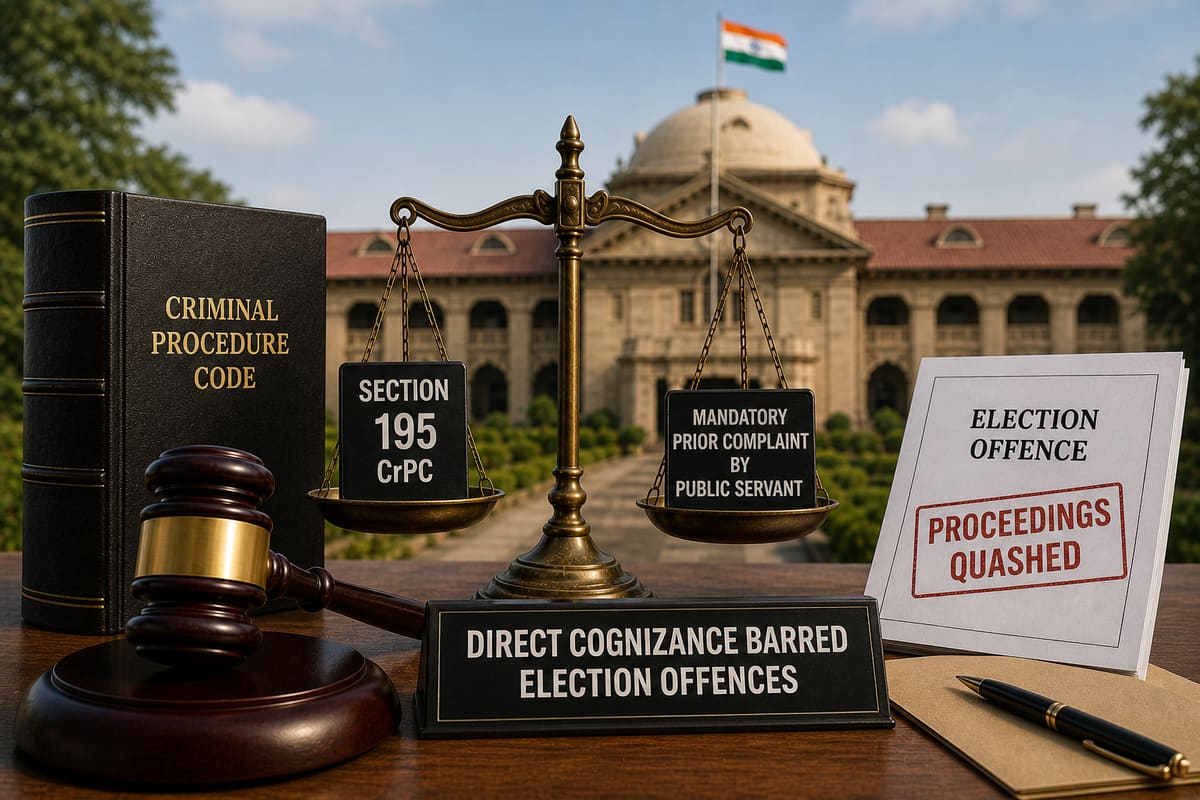
The Punjab and Haryana High Court has reaffirmed that criminal proceedings for false complaints against public servants cannot be initiated by subordinate police officers, regardless of the gravity of the allegations. This judgment clarifies a critical jurisdictional safeguard under Section 195 of the Code of Criminal Procedure, reinforcing that procedural compliance is not a formality but a mandatory precondition for prosecution.
Background & Facts
The Dispute
The petitioner, Vinod Kumar @ Akhtar, is a social worker who submitted multiple representations to state authorities alleging that a public official had fraudulently obtained employment under the OBC reservation quota. The petitioner attached documentary evidence and sought cancellation of the OBC certificate. After examination by the Welfare Department, no action was taken. The petitioner then escalated the matter to the Commissioner of Police, Ludhiana.
Procedural History
- 2017-2018: Petitioner filed representations with welfare authorities and later with the Commissioner of Police.
- 2018: Senior police officer conducted an inquiry and concluded the allegations were unsubstantiated and potentially defamatory toward a judicial officer.
- 2018: Based on this report, the Station House Officer (SHO) of P.S. Haibowal, Ludhiana, filed an impugned Qalandra under Section 66 of the Punjab Police Act, 2007 before the Judicial Magistrate First Class.
- 11.06.2018: The Magistrate issued notice to the petitioner without examining jurisdictional validity.
- 2018: Petitioner filed a petition under Section 482 Cr.P.C. seeking quashing of the proceedings.
Relief Sought
The petitioner sought quashing of the Qalandra and all consequential proceedings on grounds of jurisdictional defect under Section 195 Cr.P.C., lack of due process, and abuse of process.
The Legal Issue
The central question was whether a Station House Officer, who is administratively subordinate to the Commissioner of Police, may lawfully file a complaint under Section 66 of the Punjab Police Act, 2007 for false allegations originally made to a superior public servant, in light of the mandatory requirements of Section 195 Cr.P.C..
Arguments Presented
For the Petitioner
Learned counsel argued that Section 195 Cr.P.C. prohibits any court from taking cognizance of offences relating to public justice unless the complaint is made in writing by the public servant concerned or an officer administratively superior to him. Since the complaint was made to the Commissioner of Police, only he or his superior could initiate proceedings. The SHO, being subordinate, lacked authority. Counsel relied on P.D. Lakhani v. State of Punjab and Daulat Ram v. State of Punjab to establish that delegation of this function is impermissible. Further, the inquiry was conducted without affording the petitioner a hearing, and notice was served irregularly.
For the Respondent
The State contended that the SHO acted on lawful directions from higher authorities and that the complaint disclosed a prima facie case under Section 66 Punjab Police Act. It was argued that the SHO was a competent officer to file the Qalandra and that the petitioner had an alternative remedy before the trial court. The State also emphasized that the allegations were serious and affected public dignity, justifying prosecution.
The Court's Analysis
The Court undertook a rigorous statutory interpretation of Section 195 Cr.P.C., emphasizing its mandatory nature. The provision explicitly bars cognizance unless the complaint is filed by the public servant aggrieved or his administrative superior. The Court held that the legislative intent is to prevent lower-ranking officers from initiating prosecutions based on complaints made to higher authorities, thereby avoiding misuse and ensuring accountability.
"No complaint, therefore, could be lodged before the learned Magistrate by the Station House Officer. Even assuming that the same was done under the directions of Senior Superintendent of Police, Jallandhar, Section 195, in no uncertain terms, directs filing of an appropriate complaint petition only by the public servant concerned or his superior officer. It, therefore, cannot be done by an inferior officer."
The Court distinguished P.D. Lakhani as directly on point: the inquiry was conducted at the Commissioner’s level, making him the relevant public servant. The SHO, being subordinate, could not act as the complainant. The Magistrate’s mechanical issuance of notice without applying judicial mind to jurisdictional validity was condemned as a failure of due process.
The Court further observed that Section 195 Cr.P.C. is not a technicality but a structural safeguard to prevent private vendettas from hijacking the criminal justice system. The State’s argument that the allegations were serious was rejected as irrelevant to jurisdictional compliance. The Court noted that procedural mandates under Section 195 Cr.P.C. and its successor Section 215 BNSS are jurisdictional, not directory.
The Court also addressed the broader institutional failure, noting that such procedural lapses are common and erode public trust. It emphasized that the filing of a Qalandra under Section 195 Cr.P.C. is not a routine act but a sovereign duty requiring diligence and integrity.
The Verdict
The petitioner succeeded. The High Court quashed the impugned Qalandra and all consequential proceedings, holding that the initiation of prosecution by the SHO violated the mandatory jurisdictional bar under Section 195 Cr.P.C. The Court clarified that this quashing does not grant immunity to the petitioner but merely requires any future prosecution to comply with statutory procedure.
What This Means For Similar Cases
Prosecution Cannot Be Initiated by Subordinate Officers
- Practitioners must verify the hierarchy of the complainant before filing or opposing a complaint under Section 195 Cr.P.C.
- Any Qalandra filed by an officer inferior to the public servant to whom the original complaint was made is void ab initio.
- Courts must independently examine jurisdictional compliance at the cognizance stage - routine issuance of notice is impermissible.
Due Process in Inquiry Is Non-Negotiable
- Investigations leading to criminal complaints must afford the accused an opportunity to be heard, especially when allegations involve public interest.
- Failure to provide notice or hearing during inquiry renders subsequent prosecution vulnerable to quashing under Section 482 Cr.P.C.
- Courts may treat such procedural lapses as abuse of process, even if the underlying allegations are serious.
State Must Institutionalize Compliance
- Police departments must conduct mandatory training on Section 195 Cr.P.C. and Section 215 BNSS for all investigating officers.
- Senior officers must audit complaints filed under these provisions to prevent systemic non-compliance.
- Failure to comply may attract judicial censure or directions for departmental inquiry, as seen in this judgment.