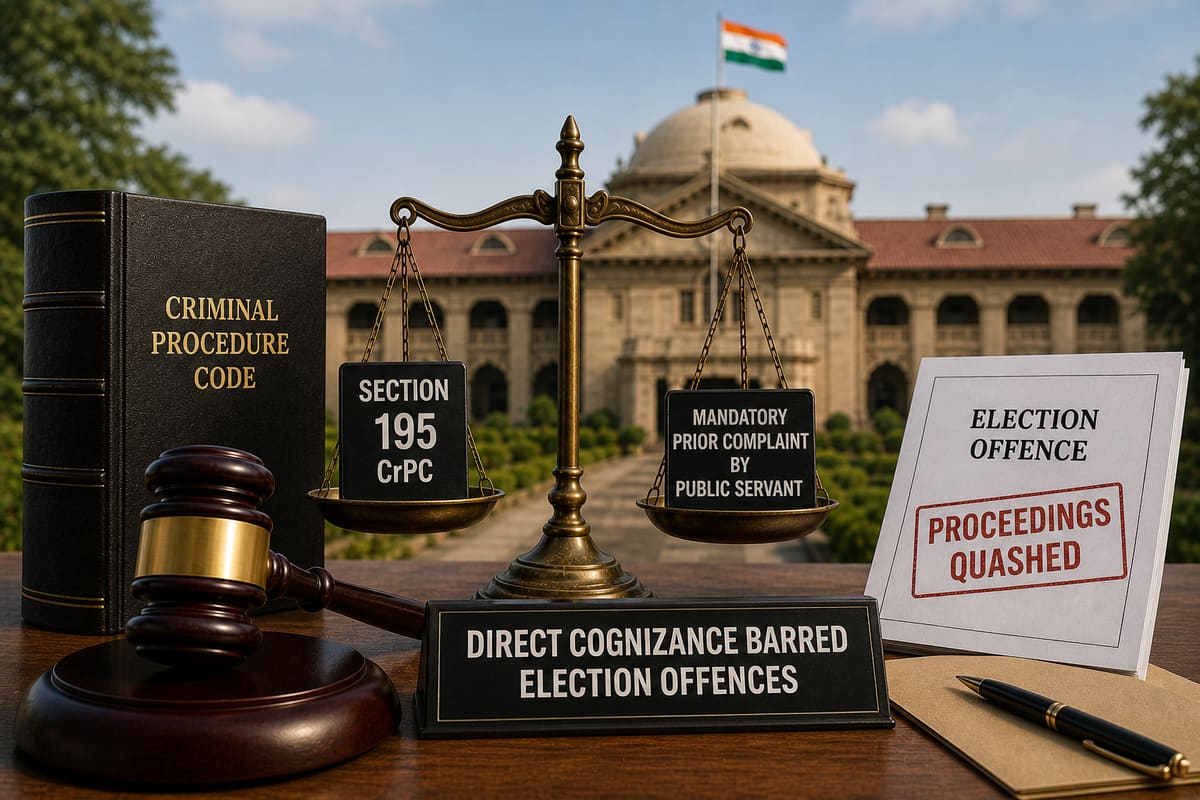
The Allahabad High Court has reaffirmed a foundational procedural safeguard in criminal jurisprudence: a Magistrate cannot initiate prosecution for false complaint under Section 182 CrPC unless a formal report is filed by the investigating officer. This ruling clarifies the non-negotiable role of Section 195 CrPC in curbing arbitrary prosecutions arising from retaliatory complaints.
Background & Facts
The Dispute
The present criminal revision arises from a complaint filed by Ali Iftekhar against the revisionist, Ejaj Ahmad, under Sections 419, 420, 467, 468, 471, and 120B IPC at Police Station Shahganj, District Jaunpur. The complaint alleged criminal conspiracy, forgery, and cheating in relation to a property dispute. The complainant sought criminal prosecution against the revisionist.
Key Facts
- The complaint was lodged on or before 15.06.2022, triggering investigation under Crime No. 268 of 2022
- On 12.08.2022, the complainant filed an application under Section 156(3) CrPC seeking direction for police investigation
- On 20.09.2022, the learned Chief Judicial Magistrate, Court No. 16, Jaunpur, directed the police to register an FIR and investigate the matter
- The Magistrate’s order of 20.09.2022 explicitly directed: "If the case is found to be false during investigation, the police shall proceed under Section 182 CrPC in accordance with law"
- The investigation concluded on 10.12.2025, with the Investigating Officer filing a Final Report (F.R.) stating that no offence was made out against the revisionist
- No report under Section 182 CrPC was filed by the police against the complainant, Ali Iftekhar
- On 05.01.2026, the revisionist filed an application before the Magistrate seeking initiation of proceedings against the complainant under Section 182 CrPC
- On 16.02.2026, the Magistrate rejected the application, holding that no police report under Section 182 CrPC had been submitted
- The revisionist filed Criminal Revision No. 2774 of 2026 before the High Court on 25.02.2026
Procedural History
- 15.06.2022: Complaint filed by Ali Iftekhar against Ejaj Ahmad
- 20.09.2022: Magistrate directs FIR registration and investigation under Section 156(3) CrPC; explicitly directs police to proceed under Section 182 CrPC if complaint is found false
- 10.12.2025: Investigating Officer files Final Report concluding no offence established
- 05.01.2026: Revisionist applies under Section 182 CrPC for prosecution of complainant
- 16.02.2026: Magistrate rejects application, citing absence of police report under Section 182 CrPC
- 25.02.2026: Criminal Revision filed before High Court
- 29.04.2026: High Court dismisses revision at admission stage
Relief Sought
The revisionist sought setting aside of the Magistrate’s order dated 16.02.2026 and direction to initiate proceedings against the complainant under Section 182 CrPC.
The Legal Issue
The central question was whether a Magistrate can initiate proceedings under Section 182 CrPC against a complainant for filing a false complaint in the absence of a formal report by the investigating officer, and whether the direction under Section 156(3) CrPC to proceed under Section 182 CrPC overrides the mandatory requirement under Section 195 CrPC.
Arguments Presented
For the Appellant/Petitioner
Learned counsel for the revisionist argued that the Magistrate’s order dated 20.09.2022 under Section 156(3) CrPC contained a clear directive to proceed under Section 182 CrPC if the complaint was found false. He contended that this direction created a binding obligation on the police and the Magistrate to act upon the finding of falsity. He relied on the principle of judicial consistency and argued that the Magistrate’s refusal to act after the Final Report was filed amounted to a failure to discharge a duty imposed by its own order.
For the Respondent/State
The Additional Government Advocate contended that Section 195 CrPC is a mandatory bar to taking cognizance of offences under Section 182 CrPC without a prior complaint in writing by the public servant or authority to whom the false information was given. He emphasized that Section 195 CrPC requires a formal report from the investigating officer to the Magistrate before any cognizance can be taken. He cited that the police, having filed a Final Report, were under no obligation to file a separate report under Section 182 CrPC unless they concluded the complaint was malicious and false, and even then, such a report is a prerequisite. He argued that the Magistrate’s earlier direction was merely advisory and did not create a legal duty to proceed without a report.
The Court's Analysis
The Court undertook a detailed examination of the interplay between Section 156(3), Section 182, and Section 195 CrPC. It observed that while Section 156(3) empowers a Magistrate to direct investigation, it does not confer power to bypass the procedural safeguards under Section 195 CrPC.
"No court shall take cognizance of an offence under Section 182 IPC except upon a complaint in writing by the public servant or authority to whom the false information was given, and such complaint must be preceded by a report from the investigating officer."
The Court held that the direction issued under Section 156(3) CrPC was a procedural observation, not a binding mandate to initiate prosecution. It clarified that Section 195 CrPC is a mandatory condition precedent to cognizance under Section 182 CrPC. The absence of a formal report from the Investigating Officer meant that the Magistrate was legally barred from taking cognizance, regardless of the earlier direction.
The Court further noted that the Investigating Officer, having concluded the case as unsubstantiated, was under no legal obligation to file a report under Section 182 CrPC unless he formed a prima facie opinion that the complaint was deliberately false and malicious. Even if such an opinion existed, the law requires a formal report to be submitted before cognizance can be taken.
The Court rejected the revisionist’s argument that the Magistrate’s earlier order created an estoppel or a duty to act. It emphasized that judicial orders must operate within the statutory framework, and no direction can override a mandatory provision of law.
The Verdict
The revision was dismissed at the admission stage. The Court held that the Magistrate correctly declined to proceed under Section 182 CrPC in the absence of a report from the Investigating Officer. No proceedings against the complainant could be initiated without compliance with Section 195 CrPC. The order dated 16.02.2026 was upheld as legally sound.
What This Means For Similar Cases
Police Report Is Mandatory for Section 182 CrPC Proceedings
- Practitioners must ensure that any application under Section 182 CrPC is supported by a formal report from the Investigating Officer
- Merely alleging falsity of a complaint is insufficient; a written report under Section 195 CrPC is indispensable
- Courts cannot rely on directions issued under Section 156(3) CrPC to bypass Section 195 CrPC
Judicial Directions Cannot Override Statutory Barriers
- Magistrates may issue observations or directions during investigation, but these cannot create legal obligations beyond statutory mandates
- Any attempt to initiate prosecution under Section 182 CrPC without a police report under Section 195 CrPC is void ab initio
- Defence counsel should immediately challenge cognizance orders under Section 182 CrPC where no report is produced
Strategic Implications for Defence Lawyers
- When a complaint is dismissed via Final Report, counsel should request the Investigating Officer to file a report under Section 182 CrPC if falsity is evident
- If the police refuse, a separate application under Section 200 CrPC may be filed before the Magistrate, but only after obtaining a written report from the police authority
- Failure to secure a Section 195-compliant report renders any subsequent prosecution liable to quashment