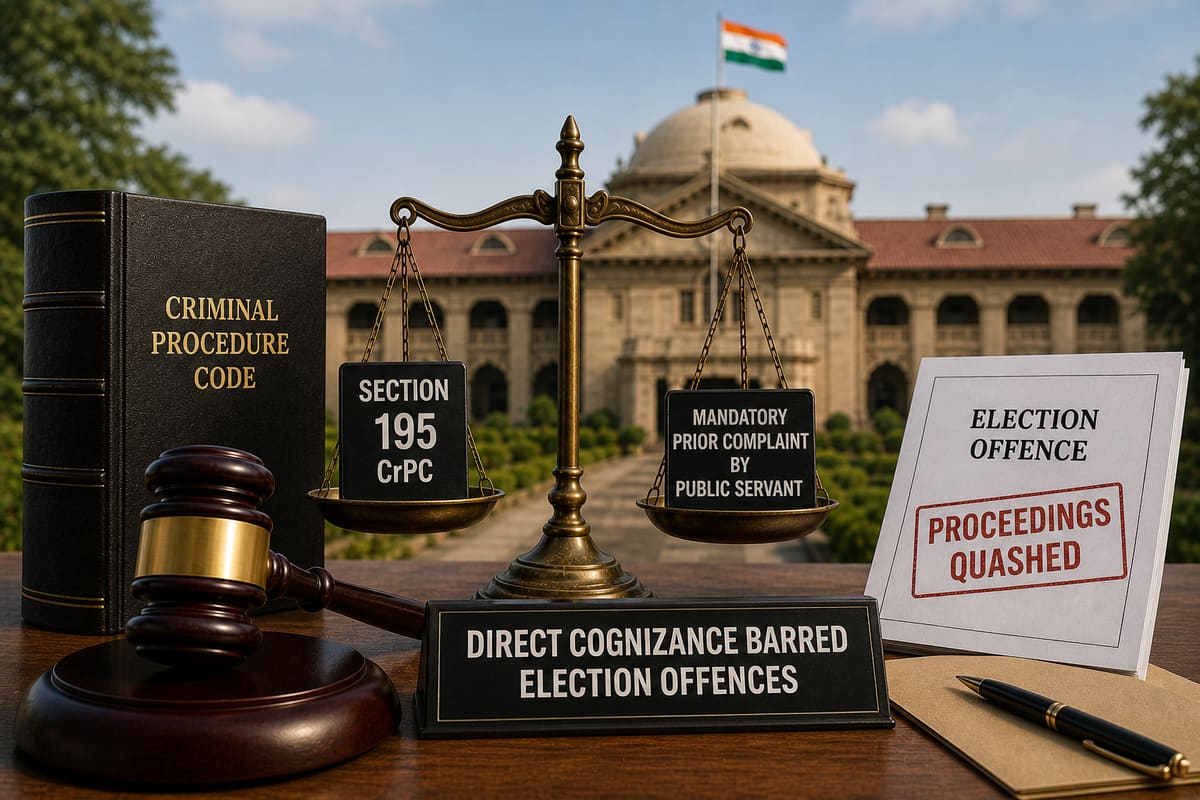
The Telangana High Court has clarified that criminal proceedings under Sections 186 and 187 of the Indian Penal Code cannot be initiated without a written complaint from the concerned public servant or his administrative superior, as mandated by Section 195(1)(a) of the Code of Criminal Procedure. This ruling, grounded in the principle of procedural legality, has led to the quashing of an entire criminal case where the complaint was filed by a police officer without satisfying this statutory requirement.
Background & Facts
The Dispute
The dispute arose from an alleged meeting organized by members of the Popular Front of India (PFI) in Jagtial, Telangana, on or about 15.07.2018. The de facto complainant, R. Prakash, an Inspector of Police, filed a complaint alleging that the accused persons, who were office bearers of PFI Jagtial, conspired to attack SFI students and the Hindu community, promote enmity between groups, and disturb public tranquility. The owner of the function hall allegedly refused to cooperate with public servants. Based on this complaint, Crime No. 189 of 2018 was registered at P.S. Jagtial Town. After investigation, a charge sheet was filed, and cognizance was taken by the Magistrate, resulting in C.C. No. 1123 of 2021.
Key Facts
- The de facto complainant, R. Prakash, is an Inspector of Police and a public servant under the meaning of Section 195(1)(a) CrPC.
- The charge sheet in C.C. No. 1123 of 2021 included charges under Sections 143, 153-A, 186, 187, 120-B read with 109 and 149 IPC.
- The complaint filed by the Inspector of Police was oral and not in writing, as required by law.
- The accused persons included 13 individuals, among them the petitioner, MD Salmanuddin, Accused No. 7.
- The prosecution did not produce any written complaint from the Inspector of Police or any superior public servant.
Procedural History
- 15.07.2018: De facto complainant (Inspector of Police) lodged complaint regarding PFI meeting.
- 18.07.2018: Crime No. 189 of 2018 registered at P.S. Jagtial Town.
- 2020: Investigation completed and charge sheet filed.
- 2021: Cognizance taken by I Additional Judicial First Class Magistrate, Jagtial; case numbered C.C. No. 1123 of 2021.
- 15.12.2024: Accused Nos. 1 to 9 and 11 to 13 filed Crl.P. No. 1337 of 2025 seeking quashing of proceedings.
- 31.01.2025: Telangana High Court, by order of Justice Juvvadi Sridevi, quashed proceedings against Accused Nos. 1 to 9 and 11 to 13 on grounds of non-compliance with Section 195 CrPC.
- 26.03.2026: Petitioner/ Accused No. 7 filed the present Crl.P. No. 4460 of 2026 seeking identical relief.
The Parties' Positions
For the Petitioner (Accused No. 7)
- Relied on the earlier order in Crl.P. No. 1337 of 2025, which quashed proceedings against co-accused on the ground that cognizance under Sections 186 and 187 IPC was invalid without a written complaint under Section 195(1)(a) CrPC.
- Argued that since the same transaction and same legal defect apply to him, he is entitled to the same relief.
- Emphasized that the complaint was filed by a police officer, who is a public servant, and no written complaint was submitted as required by law.
For the Respondent (State of Telangana)
- Did not oppose the petition.
- Did not contest the legal position that Section 195 CrPC mandates a written complaint for offences under Sections 186 and 187 IPC.
- Did not produce any written complaint or demonstrate compliance with statutory procedure.
Relief Sought
The petitioner sought quashing of C.C. No. 1123 of 2021 against him and stay of all further proceedings, including his appearance in court.
The Legal Issue
The central question was whether Section 195(1)(a) of the Code of Criminal Procedure requires a written complaint by a public servant or his superior for initiating prosecution under Sections 186 and 187 of the Indian Penal Code, and whether the absence of such a complaint vitiates the entire criminal proceeding, including allied charges under Sections 143, 153-A, 120-B, and 149 IPC.
Arguments Presented
For the Appellant/Petitioner
The petitioner relied on the precedent set in State of Karnataka v. Hemareddy (2021) 1 SCC 727, where the Supreme Court held that when offences under Section 195 CrPC and other offences form part of the same transaction, the prosecution cannot be split. The petitioner argued that since the cognizance for Sections 186 and 187 IPC was illegal due to lack of written complaint, the entire case, including charges under Sections 143, 153-A, 120-B, and 149 IPC, must be quashed as an abuse of process. He further submitted that the de facto complainant, being a police officer, was a public servant under Section 195 CrPC, and his oral complaint could not substitute the mandatory written complaint.
For the Respondent/State
The State did not oppose the petition. No counter-arguments were presented. The Additional Public Prosecutor conceded the legal position and did not dispute the applicability of Hemareddy or the non-compliance with Section 195 CrPC.
The Court's Analysis
The Court examined the statutory mandate under Section 195(1)(a) CrPC, which explicitly bars any court from taking cognizance of offences under Sections 172 to 188 IPC (including 186 and 187) except on a written complaint by the public servant concerned or his administrative superior. The Court noted that the de facto complainant, R. Prakash, was an Inspector of Police - a public servant under the definition in Section 21 IPC - and therefore, the statutory condition was triggered.
"No Court shall take cognizance... of any offence punishable under sections 172 to 188... except on the complaint in writing of the public servant concerned or of some other public servant to whom he is administratively subordinate."
The Court held that the absence of a written complaint rendered the cognizance taken under Sections 186 and 187 IPC legally invalid. The Court then applied the principle laid down in State of Karnataka v. Hemareddy, which states that when offences under Section 195 CrPC and other offences arise from the same transaction, the prosecution cannot be severed. The Court observed:
"It is not possible to split up and hold that the prosecution of the accused for the offences not mentioned in Section 195(1)(b) of the Code of Criminal Procedure should be upheld."
The Court concluded that allowing the proceedings to continue on other charges would amount to an abuse of the process of law, as the entire case originated from an illegal cognizance. The Court emphasized that procedural safeguards under Section 195 CrPC are not mere technicalities but essential to prevent misuse of criminal process against individuals by public servants acting without due process.
The Verdict
The petition was allowed. The High Court quashed all proceedings against the petitioner, MD Salmanuddin, Accused No. 7, in C.C. No. 1123 of 2021 before the I Additional Judicial First Class Magistrate, Jagtial. All pending applications in the case were closed. The order of quashing is final and binding.
What This Means For Similar Cases
Written Complaint Is Non-Negotiable for Sections 186 and 187 IPC
- Practitioners must verify whether the complaint in any case involving Sections 186 or 187 IPC is in writing and issued by the public servant concerned or his superior.
- Oral complaints, even if recorded in FIR, are legally insufficient and render cognizance void.
- Any prosecution initiated without this compliance is liable to be quashed at any stage, even after charge sheet filing.
Allied Charges May Be Quashed Under Same Transaction Doctrine
- When charges under Section 195 CrPC are linked to other offences (e.g., 143, 149, 120-B IPC) arising from the same incident, the entire case may be quashed if the Section 195 violation is established.
- Courts will not permit splitting of prosecution to save some charges while invalidating others - the transaction must be treated as a whole.
- This applies even if the accused are charged with serious offences like criminal conspiracy or promoting enmity.
Police Officers Are Not Exempt from Section 195 Requirements
- Police officers are public servants under Section 21 IPC and are subject to the same restrictions.
- FIRs filed by police officers cannot substitute the mandatory written complaint under Section 195 CrPC.
- Prosecutors must ensure compliance before filing charge sheets; failure will result in dismissal of the case.