Topic

cognizance

Cognizance in Indian criminal law refers to the formal recognition by a magistrate that an offence has been committed, triggering judicial proceedings under Sections 190 CrPC or equivalent provisions in BNSS.

39 articlesLatest 2 weeks ago
Special Judge Loses Cognizance Jurisdiction Once Charge-Sheet Omits PC Act Offences; Transferee Magistrate Must Pass Fresh BNSS Remand Orders : Bombay HC
Case Law Analysis

Special Judge Loses Cognizance Jurisdiction Once Charge-Sheet Omits PC Act Offences; Transferee Magistrate Must Pass Fresh BNSS Remand Orders : Bombay HC

Bombay HC held that a Special Judge under the PC Act loses cognizance jurisdiction once the charge-sheet omits corruption offences. The transferee magistrate must pass fresh cognizance and remand orders under the BNSS; failure renders detention illegal. Two accused were released where the CBI charge-sheet dropped PC Act charges but the Special Judge retained the file without valid BNSS remand orders.

Prior sanction essential for cognizance under Sec 19 PC Act (Amend.) 2018; amendment applies only prospectively | Delhi HC
Case Law Analysis
|Delhi High Court

Prior sanction essential for cognizance under Sec 19 PC Act (Amend.) 2018; amendment applies only prospectively | Delhi HC

The Delhi High Court held that Section 19 of the Prevention of Corruption Act (Amendment) 2018 makes prior governmental sanction a pre-condition for taking cognizance, and that the amendment operates only prospectively, leaving cases where cognizance was taken before 26 July 2018 untouched. This confines the amendment’s effect to pending and future prosecutions of public servants.

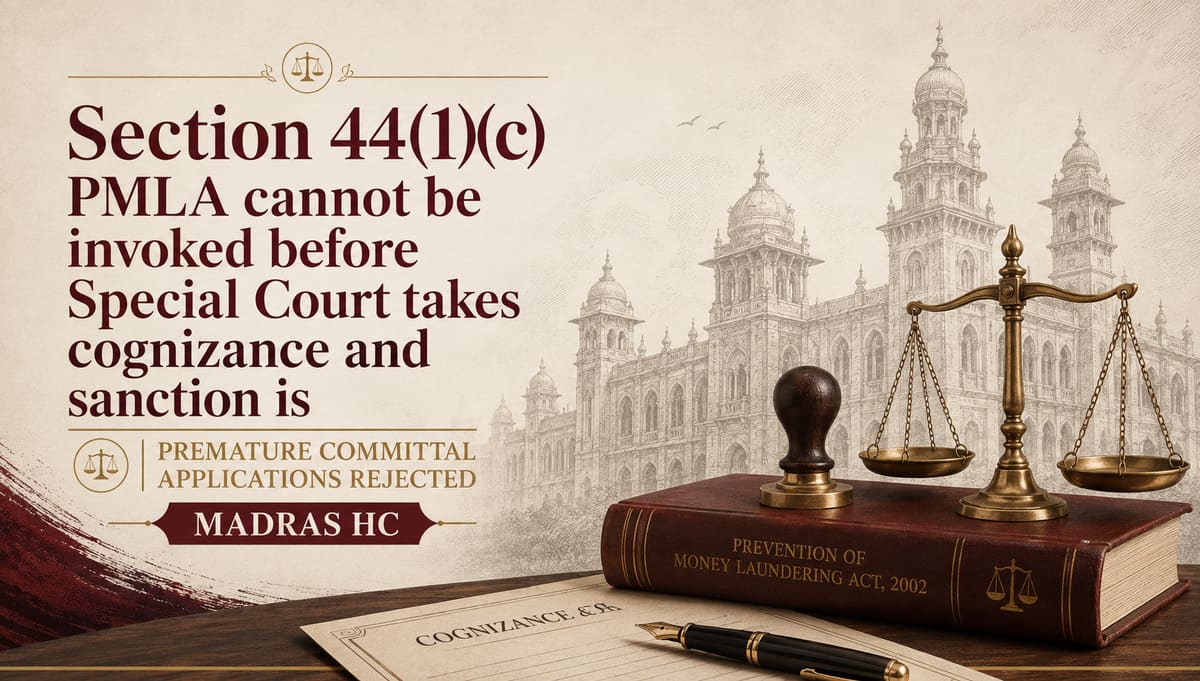
Section 44(1)(c) PMLA cannot be invoked before Special Court takes cognizance and sanction is produced | Premature committal applications rejected : Madras HC
Case Law Analysis
|Madras High Court

Section 44(1)(c) PMLA cannot be invoked before Special Court takes cognizance and sanction is produced | Premature committal applications rejected : Madras HC

The Madras High Court ruled that a Directorate of Enforcement committal petition under Section 44(1)(c) of the PMLA is invalid if filed before the Special Court has taken cognizance and the requisite sanction is produced. This bars premature transfers of DA cases to Special Courts, affecting enforcement agencies and the accused.

Section 223(1) BNSS | Accused Must Be Heard Before Cognizance in SEBI Special Courts: Bombay HC
Case Law Analysis
|Bombay High Court

Section 223(1) BNSS | Accused Must Be Heard Before Cognizance in SEBI Special Courts: Bombay HC

The Bombay High Court has ruled that Special Courts under the SEBI Act cannot take cognizance of offences without first affording the accused an opportunity to be heard, as mandated by the first proviso to Section 223 of the BNSS 2023. This sets a critical procedural safeguard for financial defendants, ensuring fair trial rights are not bypassed even in regulatory prosecutions.

Section 190 CrPC | Magistrate Must Examine Police 'B' Report Before Cognizance on Protest Petition: Karnataka HC
Case Law Analysis
|Karnataka High Court

Section 190 CrPC | Magistrate Must Examine Police 'B' Report Before Cognizance on Protest Petition: Karnataka HC

The Karnataka High Court ruled that a Magistrate cannot take cognizance of a protest petition without first examining the police 'B' report, reinforcing the principle of natural justice in criminal proceedings. This judgment mandates judicial scrutiny of closure reports before accepting complaints, impacting procedural fairness in criminal trials.

Section 208 BNSS | Dowry Offences with Partial Domestic Acts Triable in India Without Sanction: Karnataka HC
Case Law Analysis
|Karnataka High Court

Section 208 BNSS | Dowry Offences with Partial Domestic Acts Triable in India Without Sanction: Karnataka HC

Karnataka High Court rules that dowry-related offences under BNSS and Dowry Prohibition Act can be tried in India if any part-such as demand or seizure-occurs domestically, even if harassment occurred abroad. The court clarified that prior sanction under Section 208 BNSS is not required at the cognizance stage, expanding jurisdiction for victims of transnational dowry cases.

Section 190 CrPC | Cognizance Limited to Charge-Sheeted Offences; No Judicial Addition of IPC Sections at Summoning Stage : Allahabad HC
Case Law Analysis
|Allahabad High Court

Section 190 CrPC | Cognizance Limited to Charge-Sheeted Offences; No Judicial Addition of IPC Sections at Summoning Stage : Allahabad HC

Allahabad High Court rules that courts cannot take cognizance of offences not included in the charge-sheet, reinforcing the statutory limitation under Section 190 CrPC. The judgment quashes summoning orders for uncharged IPC sections, safeguarding fair trial rights and preventing judicial overreach at the pre-trial stage.

Section 190 CrPC | Magistrate Cannot Alter Charges at Cognizance Stage Under Prevention of Corruption Act : Allahabad HC
Case Law Analysis
|Allahabad High Court

Section 190 CrPC | Magistrate Cannot Alter Charges at Cognizance Stage Under Prevention of Corruption Act : Allahabad HC

Allahabad High Court quashed a cognizance order where the Magistrate unilaterally altered charges under the Prevention of Corruption Act, violating the principle that charges must mirror the FIR. The ruling reinforces procedural fairness, mandating that trial courts strictly adhere to the charge-sheeted offences at the cognizance stage.

Section 204 CrPC | Mechanical Cognizance Orders on Proforma Invalid Without Judicial Reasoning : Allahabad HC
Case Law Analysis
|Allahabad High Court

Section 204 CrPC | Mechanical Cognizance Orders on Proforma Invalid Without Judicial Reasoning : Allahabad HC

The Allahabad High Court has held that magistrates cannot issue summoning or cognizance orders by merely filling blanks on printed proformas. The law demands a reasoned application of judicial mind to establish a prima facie case, ensuring procedural fairness and preventing arbitrary prosecution. This ruling binds all trial courts in Uttar Pradesh and reinforces the constitutional right to a fair hearing at the earliest stage of criminal proceedings.