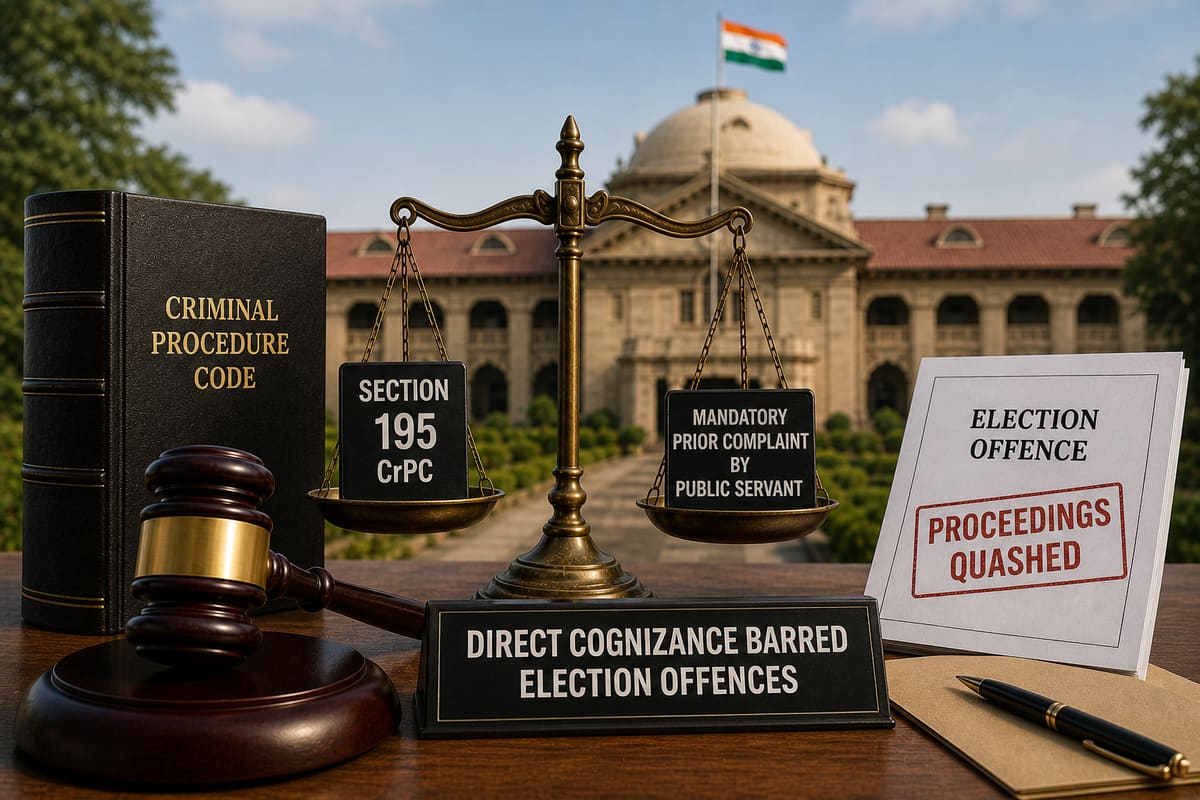
The Allahabad High Court has clarified that cognizance of an offence under Section 188 IPC cannot be taken on a police report, reinforcing the mandatory requirement of a written complaint by a public servant under Section 195(1)(a)(i) CrPC. This ruling underscores the procedural safeguards against arbitrary prosecution for public order offences.
Background & Facts
The Dispute
The applicants, including Iqbal Ahmad and eight others, are accused in connection with an alleged gathering on 23.05.2024 near the village of Dikauli, District Shrawasti, Uttar Pradesh. The incident occurred during the Lok Sabha General Elections 2024, when prohibitory orders under Section 144 CrPC were in force. The State alleged that approximately 100 persons, including the applicants, assembled illegally in a public place, thereby violating Section 188 IPC for disobedience to a lawful order.
Key Facts
- The alleged gathering took place on 23.05.2024 at 18:30 hours
- An FIR was registered on 25.04.2024 at 18:42 hours under Crime No. 108/2024 at Police Station Sonwa
- The FIR named the applicants and others as participants in an unlawful assembly
- The charge sheet (No. 1) was filed on 19.07.2024 under Section 188 IPC
- The Magistrate took cognizance and issued summons on 09.01.2026 in Criminal Case No. 81/2026
- The applicants claim the gathering was a peaceful procession, not an unlawful assembly
- The applicants assert that no public servant filed a written complaint as required under Section 195 CrPC
Procedural History
- 23.05.2024: Alleged incident occurred
- 25.04.2024: FIR registered (date appears inconsistent with incident date)
- 19.07.2024: Charge sheet filed by police under Section 173(2) CrPC
- 09.01.2026: Magistrate took cognizance and issued summons based on the charge sheet
- 10.07.2025: Investigating Officer filed an application before the Additional Chief Judicial Magistrate seeking to treat the matter as a complaint
- 20.05.2026: Application under Section 482 CrPC filed before the Allahabad High Court (Lucknow Bench)
The Parties' Positions
The applicants contend that the prosecution is legally defective because:
- No written complaint was made by a public servant as mandated by Section 195(1)(a)(i) CrPC
- The Magistrate took cognizance solely on the police charge sheet, which is not a complaint under Section 2(d) CrPC
- The offence under Section 188 IPC requires proof of actual obstruction, annoyance, or injury, which is absent
The State, through the Additional Government Advocate, argues that:
- The Investigating Officer filed an application on 10.07.2025 seeking to convert the matter into a complaint
- The summons order explicitly records that a complaint was presented before the Magistrate
- The Magistrate proceeded under Section 200 CrPC after receiving the complaint
Relief Sought
The applicants seek:
- Quashing of the charge sheet dated 19.07.2024
- Setting aside of the cognizance and summoning order dated 09.01.2026
- Stay of all further proceedings in Criminal Case No. 81/2026
The Legal Issue
Can a Magistrate take cognizance of an offence under Section 188 IPC based on a police charge sheet filed under Section 173(2) CrPC, or is a written complaint by a public servant under Section 195(1)(a)(i) CrPC mandatory?
Arguments Presented
For the Appellant/Petitioner
Learned counsel for the applicants relied on Subroto Paul v. State of U.P. and Ajay Rai v. State of U.P. to argue that Section 195 CrPC is mandatory and non-derogable. They emphasized that Section 2(d) CrPC explicitly excludes police reports from the definition of "complaint." They cited Umashankar Yadav v. State of U.P. to assert that cognizance taken on a police report in offences under Sections 178 to 188 IPC is void ab initio. They further contended that mere violation of Section 144 CrPC does not automatically constitute an offence under Section 188 IPC, which requires proof of obstruction, annoyance, or injury.
For the Respondent/State
The Additional Government Advocate submitted that the Investigating Officer’s application dated 10.07.2025 effectively functioned as a complaint. He argued that the Magistrate’s summons order explicitly noted the receipt of a complaint and that the procedural defect, if any, had been cured. He relied on the fact that the Magistrate recorded compliance with Section 200 CrPC, indicating that the matter was treated as a complaint, not a police report.
The Court's Analysis
The Court examined the interplay between Section 195(1)(a)(i) CrPC and Section 2(d) CrPC. It noted that Section 195 mandates that no court shall take cognizance of an offence under Section 188 IPC except upon a written complaint by a public servant. Section 2(d) CrPC defines "complaint" as an allegation made to a Magistrate, explicitly excluding a police report.
"Section 2(d) Cr.P.C. provides that the complaint means any allegation made orally or in writing to a Magistrate, with a view to his taking action under this Code, but does not include a police report."
The Court observed that the charge sheet filed on 19.07.2024 was a police report under Section 173(2) CrPC and could not, by itself, serve as the basis for cognizance. However, the Court noted the application dated 10.07.2025, filed by the Investigating Officer, which explicitly requested the Magistrate to treat the matter as a complaint. The Magistrate, in the summoning order, recorded that a complaint had been presented and proceeded under Section 200 CrPC.
The Court held that this application, though filed by the Investigating Officer, was presented to the Magistrate as a complaint and was accepted as such. The Magistrate’s explicit reference to the complaint and compliance with Section 200 CrPC cured any procedural irregularity. The Court emphasized that Section 482 CrPC is not a forum for re-evaluating evidence or conducting a mini-trial. The factual dispute regarding whether the gathering constituted an offence under Section 188 IPC must be resolved at trial.
The Verdict
The application under Section 482 CrPC was rejected. The Court held that the cognizance taken by the Magistrate was valid, as it was based on a complaint filed by the Investigating Officer on 10.07.2025, which satisfied the requirements of Section 195(1)(a)(i) and Section 2(d) CrPC. The proceedings in Criminal Case No. 81/2026 shall continue. No stay was granted. The applicants are not entitled to quashment of the charge sheet or summoning order.
What This Means For Similar Cases
Written Complaint Is Non-Negotiable for Section 188 IPC Cases
- Practitioners must verify whether a written complaint by a public servant was filed before cognizance is taken
- Police reports alone cannot initiate proceedings under Sections 178 - 188 IPC
- Any attempt to bypass Section 195 CrPC renders proceedings void
Post-Filing Complaints Can Cure Procedural Defects
- If a police report is initially filed, but a formal complaint is later submitted to the Magistrate and accepted, the defect may be cured
- The Magistrate’s explicit recording of the complaint and compliance with Section 200 CrPC is critical
- Practitioners should scrutinize the Magistrate’s order for language indicating receipt of a complaint, not a charge sheet
Section 482 CrPC Is Not a Trial Forum
- Courts will not interfere under Section 482 to assess the truth of allegations or weigh evidence
- Challenges based on factual disputes must be raised during trial
- Applications under Section 482 are viable only for clear legal defects, not contested facts