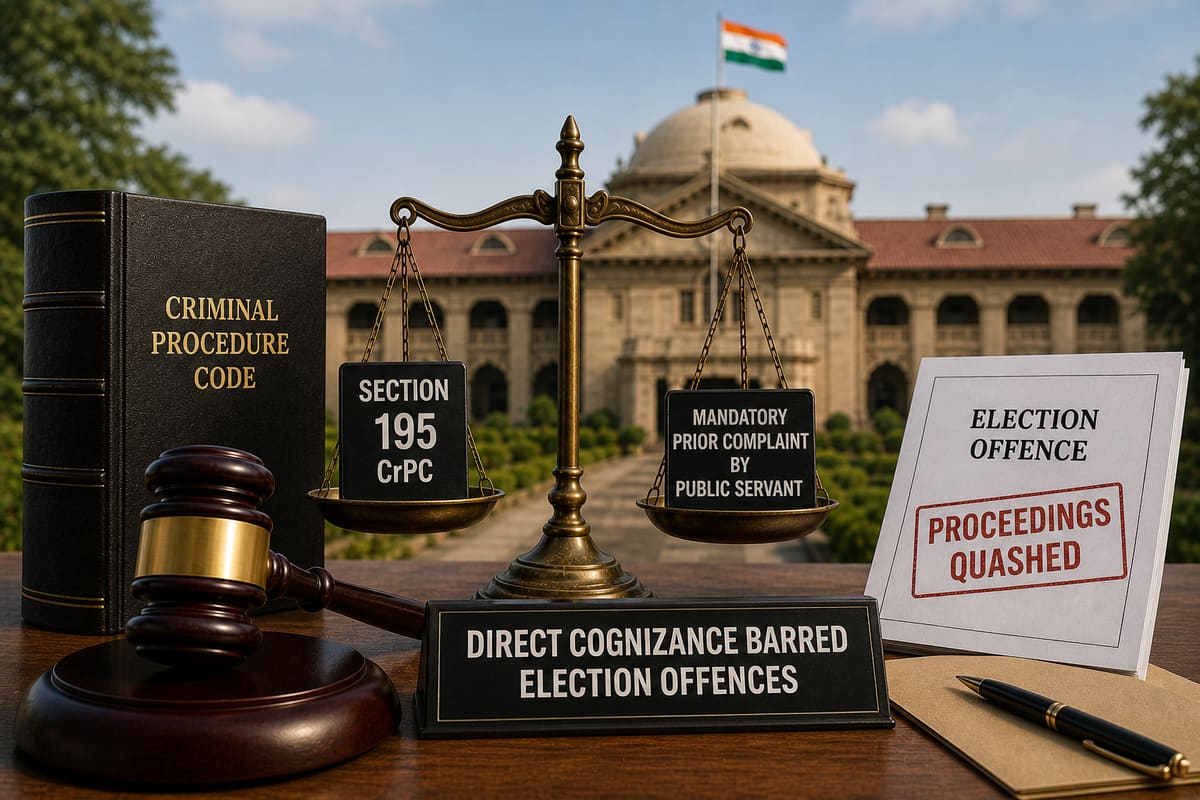
The Calcutta High Court has delivered a decisive clarification on the procedural prerequisites for initiating prosecution under Section 188 IPC, holding that police-initiated proceedings without a written complaint from the concerned public servant are legally void. This ruling reinforces the non-negotiable nature of Section 195(1)(a) of the CrPC and aligns with recent Supreme Court directives on the sufficiency of charge sheets.
Background & Facts
The Dispute
The petitioner, a government contractor, was named in a criminal case under Section 188/506 IPC following allegations that he violated a High Court stay order by continuing road widening work. The complainants, shopkeepers adjacent to the road, claimed the petitioner threatened them to vacate government land. However, the petitioner asserted he was merely executing a valid work order issued by the Public Works Department (PWD) on 25.11.2020 and had no authority to act beyond its scope.
Procedural History
- 15.03.2022: PWD issued notice for road widening.
- 12.05.2022: High Court stayed the operation of the PWD notice (WPA 8517 of 2022).
- 07.06.2022: Complainants filed WPA 10091 of 2022, making no mention of the petitioner.
- 16.03.2023: High Court dismissed a contempt application against the petitioner based on identical allegations.
- 31.03.2023: Police filed charge sheet under Section 188/506 IPC without any written complaint from PWD.
- 21.09.2023: Trial Court took cognizance based solely on police report.
Relief Sought
The petitioner sought quashing of the entire criminal proceeding on grounds of abuse of process, non-compliance with Section 195(1)(a) CrPC, and absence of any prima facie offence under Sections 188 or 506 IPC.
The Legal Issue
The central question was whether Section 195(1)(a) of the CrPC permits a court to take cognizance of an offence under Section 188 IPC based on a police report, or whether a written complaint by the public servant concerned is an absolute precondition.
Arguments Presented
For the Petitioner
The petitioner’s counsel argued that Section 195(1)(a) CrPC mandates that cognizance of offences under Sections 172 to 188 IPC can only be taken upon a written complaint by the public servant affected or his administrative superior. They emphasized that the PWD authority never filed such a complaint, and the police report was legally incompetent to trigger proceedings. Further, they cited Sharif Ahmed v. State of U.P. to highlight the charge sheet’s failure to specify the petitioner’s role or material evidence, rendering it legally defective.
For the Respondent
The State did not contest the legal position but left the matter to the Court’s discretion, offering no substantive defence of the charge sheet’s validity or the cognizance order’s legality.
The Court's Analysis
The Court undertook a rigorous analysis of Section 195(1)(a) CrPC, noting its mandatory nature and the legislative intent to prevent misuse of criminal process against public servants’ lawful actions. The Court observed that the High Court’s stay order dated 12.05.2022 restrained only the PWD notice, not the underlying work order under which the petitioner operated. Thus, no violation of court order occurred.
"The allegation made in the FIR has been negated by the High Court in its order dated 16.03.2023 in connection with aforesaid contempt application."
The Court further held that the charge sheet was legally unsustainable under Sharif Ahmed v. State of U.P. (2024 LiveLaw SC 337), as it failed to delineate the petitioner’s specific role, omitted material evidence, and did not establish a prima facie case. Regarding Section 506 IPC, the Court found no allegation of threat with intent to cause alarm or compel unlawful action - essential ingredients for the offence. The absence of a written complaint by the PWD rendered the cognizance order void ab initio.
The Verdict
The petitioner succeeded. The Calcutta High Court quashed the entire criminal proceeding under Section 188/506 IPC, holding that cognizance taken on a police report without a written complaint under Section 195(1)(a) CrPC is illegal, and the charge sheet failed to establish any offence under either provision.
What This Means For Similar Cases
Written Complaint Is Mandatory for Section 188 IPC Cases
- Practitioners must verify whether a written complaint from the public servant or his superior exists before filing or defending any charge sheet under Section 188 IPC.
- Any cognizance order based on FIR or police report alone is void and subject to immediate quashing.
Charge Sheets Must Meet Sharif Ahmed Standards
- Every charge sheet must clearly state: (a) the specific act attributed to each accused, (b) the material evidence supporting each allegation, and (c) the legal ingredients satisfied.
- Vague, boilerplate charge sheets will be rejected as non-compliant with the Supreme Court’s directive in Sharif Ahmed.
No Offence Under Section 506 Without Threat to Cause Alarm
- Section 506 IPC requires proof of threat with intent to cause alarm and compel unlawful conduct.
- Mere presence during official work or verbal exchanges without explicit threats cannot sustain a charge under this section.