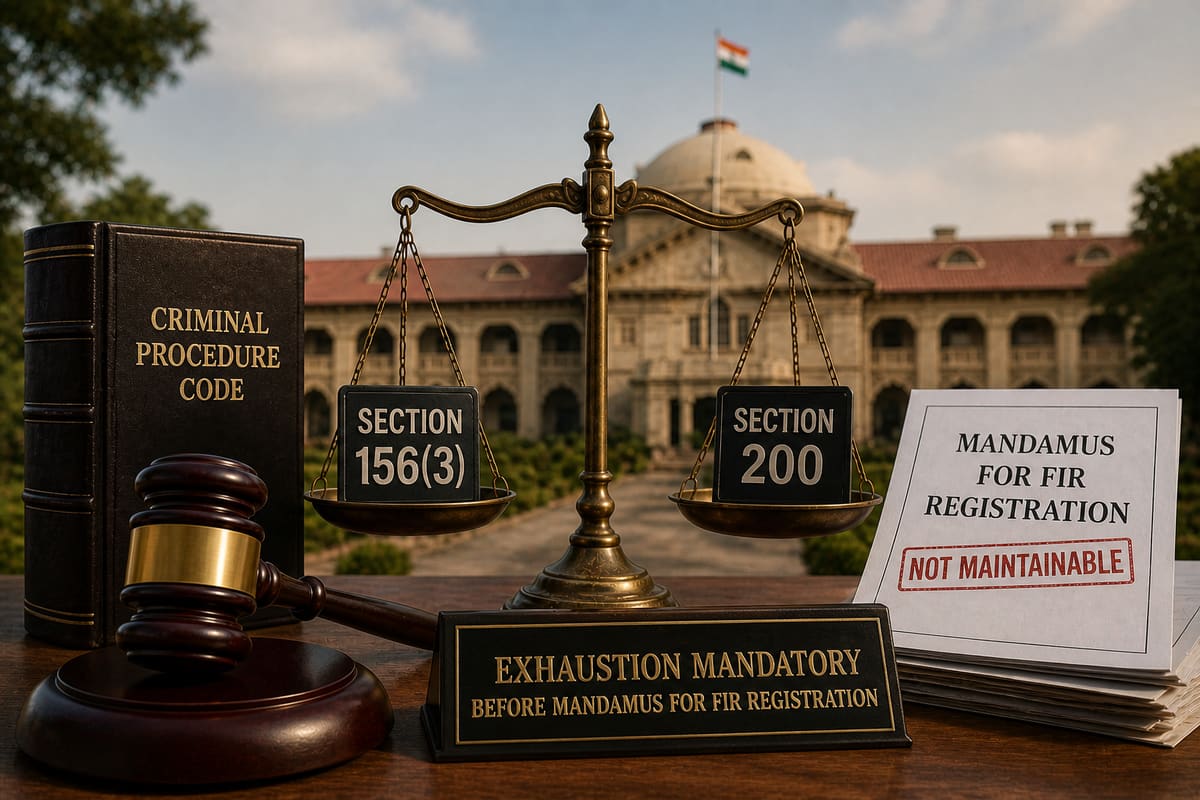
The Madhya Pradesh High Court at Gwalior has reaffirmed that a writ petition under Article 226 is not the appropriate forum to compel registration of an FIR or to demand an independent investigation when statutory remedies under the Code of Criminal Procedure are available. The judgment underscores the principle that judicial intervention at the High Court level must yield to prescribed procedural alternatives, particularly in cases of police inaction.
Background & Facts
The Dispute
The petitioner, Brajesh Singh Raghuvanshi, filed a complaint on 10.02.2026 alleging criminal conduct by one Akash @ Bittu. Despite this formal complaint, the concerned police station refused to register an FIR. The petitioner then approached the High Court via a writ petition under Article 226 of the Constitution, seeking: (i) mandatory registration of an FIR under the Bharatiya Nyaya Sanhita; (ii) direction for an independent investigation by a senior police officer or CID; (iii) a status report on the investigation; and (iv) costs.
Key Facts
- The petitioner submitted a written complaint on 10.02.2026 to the local police station
- No FIR was registered in response to the complaint
- No record of any representation made to higher police authorities (e.g., Superintendent of Police) was presented
- The petitioner did not file any application before a Magistrate under Section 156(3) CrPC or Section 175(3) BNS
- The complaint allegedly pertains to offences under the Bharatiya Nyaya Sanhita, 2023
Procedural History
- 10.02.2026: Petitioner files complaint with police station
- No FIR registered by police
- 2026: Writ Petition No. 9251 of 2026 filed before the High Court of Madhya Pradesh at Gwalior
- 23.03.2026: Court hears arguments and delivers judgment
The Parties' Positions
For the Petitioner
The petitioner contended that the refusal to register an FIR amounted to a violation of his right to access justice and sought judicial intervention to ensure accountability and impartial investigation.
For the Respondent (State)
The State did not contest the factual allegations but relied on settled legal principles regarding the availability of alternative remedies under the CrPC and BNS.
Relief Sought
The petitioner sought:
- Mandatory registration of FIR against Akash @ Bittu under appropriate provisions of the Bharatiya Nyaya Sanhita
- Direction for investigation by CID or senior officer
- Status report on investigation
- Costs of the petition
The Legal Issue
Whether a writ petition under Article 226 of the Constitution is maintainable to compel registration of an FIR and direct an independent investigation when the petitioner has not exhausted the statutory remedy under Section 156(3) of the Code of Criminal Procedure or Section 175(3) of the Bharatiya Nyaya Sanhita.
Arguments Presented
For the Petitioner
The petitioner argued that the refusal to register an FIR amounted to a denial of justice and that the gravity of the alleged offence warranted immediate judicial intervention. He contended that the High Court’s writ jurisdiction under Article 226 is plenary and should not be denied merely because alternative remedies exist.
For the Respondent
The State relied on binding precedents from the Supreme Court, particularly Sakiri Vasu v. State of U.P. and Aleque Padamsee v. Union of India, to argue that the petitioner’s remedy lies exclusively under Section 156(3) CrPC or Section 175(3) BNS before a Magistrate, and not through a writ petition. The State emphasized that the High Court must not entertain such petitions when statutory alternatives are available and unexhausted.
The Court's Analysis
The Court undertook a detailed review of the Supreme Court’s jurisprudence on the subject, particularly the landmark judgment in Sakiri Vasu v. State of U.P. The Court held that Section 156(3) CrPC (and its equivalent under BNS, Section 175(3)) confers wide and effective powers upon Magistrates to direct registration of an FIR and to supervise the investigation. The Court emphasized that this statutory mechanism is specifically designed to address police inaction and is both accessible and efficacious.
"Section 156(3) Cr.P.C. is wide enough to include all such powers in a Magistrate which are necessary for ensuring a proper investigation, and it includes the power to order registration of an F.I.R. and of ordering a proper investigation if the Magistrate is satisfied that a proper investigation has not been done, or is not being done by the police."
The Court further noted that the Supreme Court has consistently discouraged the practice of approaching High Courts directly in such matters, observing that doing so undermines the legislative intent behind the CrPC’s layered complaint mechanism. The Court highlighted that the petitioner had not approached the Superintendent of Police under Section 154(3) CrPC or Section 36 CrPC, nor had he filed an application under Section 156(3) CrPC before the Magistrate. The Court held that the existence of these remedies, which are specifically tailored to address the grievance, renders the writ petition inappropriate.
The Court also clarified that while an alternative remedy is not an absolute bar to writ jurisdiction, it is a strong factor that must be weighed. In cases where the alternative remedy is effective, accessible, and statutorily mandated, the High Court must decline to interfere. The Court observed that the petitioner’s failure to pursue the prescribed route cannot be remedied by invoking constitutional jurisdiction.
The Verdict
The writ petition was dismissed. The petitioner is at liberty to file an application under Section 156(3) of the Code of Criminal Procedure or Section 175(3) of the Bharatiya Nyaya Sanhita before the jurisdictional Magistrate. No costs were awarded.
What This Means For Similar Cases
Alternative Remedy Is Not Merely Theoretical
- Practitioners must advise clients to exhaust remedies under Section 154(3) CrPC (report to Superintendent of Police) before approaching a Magistrate under Section 156(3)
- Filing a writ petition without first seeking redress under Section 156(3) CrPC will result in dismissal on grounds of maintainability
- The Magistrate’s power under Section 156(3) includes not only directing FIR registration but also monitoring investigation progress
High Court Will Not Act as First Resort for Police Inaction
- Writ petitions under Article 226 are not substitutes for criminal procedure
- Courts will not entertain petitions seeking CID investigations or transfer of cases unless there is clear evidence of systemic bias or gross procedural failure
- Petitioners must demonstrate that the statutory remedy is inadequate or illusory - mere delay or refusal by police is insufficient
Procedural Discipline Is Non-Negotiable
- Always document all representations made to police and higher authorities
- Maintain proof of non-registration of FIR (e.g., acknowledgment receipt, written refusal)
- File Section 156(3) applications promptly - delay may be construed as acquiescence
- Avoid framing writ petitions as a tactical shortcut; courts are increasingly vigilant against procedural abuse