The Telangana High Court recently dismissed a writ petition seeking a mandamus to direct police to register an FIR in a matrimonial dispute, reinforcing that alternative remedies under the Code of Criminal Procedure (CrPC) and pending private complaints before judicial magistrates constitute adequate legal recourse. The judgment underscores the non-maintainability of writ petitions where statutory remedies remain unexhausted, particularly in cases involving matrimonial discord and criminal complaints under the Bharatiya Nyaya Sanhita (BNS).
Background & Facts
The Dispute
The petitioner, Sri Ivl. Kiran Kumar, alleged that his wife, Smt. Sireesha, was forcibly taken away by her parents on 09.06.2023 under the pretext of medical reasons. Despite initial willingness to rejoin the petitioner on 21.06.2023, she subsequently filed multiple complaints against him, including:
- Cr.No. 119/2023 under Section 498-A IPC and Section 3 of the Dowry Prohibition Act (15.11.2023)
- Domestic Violence Case (10.10.2024) before the III Additional Metropolitan Magistrate, Malkajgiri
- Cr.No. 25/2025 under Section 351(2) BNS (06.01.2025)
The petitioner further alleged that his wife left the matrimonial home again, taking valuables including gold, silver, and cash. He filed a petition under Section 9 of the Hindu Marriage Act for restitution of conjugal rights, which culminated in a decree on 07.01.2024.
Procedural History
- 28.06.2025: Petitioner filed a complaint with Shamshabad Police Station alleging offences under Sections 328, 316(2), 303(2), 142, 131, 126(2), 165, 356, 351(2) r/w 61(2) BNS.
- 03.07.2025: Filed a private complaint before the XI Additional Judicial Magistrate of First Class, Rajendranagar, which was adjourned to 20.08.2025 and later to 09.09.2025.
- 23.08.2025: Police closed the petitioner’s representation after enquiry, citing ongoing matrimonial disputes and pending criminal cases.
- 26.08.2025: Present Writ Petition No. 25182 of 2025 filed under Article 226 seeking a writ of mandamus to direct FIR registration.
Relief Sought
The petitioner sought:
- A writ of mandamus declaring police inaction as arbitrary and illegal, violating Articles 14 and 21 of the Constitution.
- Direction to respondent No. 3 (SHO, Shamshabad Police Station) to register an FIR and investigate under Section 175(3) BNSS.
- Interim relief under IA No. 1 of 2025 to direct FIR registration pending writ disposal.
The Legal Issue
The central question was whether a writ of mandamus under Article 226 lies to compel police to register an FIR in a matrimonial dispute, where:
- Multiple criminal complaints and a private complaint are already pending before judicial forums.
- The police have closed the representation after enquiry, citing ongoing litigation.
- The petitioner has alternative remedies under CrPC and BNSS.
Arguments Presented
For the Petitioner
- Police inaction in registering the FIR violates Articles 14 and 21, as established in Lalita Kumari v. State of U.P. (2014), which mandates FIR registration for cognizable offences.
- The private complaint before the magistrate is not an adequate substitute for police investigation, as it lacks the coercive powers of a state agency.
- The delay in judicial proceedings (adjournments to 09.09.2025) justifies extraordinary relief under Article 226.
For the Respondents
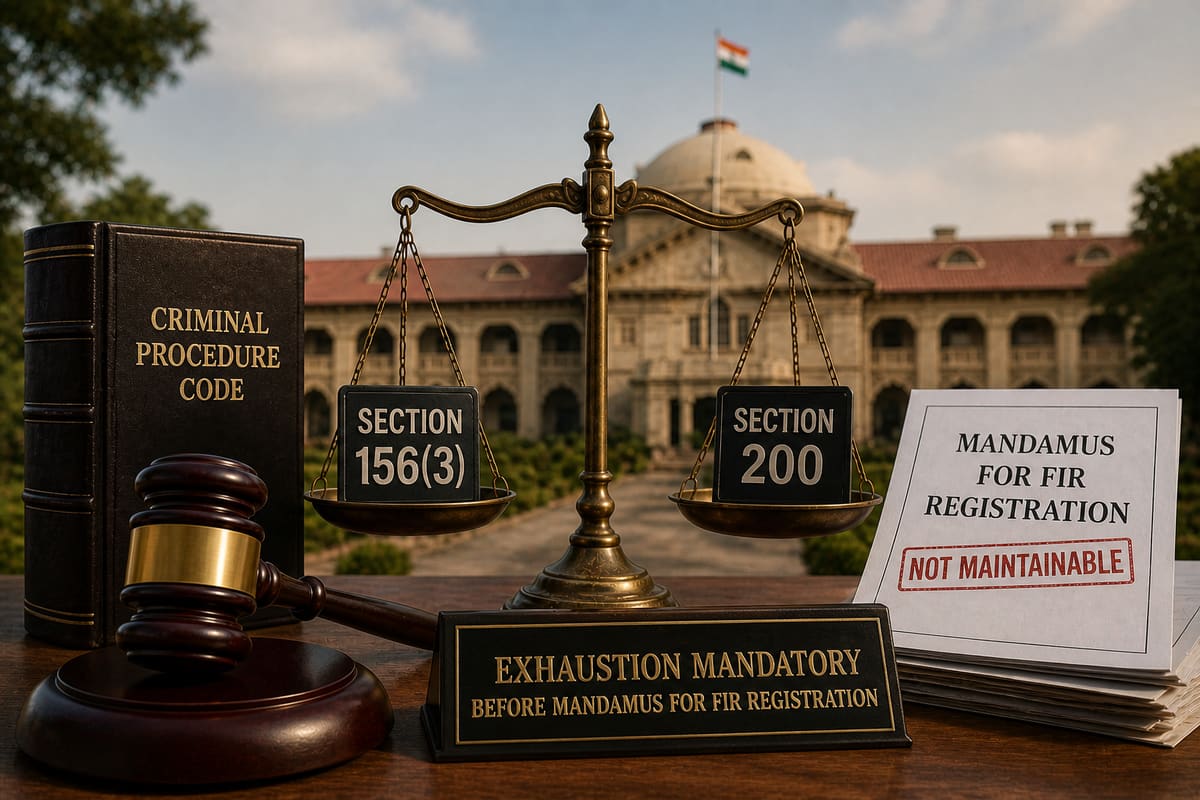
- The petitioner has alternative remedies under Section 156(3) CrPC, which empowers magistrates to direct police investigation.
- The private complaint is sub-judice, and the magistrate is yet to pass orders, rendering the writ premature.
- Police enquiry revealed a matrimonial dispute, and multiple criminal cases are already pending, making FIR registration unnecessary at this stage.
- Writ jurisdiction under Article 226 is discretionary and cannot be invoked where statutory remedies exist.
The Court's Analysis
The Court examined the maintainability of the writ petition in light of alternative remedies and pending litigation.
-
Alternative Remedies Under CrPC: The Court noted that the petitioner had already availed Section 156(3) CrPC by filing a private complaint before the XI Additional Judicial Magistrate. The magistrate’s sworn statement recording and adjournment orders demonstrated that the judicial process was already in motion. The Court relied on Mohd. Yousuf v. Afaq Jahan (2006), which held that writ petitions are not maintainable where statutory remedies under CrPC are available.
"The existence of an alternative remedy is a fundamental bar to the invocation of Article 226 unless exceptional circumstances, such as patent illegality or violation of fundamental rights, are demonstrated."
-
Police Enquiry and Closure: The Court observed that respondent No. 3 had closed the representation after enquiry, citing ongoing matrimonial disputes and pending criminal cases. The Assistant Government Pleader submitted that the petitioner’s wife had filed multiple complaints, and the police had acted within their discretion by not registering an FIR in light of competing claims.
-
Matrimonial Disputes and FIR Registration: The Court distinguished Lalita Kumari on the grounds that:
- Lalita Kumari dealt with cognizable offences where FIR registration is mandatory.
- The present case involved a matrimonial dispute with multiple pending complaints, where police discretion under Section 175(3) BNSS is not arbitrary.
"In cases of matrimonial discord, where multiple complaints are filed by both parties, police discretion to register an FIR must be exercised judiciously to avoid forum shopping or harassment."
-
Non-Maintainability of Writ: The Court held that the petitioner failed to substantiate how the writ was maintainable when:
- A private complaint was pending before the magistrate.
- The police had closed the representation after enquiry.
- No exceptional circumstances (e.g., denial of justice or patent illegality) were demonstrated.
The Court relied on State of Haryana v. Ch. Bhajan Lal (1992), which held that writ jurisdiction should not be invoked where alternative remedies exist unless gross injustice is shown.
The Verdict
The writ petition was dismissed as devoid of merits. The Court held that:
- The petitioner had alternative remedies under CrPC and BNSS, which were not exhausted.
- The private complaint before the magistrate was sub-judice, and the police enquiry was not arbitrary.
- Article 226 could not be invoked merely due to delay in judicial proceedings.
IA No. 1 of 2025 (seeking interim relief) was also dismissed, and no costs were imposed.
What This Means For Similar Cases
Writ Petitions Are Not a Substitute for Statutory Remedies
- Practitioners must exhaust alternative remedies under CrPC (e.g., Section 156(3)) before approaching Article 226.
- Writ jurisdiction is discretionary and will not be entertained where statutory remedies (e.g., private complaints, magistrate directions) are available.
- Courts will scrutinize maintainability strictly, especially in matrimonial disputes where multiple complaints are filed.
Police Discretion in Matrimonial Disputes
- Police need not register an FIR in matrimonial disputes where multiple complaints are pending, unless cognizable offences are prima facie established.
- Section 175(3) BNSS grants police discretion to close representations after enquiry if no cognizable offence is disclosed.
- Forum shopping (e.g., filing writ petitions alongside private complaints) will weaken maintainability.
Magistrates’ Role in Directing Investigations
- Section 156(3) CrPC empowers magistrates to direct police investigation if cognizable offences are disclosed.
- Petitioners should pursue private complaints diligently, as adjournments alone do not justify extraordinary relief under Article 226.
- Delay in judicial proceedings is not a ground for invoking writ jurisdiction unless gross injustice is demonstrated.