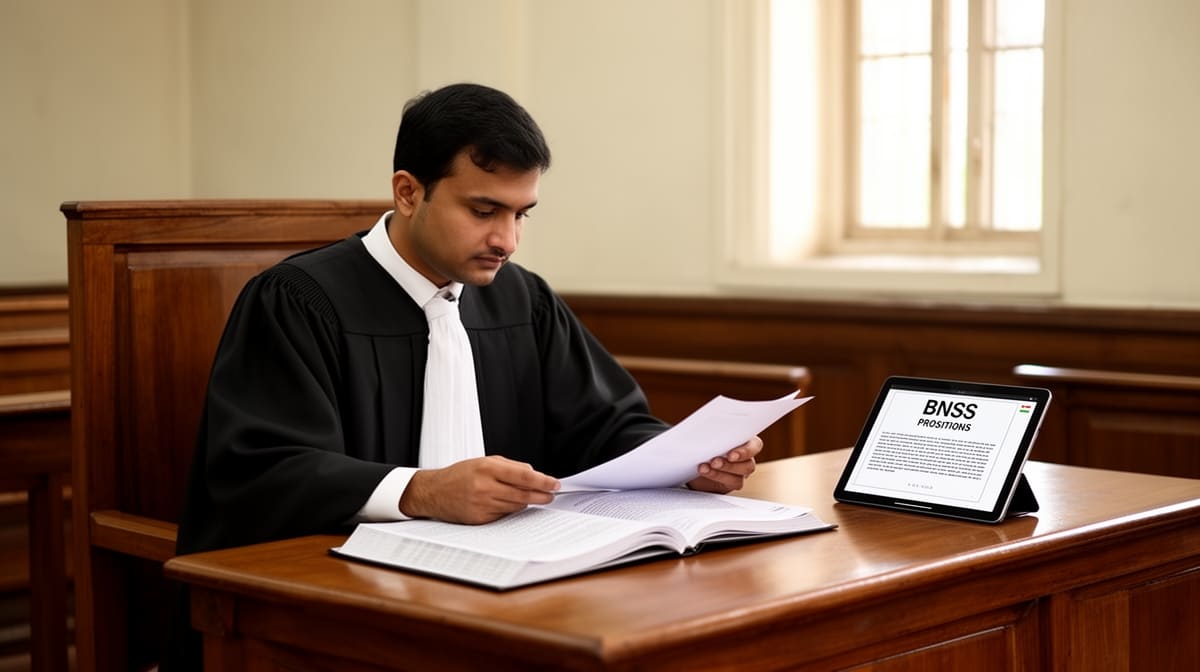
The Allahabad High Court has reaffirmed that magistrates are not obligated to direct police investigation merely because an application discloses a prima facie cognizable offence. This ruling clarifies the judicial discretion available under Section 156(3) Cr.P.C. (now Section 173(4) BNSS) and reinforces the principle that civil disputes must not be improperly converted into criminal proceedings.
Background & Facts
The Dispute
The appellant, Vindhyanvasini Devi, filed an application under Section 173(4) of the Bharatiya Nagarik Suraksha Sanhita (BNSS), which corresponds to the erstwhile Section 156(3) of the Code of Criminal Procedure, seeking direction to the police to register an FIR against four respondents for alleged assault and other criminal acts. The application was filed before the Additional Sessions Judge/Special Judge (S.C./S.T. Act), Sant Kabir Nagar, in Criminal Misc. Case No. 169 of 2024. The trial court rejected the application on 2nd August 2024, holding that the dispute was essentially civil in nature and did not warrant police intervention.
Key Facts
- The appellant alleged that respondents 2 to 5 committed assault upon her
- No prior FIR was registered by the police despite the appellant’s complaint
- The appellant sought police investigation under Section 173(4) BNSS, claiming the allegations disclosed cognizable offences
- The trial court found no substance in the allegations and concluded the matter was a civil dispute over property or personal relations
- The appellant did not provide names of witnesses or documentary evidence supporting the criminal allegations
- The application did not indicate any urgency for preservation of evidence
Procedural History
- 02.08.2024: Additional Sessions Judge/Special Judge, Sant Kabir Nagar, rejected the application under Section 173(4) BNSS without ordering FIR registration
- 29.03.2026: Criminal Appeal No. 11084 of 2024 filed before the Allahabad High Court challenging the rejection order
- 29.04.2026: Division Bench of the Allahabad High Court heard arguments and delivered judgment
The Parties' Positions
For the Appellant
The appellant contended that the trial court failed to apply its mind judicially and mechanically rejected the application. She argued that the allegations of assault constituted cognizable offences under the Indian Penal Code and that the magistrate was legally bound to direct police investigation under Section 156(3) Cr.P.C. as interpreted in prior judgments.
For the Respondent
The State, through the Additional Government Advocate, argued that the trial court correctly identified the dispute as civil in nature. It was submitted that the appellant had not demonstrated any criminal intent or independent evidence of assault, and that the application was an attempt to misuse criminal process to gain leverage in a civil matter.
Relief Sought
The appellant sought quashing of the order dated 02.08.2024, direction to register an FIR against respondents 2 to 5, and initiation of criminal investigation under Section 173(4) BNSS.
The Legal Issue
The central question was whether a Magistrate is legally bound to direct police investigation under Section 156(3) Cr.P.C. (now Section 173(4) BNSS) whenever an application discloses a prima facie cognizable offence, or whether the Magistrate retains judicial discretion to reject such applications if they appear frivolous, unsubstantiated, or civil in nature.
Arguments Presented
For the Appellant
The appellant relied on judgments where single judges of the Allahabad High Court held that if an application under Section 156(3) Cr.P.C. discloses a prima facie cognizable offence, the Magistrate is obligated to direct police investigation. She argued that the trial court’s failure to order an FIR despite allegations of assault violated the mandatory nature of the provision and deprived her of her right to criminal remedy.
For the Respondent
The State countered that the Full Bench decision in Sukhwasi v. State of U.P. (2007) had settled the law: Magistrates are not bound to order FIR registration even when cognizable offences are alleged. The State emphasized that the appellant’s allegations lacked specificity, corroborative evidence, or urgency for evidence preservation, and that the dispute was rooted in a civil disagreement, making criminal intervention inappropriate.
The Court's Analysis
The Court undertook a comprehensive review of the legal position on Section 156(3) Cr.P.C. and its successor provision under the BNSS. It noted that while earlier single judge decisions had suggested a mandatory duty on Magistrates to order investigation upon prima facie allegations, this view had been overruled by the Division Bench in Sukhwasi v. State of U.P. (2007).
"The reference is, therefore, answered in the manner that it is not incumbent upon a Magistrate to allow an application under Section 156(3) Cr.P.C. and there is no such legal mandate. He may or may not allow the application in his discretion. The second leg of the reference is also answered in the manner that the Magistrate has a discretion to treat an application under Section 156(3) Cr.P.C. as a complaint."
The Court held that the Magistrate must exercise judicial discretion, examining whether the allegations have substance, whether evidence needs preservation, and whether the dispute is genuinely criminal or merely civil in character. The Court found that the trial court had correctly identified the nature of the dispute as civil and had not acted mechanically.
The Court further relied on the Supreme Court’s judgment in Aleque Padamsee v. Union of India (2007) and the Full Bench decision in Father Thomas v. State of Uttar Pradesh (2010), which clarified that rejection of an application under Section 156(3) Cr.P.C. does not foreclose the complainant’s remedy. The proper recourse is to file a private complaint under Section 200 Cr.P.C. (now Section 223 BNSS) read with Section 190(1)(a) (now Section 210(1)(a) BNSS).
The Court emphasized that the power under Section 156(3) is an extraordinary remedy meant to prevent police inaction, not to circumvent civil litigation. Where allegations are vague, unsubstantiated, or appear to be a tool for coercion in a civil dispute, the Magistrate is not only entitled but duty-bound to refuse intervention.
The Verdict
The Criminal Appeal was dismissed. The Allahabad High Court upheld the order dated 02.08.2024 rejecting the application under Section 173(4) BNSS. The Court held that the Magistrate acted lawfully in exercising discretion and that the appellant’s remedy lies in filing a private complaint under Section 210(1)(a) read with Section 223 of the BNSS. No direction for FIR registration or police investigation was issued.
What This Means For Similar Cases
Judicial Discretion Is Paramount in Section 156(3) Applications
- Practitioners must now demonstrate more than mere allegations of cognizable offences; they must show credible, specific facts indicating criminal intent and urgency for police intervention
- Applications lacking witness names, documentary proof, or evidence of imminent destruction of evidence are likely to be rejected
- Courts will scrutinize whether the dispute is genuinely criminal or an attempt to convert civil remedies into criminal proceedings
Private Complaint Is the Proper Remedy After Rejection
- Rejection of a Section 156(3) application does not extinguish the complainant’s right to seek justice
- The correct next step is to file a complaint under Section 210(1)(a) read with Section 223 BNSS, not to seek quashing in higher courts
- Lawyers must advise clients to prepare a detailed, sworn complaint with evidence, not rely on police-initiated investigations as a default
Civil Disputes Cannot Be Colour-Coded as Criminal
- Allegations of assault, threats, or harassment in the context of property, family, or contractual disputes will be examined for their true character
- Courts will not permit criminal process to be used as leverage in civil litigation
- Practitioners must avoid filing Section 156(3) applications as a tactical tool; doing so risks adverse costs and judicial censure