The Madhya Pradesh High Court has reaffirmed that police authorities cannot remain passive when a complaint discloses a cognizable offence. The judgment mandates immediate procedural action under the Bhartiya Nagrik Suraksha Sanhita, 2023, reinforcing the constitutional duty to protect fundamental rights through timely investigation.
Background & Facts
The Dispute
The petitioner, Juber Khan, filed a complaint on 13 January 2026 alleging that respondent No. 3 committed a cognizable offence punishable under Section 173 of the Bhartiya Nagrik Suraksha Sanhita, 2023. Despite the complaint being duly submitted with supporting documents, no action was taken by the police station. The petitioner was neither informed that an FIR had been registered nor that no cognizable offence was made out, leaving her without any legal recourse.
Procedural History
- 13 January 2026: Petitioner filed formal complaint with local police station (Annexure P/2)
- No action taken: Police neither registered FIR nor provided written refusal
- 17 February 2026: Petitioner filed writ petition under Article 226 of the Constitution
- State’s response: Argued that petitioner had alternate remedy under procedural law
Relief Sought
The petitioner sought a writ directing the police to either register an FIR or issue a reasoned order explaining why no cognizable offence was made out, in compliance with statutory obligations under the Bhartiya Nagrik Suraksha Sanhita, 2023.
The Legal Issue
The central question was whether the police can indefinitely delay action on a complaint disclosing a cognizable offence, and whether the existence of an alternate remedy bars a writ petition under Article 226 when fundamental rights to life and liberty are at stake.
Arguments Presented
For the Petitioner
The petitioner’s counsel relied on Lalita Kumari v. Government of U.P. to argue that registration of FIR is mandatory upon disclosure of a cognizable offence. It was contended that Section 173 of the Bhartiya Nagrik Suraksha Sanhita, 2023 imposes a non-discretionary duty on police to conduct a preliminary enquiry within 14 days and register an FIR if a prima facie case exists. Delay and inaction, it was submitted, amounted to a violation of Article 21 and rendered the petitioner helpless.
For the Respondent/State
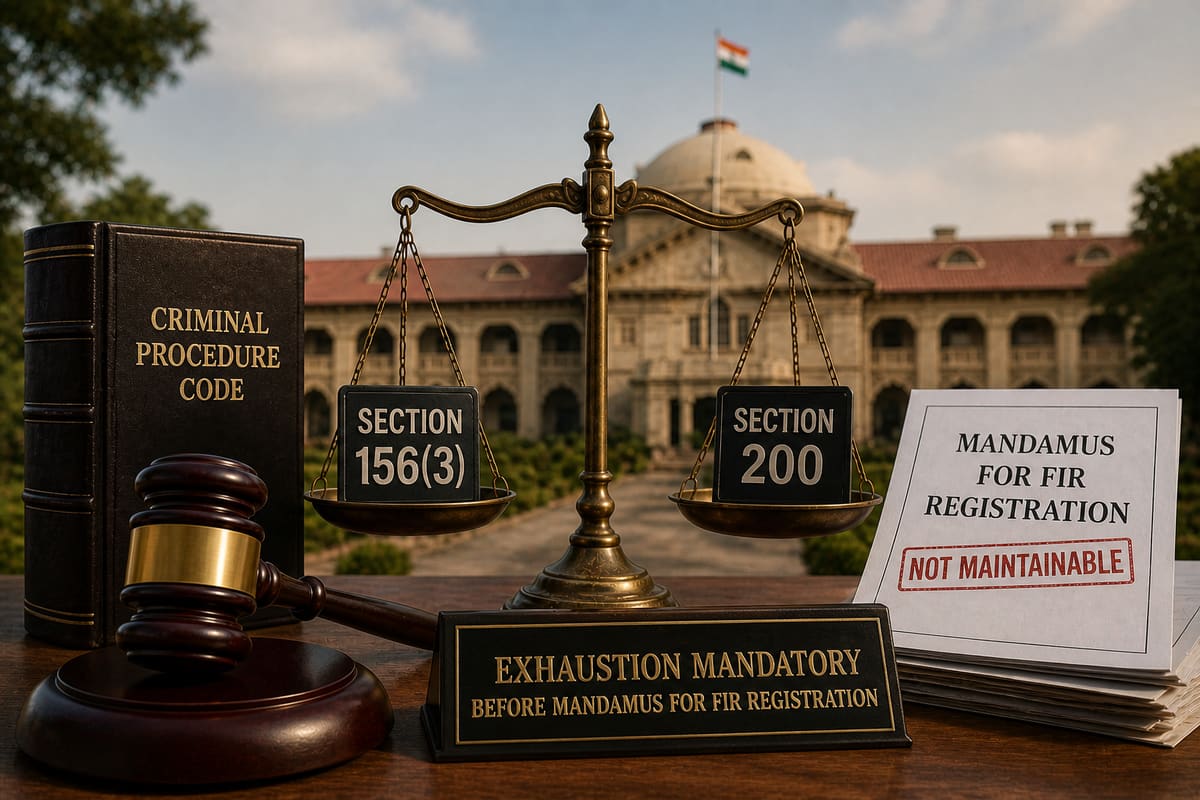
The Government Advocate argued that the petition was not maintainable because the petitioner could have approached the Superintendent of Police or filed a complaint before the Magistrate under Section 156(3) CrPC (now BNS). It was submitted that judicial intervention under Article 226 should be avoided where statutory remedies exist.
The Court's Analysis
The Court rejected the argument that alternate remedy precluded writ jurisdiction. It held that Article 226 is not ousted merely because other remedies exist, particularly when fundamental rights are infringed by state inaction. The Court emphasized that Lalita Kumari remains binding and was expressly incorporated into the statutory framework of the Bhartiya Nagrik Suraksha Sanhita, 2023.
"If a cognizable offence is made out, FIR is to be registered. A party will have alternate remedy only when Police informs that no cognizable offence is made out. In the present case, the Police is sitting tight over the matter and no decision is taken to lodge information or to take any other action."
The Court clarified that Section 173 does not permit police to remain silent. The duty to conduct a preliminary enquiry is mandatory, and failure to do so constitutes a breach of statutory obligation and constitutional duty. The Court further noted that the petitioner’s right to access justice under Article 21 is meaningless if the state can indefinitely defer action without explanation.
The Verdict
The petitioner succeeded. The Court held that police must conduct a preliminary enquiry within 14 days and either register an FIR or issue a reasoned order explaining why no cognizable offence is made out. The authorities were directed to comply within 120 days of receipt of the certified order.
What This Means For Similar Cases
FIR Registration Is Non-Discretionary
- Practitioners must now treat police inaction on cognizable complaints as a violation of statutory and constitutional duty
- Writ petitions under Article 226 are maintainable even if alternate remedies exist, provided there is undue delay or silence
- A mere complaint with prima facie details triggers mandatory duty under Section 173 BNS
Preliminary Enquiry Must Be Documented
- Police cannot rely on verbal or informal assessments
- Every preliminary enquiry must result in a written record, whether FIR is registered or not
- Failure to document the enquiry exposes authorities to judicial review and contempt proceedings
Silence Equals Violation
- No response from police = violation of Lalita Kumari and BNS 2023
- Petitioners may now seek damages or compensation for delay in filing writs
- Legal aid organizations should routinely monitor police station registers for unacknowledged complaints