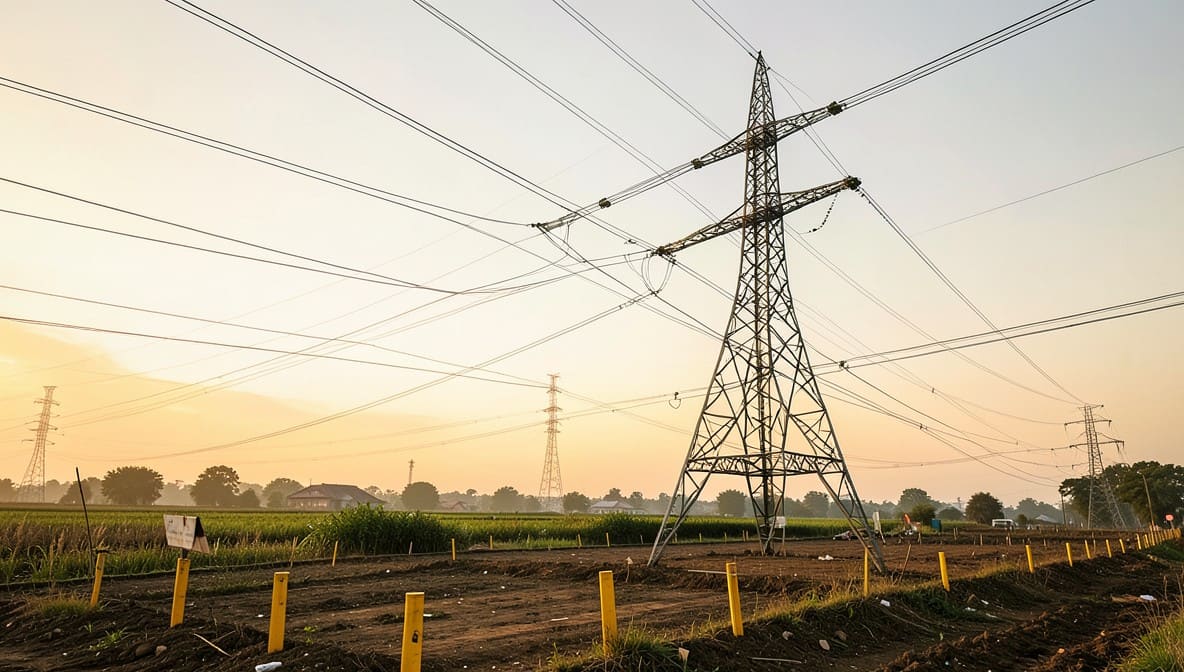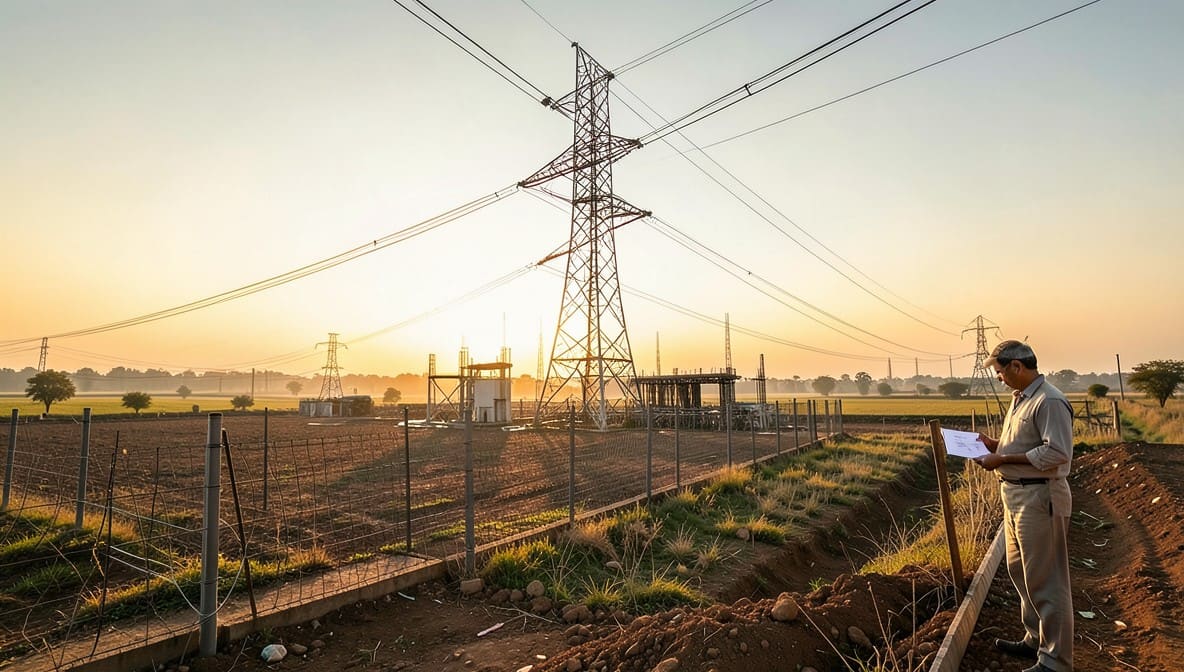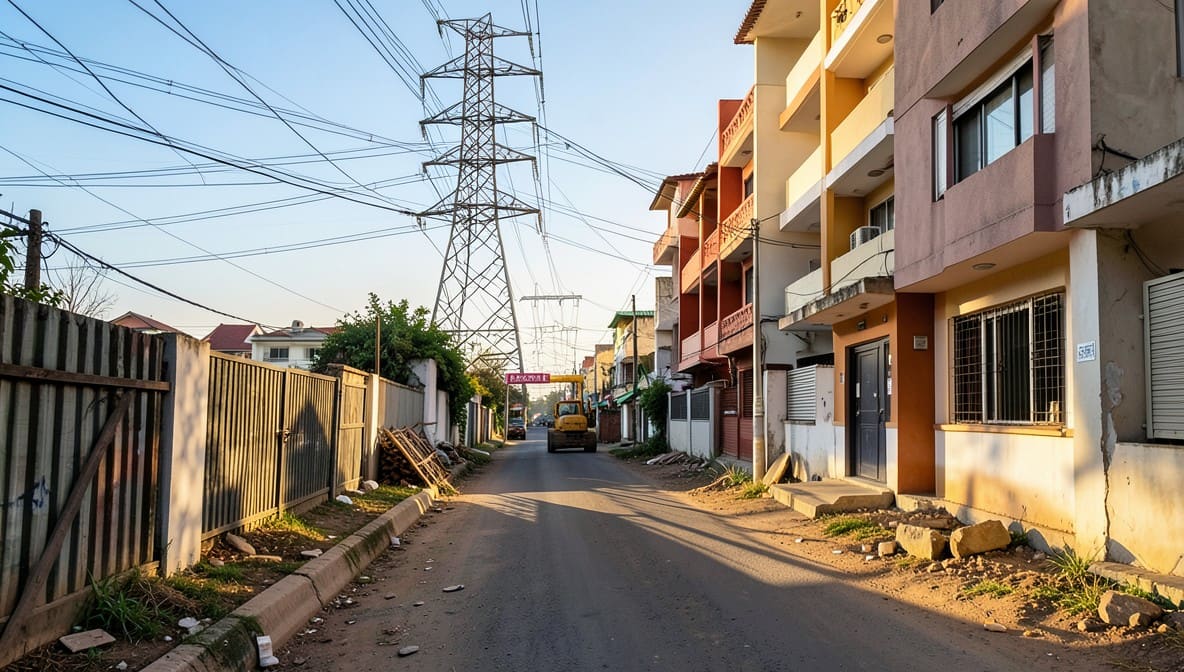
The Karnataka High Court has affirmed that the state’s power to install high-voltage transmission infrastructure under the Indian Telegraph Act is not absolute, and must yield to the fundamental obligation to cause the least possible damage to private property - particularly when such installation obstructs essential access. This ruling reinforces the doctrinal balance between public utility and individual property rights.
Background & Facts
The Dispute
The petitioner, Smt. Khushboo Bansal, is the lawful owner of a residential property located at Door No. 3-51-/170, Flat No. A2101, Planet SKS, Kadri Kuntikana Road, Mangalore-575 008. The respondents, including the Deputy Collector cum District Magistrate and the Karnataka Power Transmission Corporation Limited (KPTCL), initiated proceedings under Section 17 of the Indian Telegraph Act, 1885, to lay a 400 KV Extra High Tension (EHT) transmission line. As part of this project, Tower No.11 was proposed to be erected in close proximity to the petitioner’s property.
The petitioner objected to the proposed location of Tower No.11 on the ground that it would obstruct the only vehicular access road leading to her property, rendering it effectively inaccessible and unusable. Despite repeated representations, the respondents proceeded to issue an order on 18.11.2025 permitting the construction.
Key Facts
- The petitioner has been in continuous possession and enjoyment of the property since acquisition.
- The proposed 400 KV EHT transmission line includes multiple towers, with Tower No.11 being the critical point of contention.
- The petitioner submitted objections to the proposed alignment on 05.10.2025, highlighting the obstruction of the sole access road.
- The respondents issued the impugned order dated 18.11.2025 (Annexure-A) granting permission for Tower No.11 without altering its location.
- The impugned order contained a single paragraph acknowledging the petitioner’s concern and stating that an alternative access would be provided.
- The petitioner filed the writ petition on 22.12.2025, challenging the order as violative of her fundamental right to access and use her property.
Procedural History
- 05.10.2025: Petitioner submitted written objection to the proposed alignment of Tower No.11.
- 18.11.2025: Respondent No.1 passed the impugned order under Section 17 of the Indian Telegraph Act, permitting construction of Tower No.11.
- 22.12.2025: Writ Petition No. 38069 of 2025 filed before the Karnataka High Court under Article 226.
- 29.04.2026: Hearing before Justice K.S. Hemalekha.
The Parties' Positions
For the Petitioner
The petitioner’s counsel, Sri Anoop Haranahalli, argued that:
- The proposed location of Tower No.11 completely blocks the only access road to the property.
- This renders the property functionally unusable, violating the principle of least damage under Section 10(d) of the Indian Telegraph Act.
- The mere assertion in the impugned order that "alternative access will be provided" is vague, unenforceable, and lacks any plan, survey, or commitment.
- The order is arbitrary and violates Article 14 and Article 300A of the Constitution.
For the Respondents
The respondents, represented by Smt. Rashmi Rao and Sri S. Sriranga, contended that:
- The competent authority had duly considered the petitioner’s grievance, as evidenced by the reference to alternative access in the impugned order.
- The project is of national importance and involves public utility.
- The petitioner’s access concern is not absolute and can be mitigated through engineering solutions.
- The court should not interfere with the technical discretion of the authority under the Act.
Relief Sought
The petitioner sought:
- Quashing of the impugned order dated 18.11.2025.
- Direction to the respondents to alter the situs of Tower No.11 in accordance with the deviation report submitted as Annexure-H.
- A declaration that the proposed location violates the principle of least damage under Section 10(d) of the Indian Telegraph Act.
The Legal Issue
The central question was whether the authority under Section 17 of the Indian Telegraph Act, 1885, may permit the erection of a transmission tower that obstructs the only access to a private property, when Section 10(d) mandates the least possible damage to such property.
Arguments Presented
For the Petitioner
The petitioner relied on the principle of least damage under Section 10(d) of the Indian Telegraph Act, which obligates the authority to minimize interference with private rights. She argued that blocking the sole access road constitutes more than mere inconvenience - it renders the property economically and functionally worthless. The petitioner cited State of Haryana v. Bhagwan Das to emphasize that property rights cannot be extinguished by implication, and that access is an essential incident of ownership. The vague assurance of "alternative access" in the impugned order was submitted as legally insufficient and non-binding.
For the Respondent
The respondents argued that the authority had discharged its duty by acknowledging the grievance in the order. They contended that the Act grants broad discretion to the executive to determine the alignment of transmission lines, and that judicial interference in technical matters is unwarranted. They further submitted that the petitioner’s access could be restored through a new road or bridge, and that the impugned order was not final but part of an ongoing process.
The Court's Analysis
The Court undertook a careful review of the impugned order dated 18.11.2025 and the statutory mandate under Section 10(d) of the Indian Telegraph Act, 1885, which states: "The authority shall cause the least possible damage to the property of any person in the exercise of the powers conferred by this Act."
"The relevant portion of the impugned order... indicating that an alternative access to be provided to the petitioner is culled out as under..."
The Court observed that while the order contains a reference to providing alternative access, it offers no details - no survey, no design, no timeline, no commitment. Such a statement, the Court held, is not a binding assurance but a hollow platitude. The Court emphasized that the obligation under Section 10(d) is not merely procedural but substantive: it requires the authority to actively consider and mitigate harm, not merely acknowledge it.
The Court further noted that the petitioner’s property is residential, and the obstruction of the only access road would deprive her of the very essence of ownership - the right to use and enjoy the property. The Court rejected the respondents’ argument that public utility overrides private rights in absolute terms, holding instead that public utility must be pursued in a manner that respects constitutional property rights.
The Court declined to quash the impugned order outright, recognizing the technical complexity of transmission line alignment. However, it held that the respondents’ obligation to ensure effective access is non-negotiable and must be fulfilled with specificity and urgency.
The Verdict
The writ petition was disposed of with the following directions:
- The petitioner is granted liberty to submit a detailed representation to Respondent No.3 (Chief Engineer, Planning and Coordination) within one week from the date of judgment.
- Respondent No.3 shall consider the representation in accordance with Section 10(d) of the Indian Telegraph Act and the Court’s observations, and pass a reasoned order within two weeks thereafter.
- The respondents shall ensure that effective and usable access to the petitioner’s property is provided, as indicated in the impugned order.
- Until such consideration and order, no precipitative action shall be taken against the petitioner’s property.
What This Means For Similar Cases
Access Is an Essential Incident of Property Ownership
- Practitioners must now argue that obstruction of sole access to property constitutes a violation of Section 10(d), not merely a procedural lapse.
- Vague assurances in administrative orders, such as "access will be provided," are legally insufficient and subject to judicial scrutiny.
- Courts will treat functional inaccessibility as equivalent to deprivation of property under Article 300A.
Public Utility Must Be Balanced with Substantive Mitigation
- Authorities cannot rely on the "public interest" argument to override concrete harm to private property.
- Engineering solutions (e.g., rerouting, bridges, culverts) must be documented, feasible, and communicated to affected owners.
- Failure to provide a concrete plan for access restoration renders the administrative order arbitrary and liable to be set aside.
Procedural Fairness Requires Specificity
- Administrative orders under the Indian Telegraph Act must include specific, actionable commitments - not general assurances.
- Petitioners should demand copies of deviation studies, alternative alignment reports, and access mitigation plans during the objection stage.
- Courts will not entertain blanket deference to technical authorities when fundamental property rights are at stake.