The Rajasthan High Court has clarified that provisional compensation paid by a statutory utility for right of way acquisition does not extinguish the landowner’s statutory right to seek fair and enhanced compensation under the Indian Telegraph Act, 1885. This ruling reinforces procedural fairness in infrastructure projects involving compulsory acquisition of private land for public utility.
Background & Facts
The Dispute
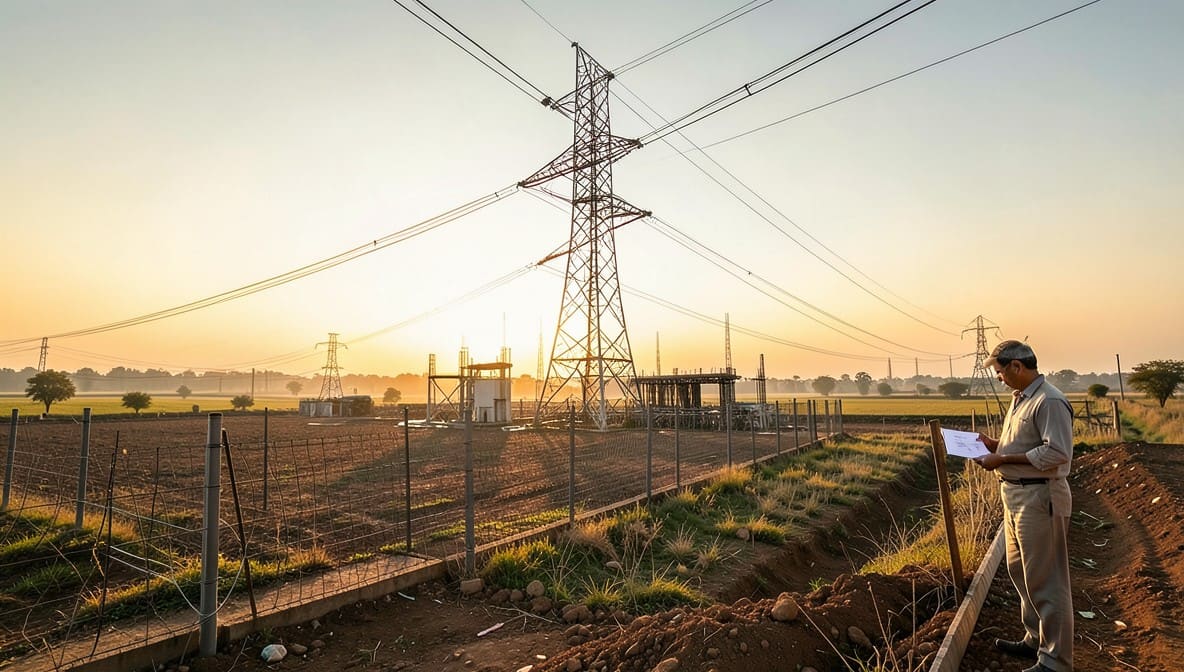
The petitioner, Panchvati Developers Pvt. Ltd., owns commercially converted and residential land situated at Village Bandhnau Utrada, Tehsil Sardarshahar, District Churu, Rajasthan. The respondents, including Power Grid Corporation of India and its subsidiary Power Grid Bikaner Neemrana Transmission Limited, proposed to construct a 765 kV D/C Bikaner-Neemrana transmission line and its right of way corridor across the petitioner’s land. The petitioner objected to the proposed alignment, arguing that it unnecessarily encroached upon high-value land and that no feasible alternate route was considered.
Key Facts
- The petitioner’s land is located in a commercially developed and residential zone, not in an agricultural or uninhabited area.
- The respondents conducted surveys and issued notices under the Indian Telegraph Act, 1885, but did not initiate formal compensation determination proceedings under Section 10 of the Act.
- On 24.03.2026, Power Grid Corporation of India communicated to the petitioner an offer of provisional compensation amounting to ₹1,22,27,241/- for the right of way.
- The petitioner accepted the offer as a provisional payment but maintained that it was inadequate and did not reflect market value or statutory entitlement under the Indian Telegraph Act.
- No formal award or determination of compensation had been made by the District Collector or any other competent authority under the Act prior to the filing of the writ petition.
Procedural History
- Prior to 2025: Respondents initiated survey and alignment processes for the transmission line without initiating formal compensation proceedings.
- 2025: Petitioner filed multiple representations to respondents seeking alternate alignment and fair compensation; no substantive response received.
- 23.09.2025: Writ Petition No. 23326/2025 filed before the High Court of Judicature for Rajasthan at Jodhpur.
- 23.04.2026: Hearing conducted before Hon’ble Mr. Justice Kuldeep Mathur.
The Parties' Positions
For the Petitioner: The petitioner contended that the proposed transmission line alignment was arbitrary and violated principles of natural justice. It argued that the respondents had not followed the mandatory procedure under the Indian Telegraph Act, 1885, particularly Section 10, which requires determination of compensation by the District Collector before taking possession. The petitioner further submitted that the offered amount was merely a token gesture and did not reflect the true market value of the land, which had been commercially converted.
For the Respondents: The respondents, through Senior Counsel Shri Rajesh Joshi, conceded that the petitioner was entitled to compensation and confirmed that Power Grid Corporation of India was ready to release ₹1,22,27,241/- as provisional payment within fifteen days. They submitted that the amount was calculated in accordance with internal guidelines and that the petitioner retained the right to seek enhanced compensation under the Indian Telegraph Act.
Relief Sought
The petitioner sought: (i) Quashing of all actions relating to the transmission line alignment over its land; (ii) Direction to adopt an alternate feasible route; (iii) In the alternative, direction to determine compensation strictly in accordance with the Central Electricity Authority (Technical Standard for Construction of Electric Plant and Electric Lines) Regulations, 2022, Guidelines for Payment of Compensation towards RoW dated 14.06.2024, and Supplementary Guidelines dated 21.03.2025; (iv) Costs of the petition; (v) Any other just and proper relief.
The Legal Issue
Whether the payment of a provisional compensation amount by a statutory utility like Power Grid Corporation of India, without a formal determination under the Indian Telegraph Act, 1885, extinguishes the landowner’s right to seek fair and enhanced compensation before the competent authority?
Arguments Presented
For the Petitioner
The petitioner relied on State of Rajasthan v. Shri Ram Singh and Union of India v. K. S. Srinivasan to argue that the Indian Telegraph Act, 1885, is a special statute governing compensation for right of way, and that Section 10 mandates a judicial or quasi-judicial determination by the District Collector. It was submitted that mere payment of an administrative offer, even if substantial, cannot substitute for statutory procedure. The petitioner emphasized that the land had been commercially converted and its value significantly enhanced, and that the offered amount did not account for this. The petitioner further contended that the respondents had failed to consider alternate routes, violating the principle of minimization of land acquisition.
For the Respondent
The respondents conceded that the petitioner’s right to seek enhanced compensation under Section 10 of the Indian Telegraph Act, 1885, remained intact. They submitted that the payment of ₹1,22,27,241/- was made in good faith to avoid further litigation and to ensure timely progress of a national infrastructure project. They argued that the amount was calculated based on market surveys and internal guidelines and that the petitioner was not prejudiced by the provisional nature of the payment.
The Court's Analysis
The Court examined the statutory framework under the Indian Telegraph Act, 1885, particularly Section 10, which provides that compensation for the right of way shall be determined by the District Collector after hearing both parties. The Court noted that the respondents had not initiated this process prior to filing the writ petition, nor had they issued any formal award.
"The payment of a provisional sum, however substantial, cannot be equated with the statutory determination of compensation under Section 10 of the Indian Telegraph Act, 1885. The landowner retains the indefeasible right to approach the District Collector for a fair and adequate award."
The Court observed that while the respondents were entitled to proceed with infrastructure projects in the public interest, they could not bypass the procedural safeguards enshrined in the Act. The Court further held that the petitioner’s acceptance of the provisional payment did not constitute a waiver of statutory rights. The Court also noted that the petitioner had raised legitimate concerns regarding the alignment and the absence of an alternate route, which, while not warranting quashing of the project, justified the preservation of the right to seek enhanced compensation.
The Court emphasized that the purpose of Section 10 is not merely to provide compensation, but to ensure that the determination is made by an impartial authority after due process. The respondents’ offer, while generous, was administrative in nature and lacked the procedural rigor required by law.
The Verdict
The writ petition is disposed of with the following directions:
- Power Grid Corporation of India shall release the compensation amount of ₹1,22,27,241/- to the petitioner within fifteen days from the date of this order.
- Such payment shall not be construed as final or conclusive compensation under the Indian Telegraph Act, 1885.
- The petitioner is entitled to approach the District Collector and District Magistrate, Churu, within one month from today for determination of fair and enhanced compensation under Section 10 of the Indian Telegraph Act, 1885.
- The competent authority shall decide such application expeditiously, preferably within three months from the date of receipt.
- The stay petition and all pending applications are disposed of.
What This Means For Similar Cases
Provisional Payments Do Not Preclude Statutory Claims
- Practitioners representing landowners in transmission line or pipeline projects must immediately file applications under Section 10 of the Indian Telegraph Act, 1885, even if provisional compensation has been offered.
- Acceptance of a provisional payment does not constitute waiver of statutory rights under the Act.
- Utilities cannot rely on internal guidelines or administrative offers to discharge their statutory obligation to determine fair compensation.
District Collector’s Role Is Non-Delegable
- The determination of compensation under Section 10 is a quasi-judicial function that cannot be delegated to project engineers or corporate entities.
- Any attempt to bypass the District Collector’s authority renders the compensation process legally defective.
- Practitioners should challenge any unilateral determination of compensation as ultra vires.
Timing Is Critical for Enhanced Claims
- Landowners must file applications for enhanced compensation within one month of receiving provisional payment to preserve their rights.
- Courts will expect the District Collector to decide such applications within three months; delays beyond this may warrant writ intervention.
- Evidence of commercial conversion, market value, and alternative land use must be meticulously documented to support enhanced claims.