The Bombay High Court has reinforced that administrative coercion against property owners cannot proceed on the basis of erroneous identification, even where unauthorized construction is alleged. A simple mismatch in CTS numbers, if established on prima facie evidence, renders notice and demolition orders legally unsustainable.
Background & Facts
The Dispute
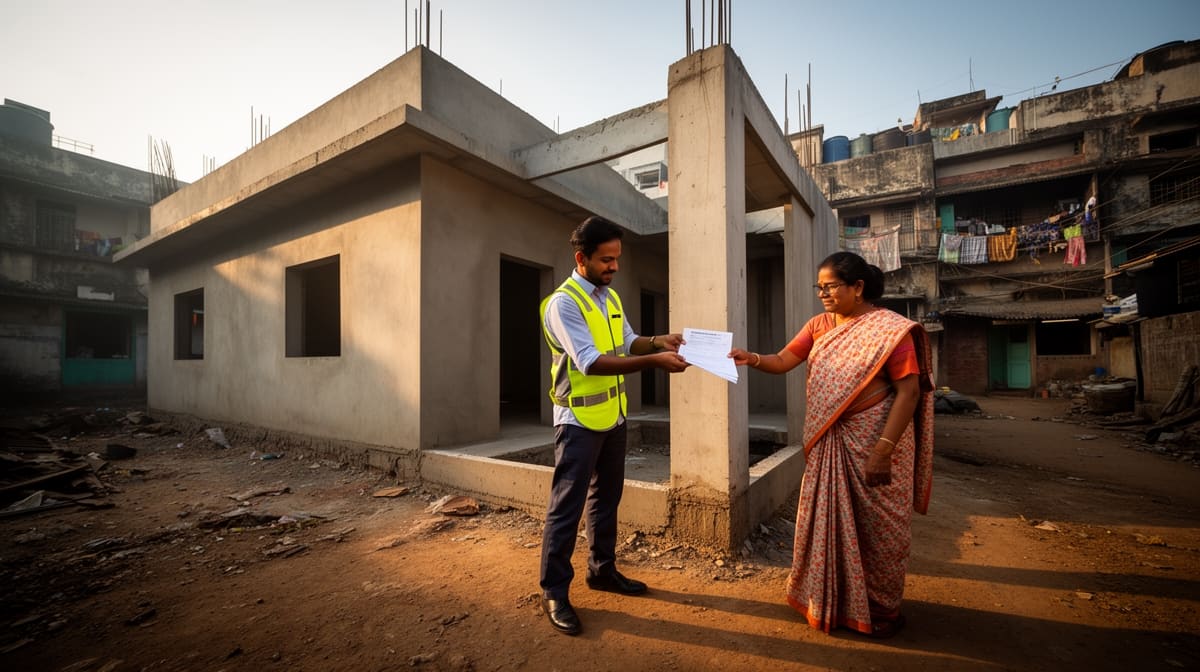
The appellant, Radha Gopal Rao, owns a residential structure on CTS No. 140 in Erangel Village, Madh, Mumbai. The Municipal Corporation of Greater Mumbai, through its Special Investigating Team (SIT), identified multiple properties for unauthorized construction and issued notices targeting those CTS numbers. The appellant’s property was erroneously included in this list despite having no connection to the investigated CTS numbers.
Procedural History
- The appellant filed a civil suit seeking injunction against demolition proceedings.
- The Trial Court rejected the interim relief application, assuming the appellant’s structure fell within the SIT’s investigation scope.
- The appellant appealed to the Bombay High Court, challenging the Trial Court’s failure to examine documentary evidence.
Relief Sought
The appellant sought an immediate stay on all demolition activities, a declaration that the notice was invalid due to incorrect CTS identification, and directions to the Corporation to reconsider its action based on accurate records.
The Legal Issue
The central question was whether a municipal authority may proceed with coercive action, including issuance of demolition notices, against a property when the CTS number cited in the notice does not correspond to the property’s documented ownership and history.
Arguments Presented
For the Appellant
The appellant’s counsel relied on the plaint and supporting documents showing that the structure on CTS No. 140 had existed since 1960, with repair permissions granted by the Corporation in 2025 for mangalore roof restoration. They argued that the SIT’s investigation was confined to entirely different CTS numbers, and the Trial Court’s assumption that the appellant’s property was included therein was legally untenable. The appellant invoked the principle of audi alteram partem and the requirement of procedural fairness under Article 14 of the Constitution.
For the Respondent
The Municipal Corporation did not file a detailed written submission. Its position, as inferred from the impugned order, was that the SIT’s findings were presumptively valid and that the appellant had not disproved the allegations of unauthorized construction. The Corporation relied on the presumption of regularity in official action.
The Court's Analysis
The Court conducted a meticulous review of the plaint and annexures, noting that the appellant’s structure was clearly identified as being on CTS No. 140, while the SIT’s investigation pertained to entirely different CTS numbers. The Trial Court had erred in assuming a connection without evidence.
"The dichotomy is prima facie seen by the Court on the face of record."
The Court emphasized that administrative action, particularly when it involves destruction of property, must be grounded in accurate factual basis. The Corporation’s reliance on the SIT’s report without cross-verifying the CTS number against the appellant’s title documents was a fatal flaw. The Court held that procedural fairness demands that notice be specific and accurate, and that a misidentification of property renders the entire process void ab initio.
The Court further noted that the appellant had obtained lawful repair permission, which further undermined any claim of unauthorized construction. The Trial Court’s refusal to grant interim relief, despite this clear discrepancy, constituted a failure to apply the triple test for injunction - prima facie case, balance of convenience, and irreparable injury.
The Verdict
The appellant succeeded. The Bombay High Court stayed all demolition proceedings against the property on CTS No. 140, held that the notice and speaking order were legally unsustainable due to the mismatch in CTS numbers, and directed the Corporation to file a reply within the stipulated time.
What This Means For Similar Cases
Notice Must Match Documentary Identity
- Practitioners must verify CTS numbers, survey maps, and title documents before challenging municipal notices.
- A single mismatch in property identification invalidates the entire enforcement process, regardless of the underlying allegation.
Repair Permissions Are Not Evidence of Unauthorized Construction
- Obtaining repair permission for existing structures does not imply prior illegality.
- Municipal authorities cannot treat repair approvals as admissions of unauthorized work.
Courts Will Intervene on Prima Facie Procedural Errors
-
Interim relief is warranted where the record reveals an obvious factual error.
-
The burden shifts to the authority to prove accuracy of its records before initiating coercive action.
-
Always cross-check CTS numbers in notices against title deeds and municipal records.
-
File urgent applications for stay with annexures showing historical ownership and prior permissions.
-
Argue that procedural irregularities in notice issuance violate Article 14 and render action void.