The Kerala High Court has underscored the necessity of expert verification of signatures before proceeding with criminal charges of forgery, particularly in cases involving financial fraud. This judgment clarifies that prima facie evidence of forgery must be established through forensic examination before initiating coercive measures, reinforcing the burden of proof on investigating agencies under Section 464 of the Indian Penal Code.
Background & Facts
The Dispute
The petitioner, a non-resident Indian, was accused of forging her brother's signature to obtain a duplicate ATM card from Federal Bank, Angamaly. The complaint alleged that the petitioner fraudulently operated the complainant's bank account using the duplicate card. The petitioner, residing in Australia, contested the allegations, claiming the signatures on the account opening form and the duplicate ATM card application were identical.
Procedural History
The case progressed through the following stages:
- 2019: Writ petition filed before the Kerala High Court seeking relief from coercive action
- 2025: High Court disposed of the writ petition with directions for further investigation
- 2026: Review petition filed challenging the 2025 order, highlighting discrepancies in signature verification
The Parties' Positions
The petitioner argued that:
- The bank's Assistant Manager had confirmed the signatures were identical
- No expert verification had been conducted to establish forgery
- The case was prematurely labeled as 'undetected' without thorough investigation
The State contended that:
- The investigation was ongoing and required the petitioner's physical presence
- Electronic evidence needed to be collected to substantiate the allegations
The Legal Issue
The central question was whether criminal proceedings for forgery under Sections 464 and 465 of the IPC can continue without expert verification of signatures, and whether the investigating agency can defer such verification until the accused's physical presence is secured.
Arguments Presented
For the Petitioner
The petitioner's counsel contended that:
- The bank's statement confirming identical signatures negated the prima facie case of forgery
- The investigating officer's failure to conduct expert verification violated the principles of natural justice
- The case diary's reliance on the bank's statement without independent verification was legally insufficient
For the Respondent
The Public Prosecutor argued that:
- The investigation was at a preliminary stage and required the petitioner's presence for further evidence collection
- The case was rightly classified as 'undetected' pending the petitioner's return to India
- Electronic evidence, if any, could only be collected with the petitioner's cooperation
The Court's Analysis
The Court examined the evidentiary standards required for initiating criminal proceedings in forgery cases. It observed that Section 464 of the IPC mandates proof of fraudulent or dishonest intent at the time of making a false document. The Court emphasized that:
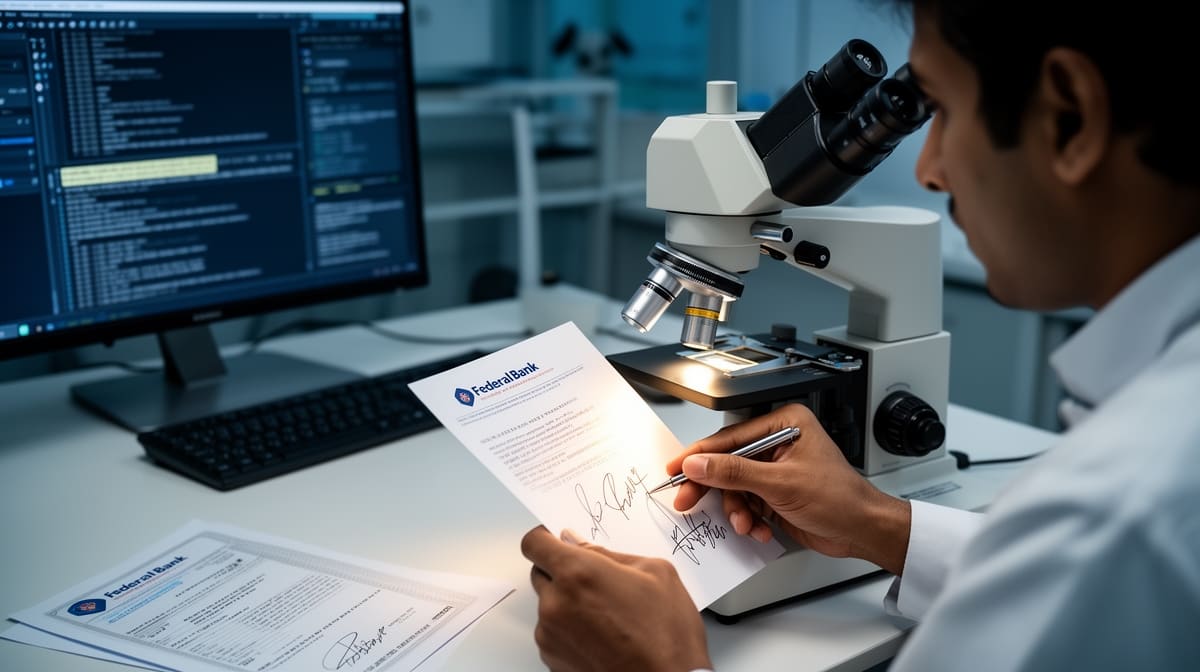
"The investigating officer shall verify the signature of the defacto complainant in the Account Opening Form and the signature in the application given for duplicate ATM card, with the help of an expert. The investigating officer shall also make every endeavour to collect the electronic evidence, if any, available with regard to the offence alleged."
The Court distinguished this case from precedents like State of Maharashtra v. Sukhdeo Singh, where expert opinion was deemed essential to establish forgery. It held that mere suspicion or bank statements without forensic verification cannot form the basis for criminal proceedings. The judgment reiterated the due process requirements under Article 21 of the Constitution, ensuring that no individual is subjected to coercive action without prima facie evidence.
The Verdict
The review petition was disposed of with the following directions:
- The petitioner must report to the investigating officer upon her return to India in April 2026.
- The investigating officer must conduct expert verification of signatures and collect electronic evidence before proceeding further.
- The case remains classified as 'undetected' until the completion of the above steps.
What This Means For Similar Cases
Expert Verification Is Mandatory Before Coercive Action
Practitioners must now ensure that:
- Forensic examination of signatures is conducted before initiating criminal proceedings for forgery
- Bank statements or internal verifications are insufficient to establish prima facie evidence under Section 464 IPC
- Electronic evidence must be diligently collected to substantiate allegations of financial fraud
Due Process Prevails Over Expediency
- Investigating agencies cannot defer expert verification indefinitely pending the accused's physical presence
- Coercive measures such as arrest or summons must be based on verified evidence, not mere allegations
- Courts will scrutinize the evidentiary foundation of forgery cases to prevent misuse of criminal law
Practical Implications for Financial Fraud Cases
- Banks and financial institutions must maintain original documents and digital records to facilitate forensic examination
- Accused individuals can seek stay of proceedings if expert verification is not conducted
- Defense strategies should focus on challenging the sufficiency of evidence before trial