The Kerala High Court has affirmed that the pursuit of justice in forgery cases demands proactive judicial intervention to secure critical documentary evidence, even when investigative agencies have closed their inquiries. This ruling clarifies that trial courts retain inherent authority under the Indian Evidence Act to ensure forensic verification of disputed documents, irrespective of procedural delays or omissions by the prosecution.
Background & Facts
The Dispute
The de facto complainant, P. Sreedharan, alleged that his relatives, respondents 1 and 2, misused signed blank stamp papers entrusted to them for a loan, to fabricate a forged sale agreement for his property in Kannur. They subsequently filed a civil suit based on this forged document, obtained an injunction, and later pursued specific performance. After the civil suit was dismissed, the complainant filed a criminal complaint under Sections 417, 420, 465, 467, and 471 r/w Section 34 IPC for forgery and cheating.
Procedural History
The case was marked by repeated procedural failures and judicial interventions:
- 2005: Criminal complaint filed; investigation deemed inadequate.
- 2007-2014: Multiple petitions filed before the Kerala High Court seeking further investigation and forensic analysis; several orders issued and set aside due to lack of hearing.
- 2014: High Court directed the Magistrate to reconsider applications for further investigation and expert analysis after hearing all parties.
- 2017: High Court allowed further investigation but denied complainant’s request for forensic analysis, citing Amrut Bhai Shambhu Bhai Patel v. Suman Bhai Kanti Bhai Patel.
- 2019: Magistrate dismissed applications to obtain the disputed sale agreement from the Sub Court, Thalassery, for forensic handwriting comparison.
Relief Sought
The de facto complainant and the State sought to have the disputed sale agreement retrieved from the Sub Court, Thalassery, and sent to the Forensic Science Laboratory for expert analysis of handwriting and content insertion.
The Legal Issue
The central question was whether a Trial Court under Section 45 of the Indian Evidence Act, 1872 can direct the production of documents from civil court records for forensic analysis, even after the investigating agency has filed a supplementary charge sheet and closed its investigation.
Arguments Presented
For the Appellant/Petitioner
The de facto complainant and the State argued that the forged sale agreement was the cornerstone of the prosecution’s case. They relied on Section 45 of the Indian Evidence Act, which permits courts to obtain expert opinions on handwriting, and emphasized that the accused’s admission of signing blank papers did not negate the need to prove that they had inserted fraudulent content. They cited the High Court’s prior observations on the shoddy investigation and the necessity of expert evidence to establish criminal intent.
For the Respondent/State
The accused contended that the handwriting on the document was admitted, rendering forensic analysis redundant. They argued that since the investigation was complete and a supplementary report filed, the court lacked jurisdiction to reopen evidentiary matters. They also claimed the complainant had previously failed to act on earlier opportunities to obtain expert analysis.
The Court's Analysis
The Court rejected all three grounds cited by the Magistrate for denying the request. First, the claim that the document’s custody was uncertain was dismissed as a procedural excuse. The Sub Court could have responded to a formal request, and if necessary, the Magistrate could have approached the High Court directly.
Second, the Court held that the failure of the Investigating Officer to apply for forensic analysis does not bar the Trial Court from exercising its own powers under Section 45 of the Indian Evidence Act. The Court emphasized that the trial is not a mere formality but a search for truth, and the court’s duty to ensure justice supersedes investigative lapses.
"The reason that the Investigating Officer did not opt for such a procedure even during further investigation, cannot be a ground to disallow the prayer in the above regard."
Third, the Court found the complainant’s prior inaction was not voluntary but resulted from the accused’s refusal to appear for specimen collection, despite court orders. The Magistrate’s failure to follow up on that refusal could not be blamed on the complainant.
The Court further clarified that the accused’s admission to signing blank papers was irrelevant to the core issue: whether they had fraudulently inserted content. Only expert analysis could resolve this.
The Verdict
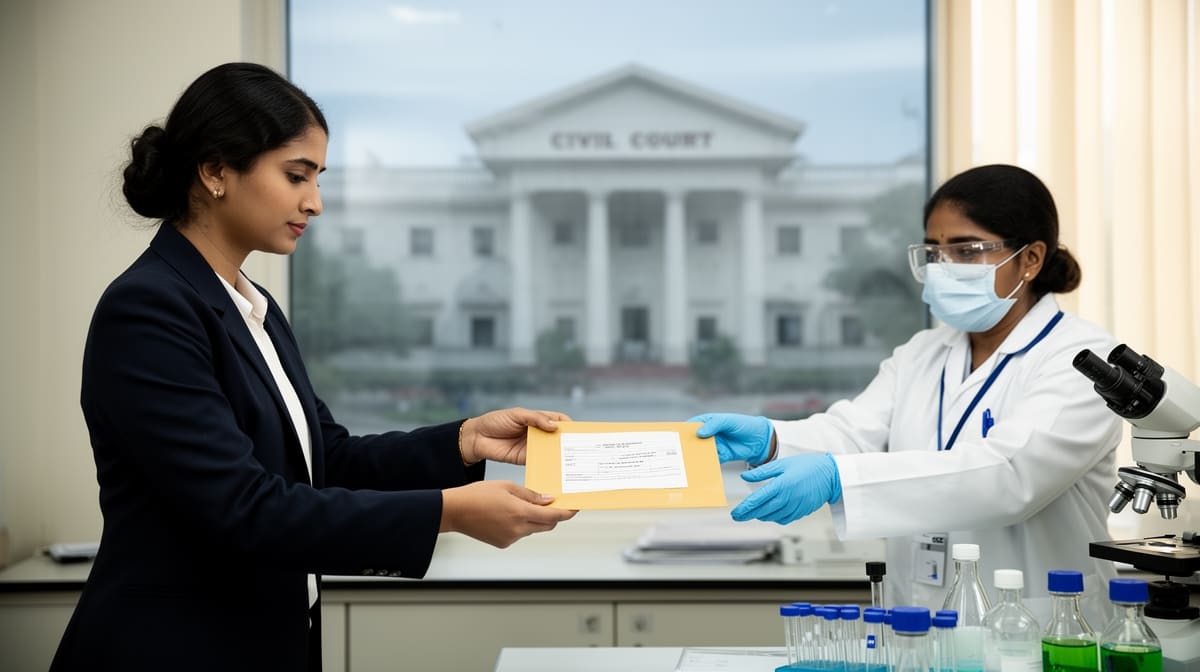
The petitioners succeeded. The Kerala High Court set aside the Magistrate’s order and directed the Trial Court to summon the disputed sale agreement from the Sub Court, Thalassery, and forward it for forensic handwriting and content analysis under Section 45 of the Indian Evidence Act.
What This Means For Similar Cases
Judicial Authority to Secure Evidence Trumps Investigative Lapses
- Practitioners must now argue that Section 45 Evidence Act empowers the court to act independently, even if the police have closed the investigation.
- Courts cannot defer to investigative inaction when the integrity of evidence is at stake.
- Applications for forensic analysis remain viable at any stage before judgment.
Forensic Analysis Is Essential When Content Insertion Is Alleged
- Admission of signing a document does not equate to admission of its contents.
- In forgery cases involving blank instruments, expert analysis of handwriting sequence and ink deposition is critical to prove fabrication.
- Courts must treat such requests as substantive, not technical.
Procedural Uncertainty Is Not a Valid Ground for Denial
- If a document’s custody is unclear, the court must issue a formal request to the relevant civil court, not dismiss the application.
- The burden to clarify custody lies with the custodial court, not the applicant.
- Courts must proactively coordinate across civil and criminal jurisdictions to secure evidence.