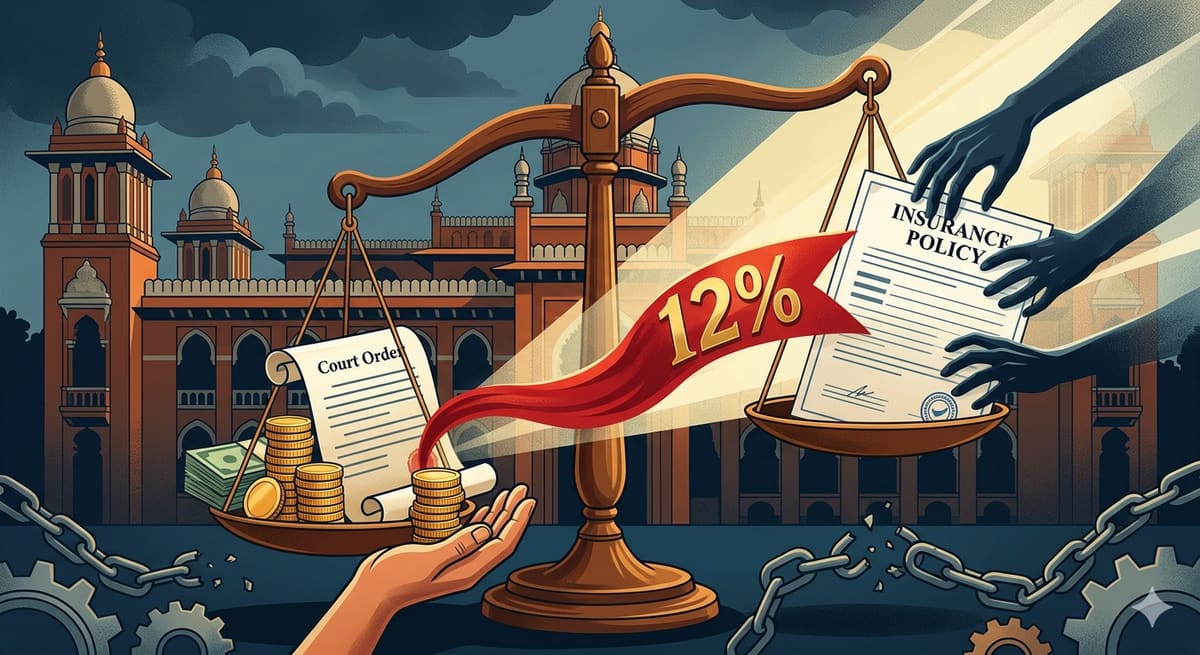
The Bombay High Court has clarified that insurers cannot escape liability for interest payments when compensation under the Workmen's Compensation Act, 1923 is delayed. The judgment establishes that interest liability flows from the primary compensation obligation, making both employers and insurers jointly and severally liable for such payments. This ruling strengthens the financial protection available to workers' dependents in compensation claims.
Background & Facts
The Dispute
The case arose from a fatal workplace accident where the deceased worker's dependents filed a claim for compensation under the Workmen's Compensation Act, 1923. The Labour Commissioner initially awarded compensation based on a monthly salary of Rs. 4,000, despite evidence proving the deceased earned Rs. 8,000 per month. Additionally, the Commissioner directed only the employer to pay interest on delayed compensation, excluding the insurance company from this liability.
Procedural History
The matter progressed through the following stages:
- Original Claim: Filed before the Labour Commissioner under the Workmen's Compensation Act, 1923
- Award: Labour Commissioner passed an order on compensation and interest liability
- Appeal: The dependents challenged the award before the Bombay High Court, raising two substantial questions of law
Relief Sought
The appellants sought:
- Recalculation of compensation based on the proven salary of Rs. 8,000
- Extension of joint and several liability for interest payments to include the insurance company
The Legal Issue
The Bombay High Court addressed two key questions:
- Whether the Labour Commissioner erred in calculating compensation based on Rs. 4,000 instead of the proven salary of Rs. 8,000
- Whether the liability for interest on delayed compensation should be joint and several between the employer and the insurer
Arguments Presented
For the Appellants
The appellants contended that:
- The Labour Commissioner's finding that the deceased earned Rs. 8,000 per month was supported by employer records and salary slips, making the Rs. 4,000 calculation arbitrary
- Since the Workmen's Compensation Act, 1923 imposes joint and several liability for compensation, interest on delayed payment should similarly bind both the employer and the insurer
- The Commissioner's failure to provide reasoning for excluding the insurer from interest liability violated principles of natural justice
For the Respondent
The employer's counsel argued that:
- The Labour Commissioner had discretion in determining compensation amounts
- Interest liability was distinct from primary compensation liability and could be imposed solely on the employer
- The insurance policy terms might limit the insurer's liability for interest payments
The Court's Analysis
The Court conducted a meticulous examination of the Workmen's Compensation Act, 1923 and the principles governing joint and several liability.
On the salary calculation issue, the Court observed:
"Once having come to a conclusion that the salary drawn by the deceased was Rs. 8,000/-, the Labour Commissioner appears to be in error in taking Rs. 4,000/- as salary."
The Court emphasized that factual findings must align with the evidence on record, particularly when employer records and salary slips clearly established the higher salary.
Regarding interest liability, the Court held:
"Since the liability of compensation is joint and several, even the interest liability has to be joint and several. There is nothing brought to my notice for coming to the conclusion that only employer would be liable for interest."
The Court rejected the artificial distinction between primary compensation and interest liability, reasoning that:
- Interest is a consequential liability arising from delayed payment of compensation
- The Workmen's Compensation Act, 1923 does not create separate liability regimes for compensation and interest
- Insurance policies covering workmen's compensation must logically extend to all consequential liabilities, including interest
- Excluding insurers from interest liability would undermine the protective purpose of the legislation
The Verdict
The Bombay High Court allowed the appeal on both counts. The Court:
- Directed the Labour Commissioner to recalculate compensation based on the proven salary of Rs. 8,000
- Held that both the employer and the insurance company are jointly and severally liable for interest on delayed compensation payments
- Remanded the matter to the Labour Commissioner for modification of the award in accordance with these directions
What This Means For Similar Cases
Insurers Cannot Escape Interest Liability
The judgment establishes a critical precedent for insurance companies:
- Insurers must now account for potential interest liability when underwriting workmen's compensation policies
- Policy wordings will be scrutinized to ensure coverage extends to interest payments
- Insurers may face increased claims exposure in delayed compensation cases
Evidentiary Standards for Salary Determination
Practitioners should note:
- Employer records and salary slips carry significant evidentiary weight in compensation claims
- Arbitrary reductions in salary calculations without justification will not withstand judicial scrutiny
- Claimants should prioritize gathering comprehensive employment documentation
Joint and Several Liability Principles Strengthened
The ruling reinforces that:
- Consequential liabilities flow from the primary obligation under the Workmen's Compensation Act, 1923
- Courts will not entertain artificial distinctions between compensation and interest liability
- Both employers and insurers must prepare for joint liability in all aspects of compensation claims, including interest payments