The Bombay High Court has clarified that statutory compensation payable under the Workmen's Compensation Act, 1923, cannot be reduced or offset by amounts received by dependents through a group insurance policy, even when the employer pays the premium - provided the employee has also contributed toward the premium through salary deductions. This ruling reinforces the non-negotiable nature of statutory liability under the WC Act and sets a critical precedent for employers seeking to rely on insurance payouts as a substitute for legal obligations.
Background & Facts
The Dispute
The dispute arose after Dadasaheb Laxman Kale, a fireman employed by the Nashik Municipal Corporation, died on 1 February 2006 while on duty. He was standing on a tin roof during a fire-extinguishing operation when it collapsed, causing fatal injuries. His widow and two sons, the respondents, filed a claim for compensation under the Workmen’s Compensation Act, 1923, seeking Rs. 3,07,800/- based on his monthly salary of Rs. 10,559/- and age of 50 years at the time of death.
Procedural History
- 2007: Claim filed before the Commissioner for Workmen’s Compensation, Nashik
- 2012: Labour Court awarded compensation of Rs. 3,06,180/- with 12% interest from 1 March 2006
- 2023: Municipal Corporation filed First Appeal before the Bombay High Court challenging the award
- 2026: Appeal heard and dismissed by Justice M. M. Sathaye
Relief Sought
The respondents sought full statutory compensation under the WC Act, arguing that payments received from group insurance and a voluntary ‘additional compensation’ of Rs. 1,00,000/- did not discharge the employer’s statutory liability. The appellant sought to set off the Rs. 2,75,000/- insurance payout and the Rs. 1,00,000/- ex-gratia payment against the statutory award.
The Legal Issue
The central question was whether compensation received under a group insurance policy can be adjusted against the statutory liability of an employer under Section 3 and Section 4 of the Workmen’s Compensation Act, 1923, particularly when the employee’s salary was deducted toward the insurance premium.
Arguments Presented
For the Appellant
The Municipal Corporation contended that since it had purchased a group insurance policy from The Oriental Insurance Company Ltd. and paid the premium, and since the deceased’s name was listed among covered employees, the Rs. 2,75,000/- paid to the respondents under the policy should be adjusted against the statutory compensation. It further argued that the Rs. 1,00,000/- ex-gratia payment and the compassionate appointment of one son rendered further liability unjustified. It relied on Associated Electrical Agencies and Dhropadabai v. Technocraft Toolings to argue that insurance payouts extinguish statutory liability.
For the Respondent
The respondents argued that monthly deductions of Rs. 1,043/- from the deceased’s salary toward ‘vima’ (insurance) proved that the policy was effectively funded by the employee himself. They contended that such a policy is a separate, voluntary benefit and cannot substitute statutory liability under the WC Act. They relied on National Insurance Co. Ltd. v. Kathamuthu Bright Industries to assert that insurance proceeds are not a legal substitute for compensation under the Act.
The Court's Analysis
The Court examined the nature of the group insurance policy and the source of premium payment. It noted that while the Municipal Corporation had arranged the policy, the pay slip (Exh. U-16) and income tax records clearly showed monthly deductions of Rs. 1,043/- from the deceased’s salary labeled as ‘vima’. This was not a mere administrative convenience but a direct financial contribution by the employee.
"If the Appellant Municipal Corporation was deducting monthly amounts towards Insurance policy from the salary of deceased Dadasaheb, it cannot be said that the Municipal corporation has paid the premium. However, this is a clear indication that the deceased Dadasaheb was paying premium towards insurance from his own pocket and the policy benefits were purchased by him."
The Court held that statutory liability under the WC Act is independent and non-derogable. Even if the employer pays the premium, if the employee contributes, the insurance benefit becomes a personal entitlement, not a substitute for statutory compensation. The Court distinguished Dhropadabai and Associated Electrical Agencies on the ground that those cases involved the Employees’ State Insurance Act, which contains an express bar under Section 53 - a provision absent in the WC Act.
The Court also affirmed that the Rs. 1,00,000/- payment was explicitly labeled as ‘special financial help’ and thus voluntary. It cannot be construed as an adjustment against statutory liability. The interest award under Section 4A(3)(a) was upheld as mandatory, given the employer’s failure to pay within one month of the accident.
The Verdict
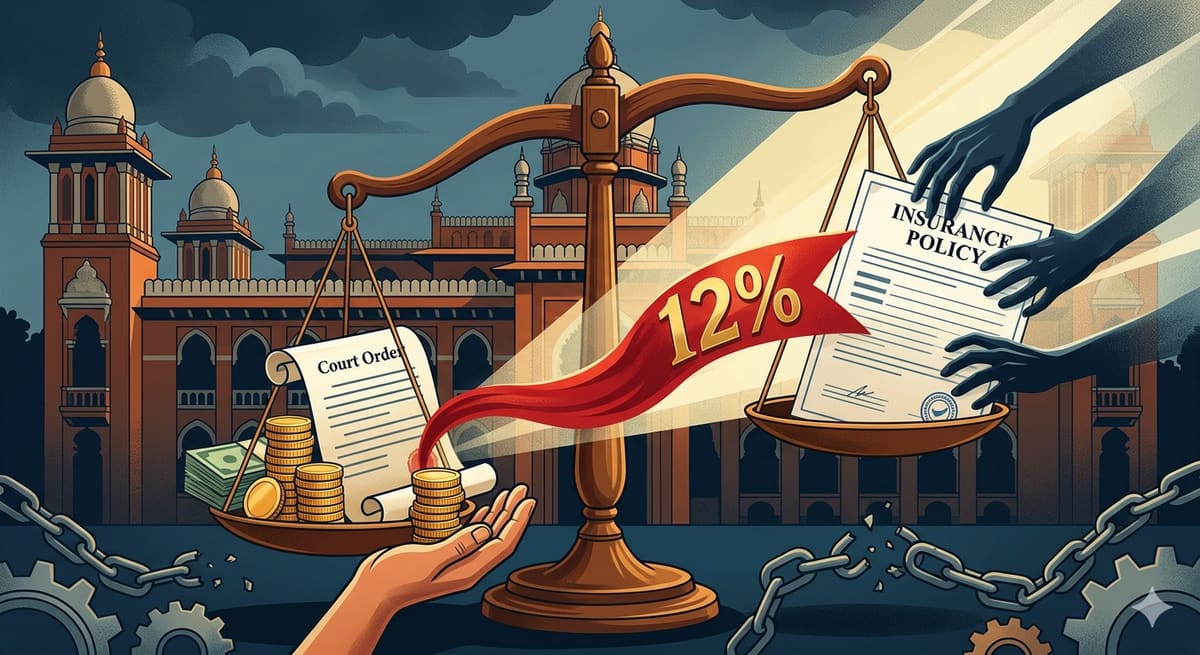
The respondents won. The Bombay High Court held that statutory compensation under the Workmen’s Compensation Act, 1923, cannot be reduced or offset by group insurance payouts when the employee has contributed to the premium. The appeal was dismissed, and the compensation award of Rs. 3,06,180/- with 12% interest was upheld.
What This Means For Similar Cases
Insurance Payouts Are Not a Substitute for Statutory Compensation
- Employers cannot claim set-off against WC Act compensation merely because they provide group insurance
- If any portion of the premium is deducted from the employee’s salary, the benefit is treated as the employee’s own acquisition
- Employers must pay statutory compensation regardless of insurance payouts, unless the policy is fully employer-funded and explicitly intended as a substitute
Documentary Evidence of Salary Deductions Is Decisive
- Pay slips showing deductions labeled as ‘insurance’ or ‘vima’ are conclusive proof of employee contribution
- Absence of explanation for such deductions by the employer will be construed against them
- Practitioners must insist on production of payroll records in all WC Act claims involving insurance
Voluntary Payments Do Not Discharge Legal Liability
- Ex-gratia payments, compassionate appointments, or humanitarian aid cannot be treated as partial fulfillment of statutory obligations
- Employers must separately discharge statutory liability even after making voluntary payments
- Courts will strictly interpret the language of payment vouchers - terms like ‘special help’ or ‘assistance’ will not be construed as legal adjustment