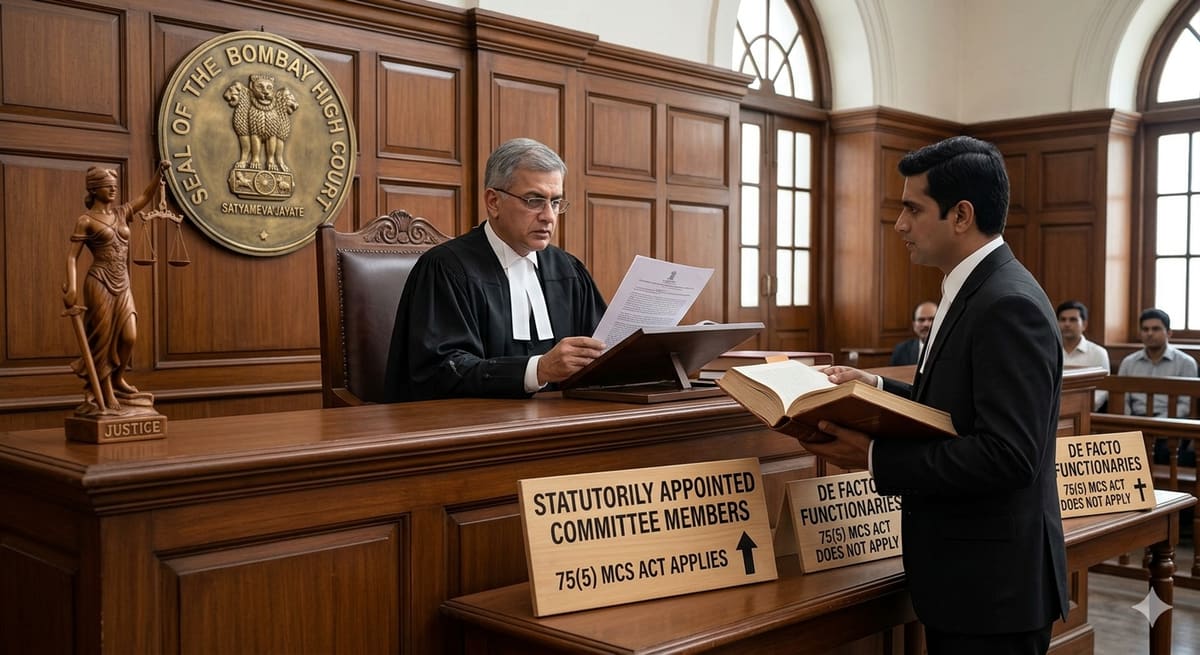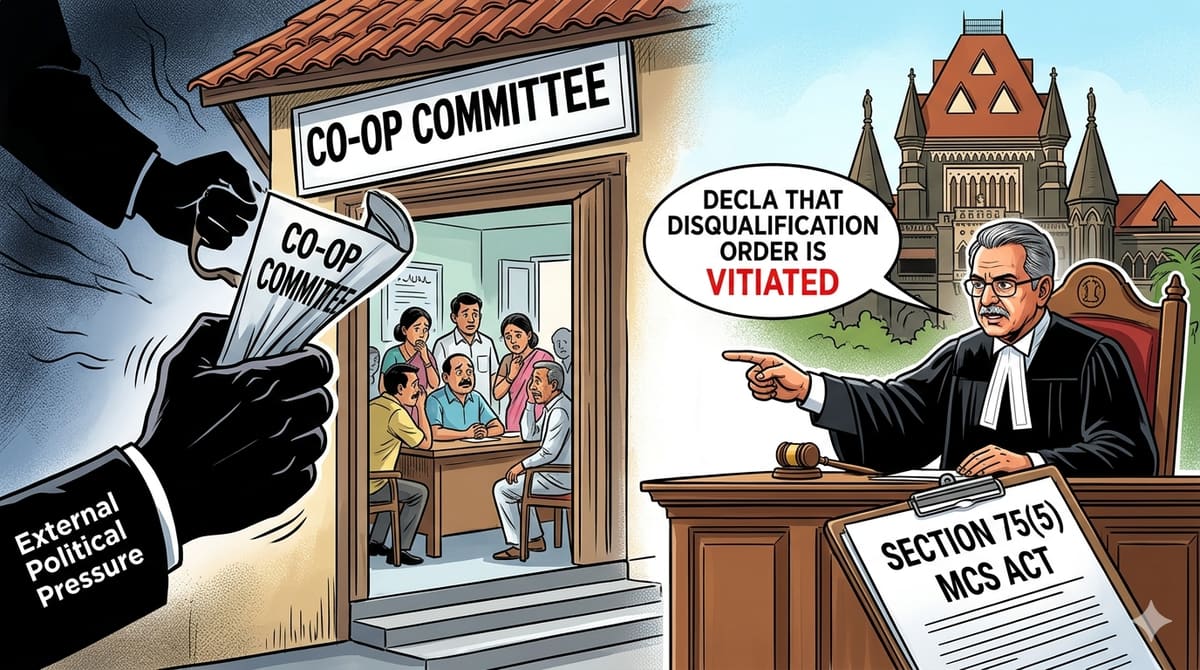
The Bombay High Court has clarified that disqualification of cooperative society managing committee members under Section 75 of the Maharashtra Cooperative Societies Act, 1960 requires proof of substantive breaches, not mere procedural irregularities. This judgment establishes that authorities cannot invoke Section 75(5) powers without demonstrating violations specifically contemplated under Section 75, marking a significant check on arbitrary disqualifications.
Background & Facts
The Dispute
The petitioners, members of a cooperative society's Managing Committee, were disqualified by the Deputy Registrar under Section 75(5) of the MCS Act through an order dated 24 June 2024. The disqualification order barred them from committee membership for six months and prohibited future appointments during this period.
Procedural History
The case progressed through multiple adjudicatory stages:
- June 2024: Deputy Registrar passed disqualification order under Section 75(5)
- Subsequent proceedings: Revision application dismissed by higher authority
- Election context: Society conducted elections under Section 77A while disqualification remained stayed
The Core Irregularity
The sole ground for disqualification was a procedural lapse: the society's auditor was allegedly appointed without a proper Managing Committee resolution. The Deputy Registrar recorded that all core compliances under the MCS Act were otherwise satisfied.
The Legal Issue
The central question before the Court was whether Section 75(5) of the MCS Act empowers authorities to disqualify managing committee members for procedural irregularities that do not constitute substantive breaches specifically enumerated under Section 75 of the Act.
The Court's Analysis
The Court conducted a textual analysis of Section 75 and its sub-sections, emphasizing the following principles:
-
Statutory Interpretation: The Court examined the language of Section 75 and found that it enumerates specific grounds for disqualification. The provision does not include procedural lapses like improper auditor appointment.
-
Precedential Reasoning: While no specific precedents were cited, the Court relied on the fundamental principle that statutory powers must be exercised strictly within their prescribed limits. The judgment observed:
"In the absence of any breach contemplated under Section 75, the Authority could not have exercised powers under Section 75(5), much less against the entire Managing Committee."
-
Procedural Safeguards: The Court noted that the Revisional Authority had dismissed the petitioners' challenge primarily on technical grounds - that elections had already been conducted under Section 77A - without addressing the substantive merits of the disqualification.
-
Substantive vs. Procedural Compliance: The judgment distinguished between core compliances (which were satisfied) and procedural irregularities (which cannot trigger disqualification under Section 75).
The Verdict
The Bombay High Court allowed the writ petitions and set aside the disqualification order. The Court held that:
- The Deputy Registrar's order under Section 75(5) was unsustainable in law
- Disqualification requires proof of breaches specifically contemplated under Section 75
- Mere procedural irregularities cannot justify invocation of Section 75(5) powers
What This Means For Similar Cases
Disqualification Requires Substantive Breach
Cooperative societies and their legal advisors must now recognize that:
- Section 75(5) powers cannot be invoked for procedural lapses not enumerated in Section 75
- Authorities must demonstrate specific violations of Section 75 provisions before disqualifying committee members
- General compliance with core requirements creates a presumption against disqualification
Procedural Irregularities Are Not Punishable Under Section 75
The judgment establishes clear boundaries for administrative action:
- Auditor appointment irregularities cannot trigger Section 75(5) disqualification
- Resolution defects must be addressed through other statutory mechanisms, not removal powers
- Election-related disqualifications require separate consideration under Section 77A
Strategic Considerations for Practitioners
- When challenging disqualification orders, examine whether the alleged breach falls within Section 75's enumerated grounds
- Argue that core compliance creates a presumption against arbitrary removal
- Distinguish between substantive violations and procedural irregularities in disqualification proceedings