
Topic

Maharashtra Cooperative Societies Act

The Maharashtra Cooperative Societies Act governs the formation, management, and disputes of cooperative societies in Maharashtra, including membership, elections, bye-laws, and property rights.

25 articlesLatest May 2026
Section 77A Maharashtra Cooperative Societies Act | Vacant Reserved Seats Excluded from Two-Third Majority Calculation for Committee Supersession : Bombay HC
Case Law Analysis
|Bombay High Court

Section 77A Maharashtra Cooperative Societies Act | Vacant Reserved Seats Excluded from Two-Third Majority Calculation for Committee Supersession : Bombay HC

The Bombay High Court has ruled that vacant seats reserved under the Maharashtra Cooperative Societies Act must be excluded when determining the effective strength of a managing committee for the purpose of Section 77A supersession. This clarifies that only elected and filled positions count toward the two-thirds majority threshold, protecting cooperative societies from arbitrary state intervention when reserved seats remain unfilled due to lack of eligible candidates.

Section 73-AAA(3) Maharashtra Cooperative Societies Act | Term Expiry Voids Committee Continuity, Validates Authorized Officer Appointment : Bombay HC Aurangabad Bench
Case Law Analysis
|Bombay High Court

Section 73-AAA(3) Maharashtra Cooperative Societies Act | Term Expiry Voids Committee Continuity, Validates Authorized Officer Appointment : Bombay HC Aurangabad Bench

Bombay High Court rules that the 2025 amendment to Section 73-AAA(3) of the Maharashtra Cooperative Societies Act removes statutory protection for Type 'A' societies post-term expiry, empowering the Registrar to appoint an Authorized Officer. This ruling impacts all cooperative societies failing to conduct timely elections, stripping outgoing committees of authority.

Section 75(5) MCS Act | Disqualification Applies Only to Statutorily Appointed Committee Members, Not De Facto Functionaries : Bombay HC
Case Law Analysis
|Bombay High Court

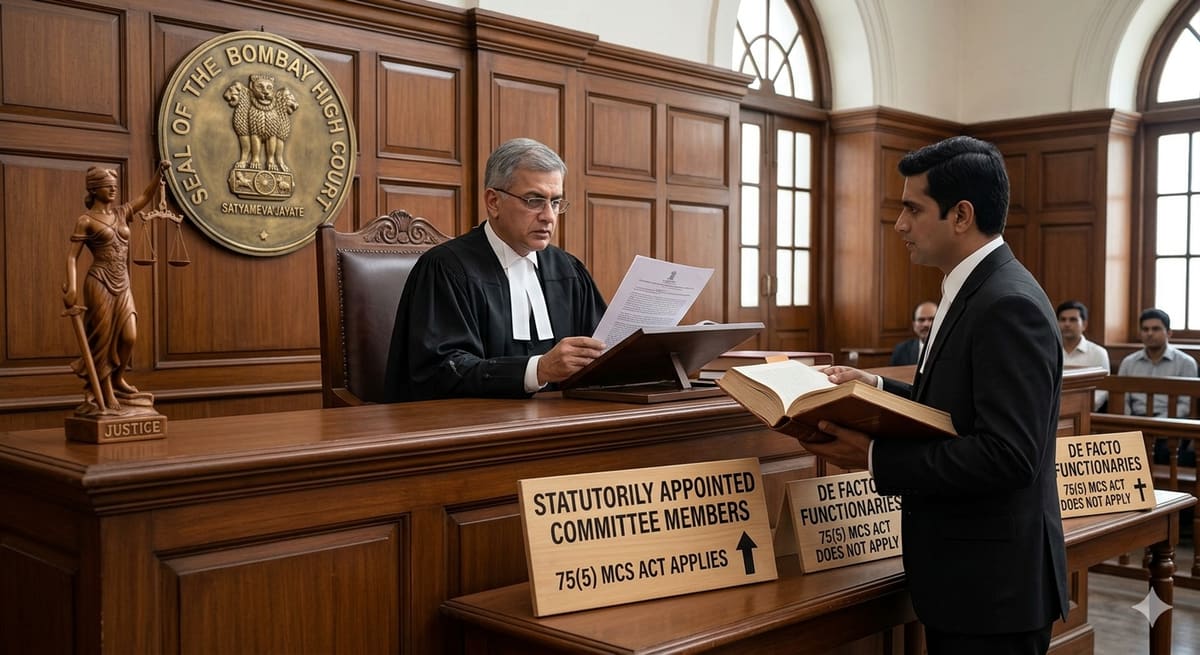
Section 75(5) MCS Act | Disqualification Applies Only to Statutorily Appointed Committee Members, Not De Facto Functionaries : Bombay HC

The Bombay High Court has ruled that disqualification under Section 75(5) of the Maharashtra Cooperative Societies Act requires formal legal office-holding, not mere de facto control after tenure expiry. This sets a vital precedent for cooperative societies, protecting former members from retrospective liability and reinforcing statutory compliance over functional continuity.

Section 154B(27) MCoS Act | Cooperative Court Retains Jurisdiction Over Lease Deed Disputes When Society Recognizes Associate Membership, Even Amid Contested Family Arrangement : Bombay HC
Case Law Analysis
|Bombay High Court

Section 154B(27) MCoS Act | Cooperative Court Retains Jurisdiction Over Lease Deed Disputes When Society Recognizes Associate Membership, Even Amid Contested Family Arrangement : Bombay HC

The Bombay High Court has ruled that a cooperative society’s recognition of a deceased member’s associate membership vests the Cooperative Court with jurisdiction to adjudicate disputes over lease deed execution, regardless of whether a family arrangement is later contested. This affirms that procedural recognition by the society, not private familial agreements, determines the forum for property disputes under the Maharashtra Cooperative Societies Act - a critical precedent for housing societies and heirs navigating succession and tenancy rights.

Section 73-CB Maharashtra Cooperative Societies Act | Statutory Election Procedure Mandatory for Managing Committee Validity: Bombay HC
Case Law Analysis
|Bombay High Court

Section 73-CB Maharashtra Cooperative Societies Act | Statutory Election Procedure Mandatory for Managing Committee Validity: Bombay HC

Bombay High Court rules that cooperative society elections conducted without adhering to the statutory procedure under Section 73-CB of the Maharashtra Cooperative Societies Act, 1960 and the 2014 Rules are legally void. The court mandates strict compliance with notification, eligibility scrutiny, and nomination processes, even for unanimous elections, to prevent bypassing statutory mandates.

Maharashtra Cooperative Societies Act | Joint Membership in Tenant Ownership Society Does Not Confer Land Title: Bombay HC
Case Law Analysis
|Bombay High Court

Maharashtra Cooperative Societies Act | Joint Membership in Tenant Ownership Society Does Not Confer Land Title: Bombay HC

Bombay High Court clarifies that joint membership under Section 154B of the Maharashtra Cooperative Societies Act merely records internal society rights and does not transfer or create proprietary rights in land. The ruling protects original owners' titles from being diluted by cooperative society records, impacting family settlements and inheritance disputes in tenant ownership housing societies.

Maharashtra Cooperative Societies Act | Cooperative Societies Cannot Deny Membership Transfer Over Disputed Common Areas : Bombay HC
Case Law Analysis
|Bombay High Court

Maharashtra Cooperative Societies Act | Cooperative Societies Cannot Deny Membership Transfer Over Disputed Common Areas : Bombay HC

The Bombay High Court has ruled that cooperative housing societies must process membership transfers based solely on registered instruments and statutory eligibility, even when common areas are in dispute. This clarifies that title disagreements over shared spaces cannot be weaponized to block legal transfers, protecting buyers' rights under the Act and ensuring statutory compliance over arbitrary society discretion.

Section 154B-27 MCS Act | Registrar Cannot Enforce Developer’s Contractual Claims - Only Statutory Obligations Fall Within Jurisdiction : Bombay HC
Case Law Analysis
|Bombay High Court

Section 154B-27 MCS Act | Registrar Cannot Enforce Developer’s Contractual Claims - Only Statutory Obligations Fall Within Jurisdiction : Bombay HC

The Bombay High Court has ruled that the Registrar under the Maharashtra Cooperative Societies Act lacks authority to enforce developmental or contractual rights claimed by a developer, limiting intervention strictly to statutory duties under the Act or bye-laws. This sets a vital precedent for cooperative societies resisting undue interference in private agreements, reinforcing the boundary between administrative oversight and civil contract enforcement.