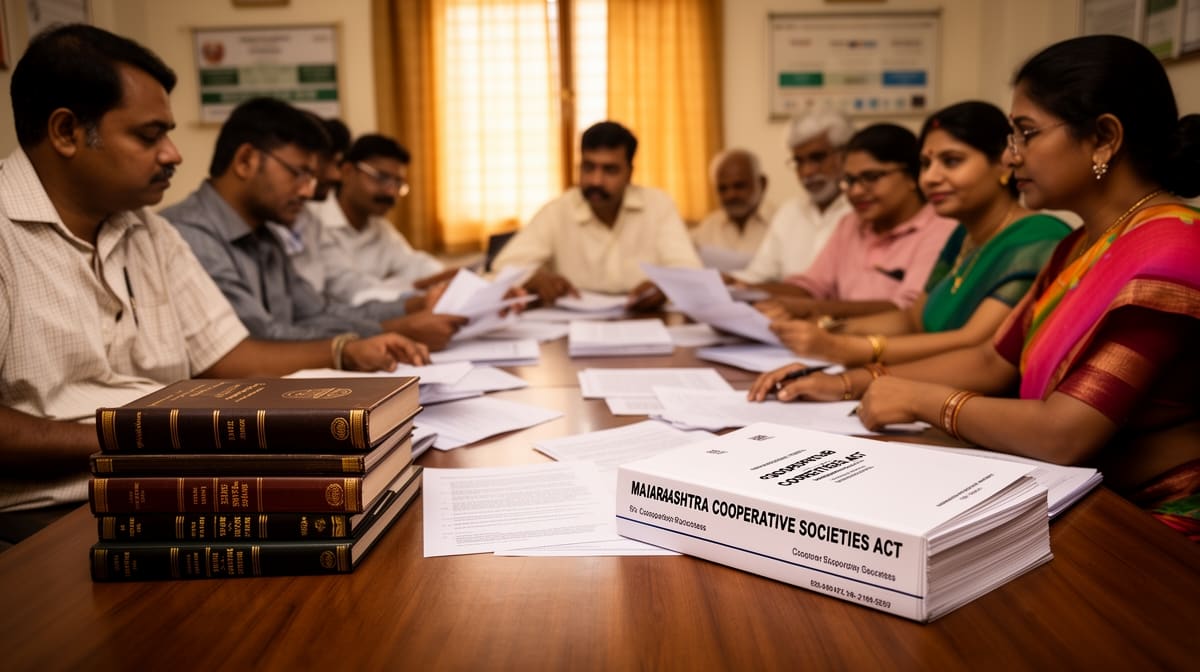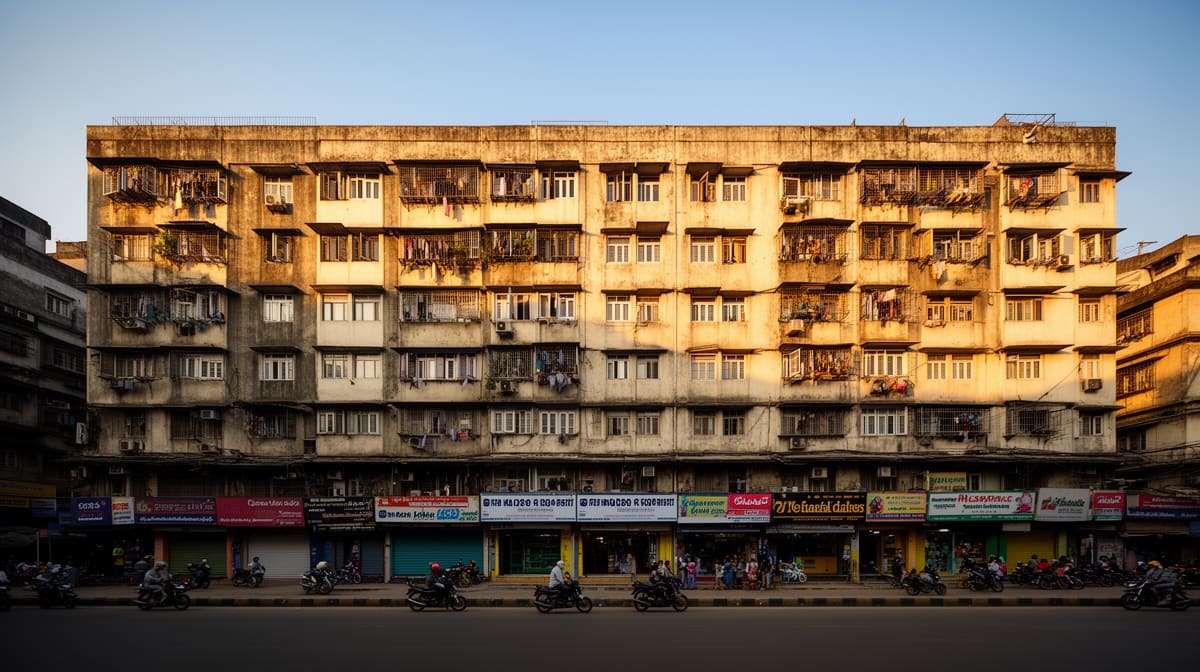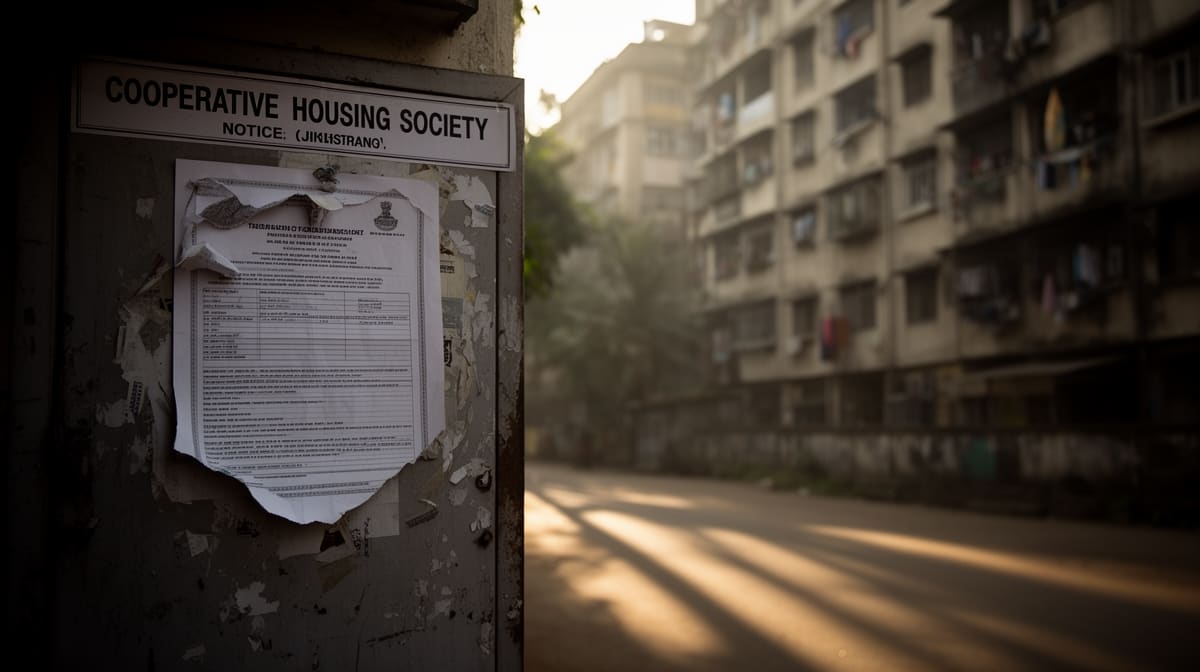
The Bombay High Court dismissed the Minister’s order de-registering Hatkesh Udyog Nagar Industrial Premises Co-operative Housing Society Ltd., holding that the power under Section 21A of the Maharashtra Co-operative Societies Act can be exercised only when the society was registered on a material misrepresentation, not merely on subsequent construction irregularities.
Background & Facts
The Dispute
The petitioners, members of Hatkesh Udyog Nagar Industrial Premises Co-operative Housing Society Ltd. (the Society), challenged the de-registration order dated 15 July 2024 passed by the Divisional Joint Registrar and the subsequent affirmation by the Hon’ble Minister on 23 June 2025. The respondents, led by Mr. Paresh S. Vohra, are the proprietors of M/s. Hatkesh Builders, the original developer of the industrial units on the land.
Key Facts
- The land comprising Survey Nos. 94-97, Village-Ghodbunder, Thane, was originally sold by Smt. Dayabai Gajanan Patil on 21 Oct 1975 and subsequently transferred to M/s. Hatkesh Builders by 19 July 1980.
- About 72 industrial units were constructed on the land between 1979-80 and 2008.
- The Society was registered on 11 Nov 2008 (Certificate of Registration No. ??) after unit purchasers applied for a cooperative industrial premise society.
- Respondent No. 1 (Mr. Vohra) filed Misc. Application No. 5 of 2015 under Section 21A seeking de-registration, alleging forged documents and misrepresentation.
- The Divisional Joint Registrar initially rejected the application on 26 Dec 2016 for delay, but the Minister set aside that order on 27 Nov 2020 and remanded for fresh adjudication.
- The Minister again remanded on 10 May 2021; the Society challenged this in Writ Petition No. 2250 of 2021, which the Court dismissed on 15 Mar 2024.
- The Divisional Joint Registrar finally allowed the de-registration application as Misc. Application No. 15 of 2020 on 15 July 2024, directing cancellation of the Society’s registration and appointment of an Official Assignee.
- Petitioners filed Appeal No. 565 of 2024 before the Minister, which was dismissed on 23 June 2025. The petitioners then obtained interim relief on 4 May 2026 staying both the Registrar’s and Minister’s orders.
Procedural History
- 21 Oct 1975: Sale deed of land to Shri Rasiklal Trikam Lal Shah.
- 19 July 1980: Sale deed to M/s. Hatkesh Builders.
- 30 June 2008: Application for reservation of society name.
- 1 Oct 2008: Application for registration of the Society.
- 11 Nov 2008: Certificate of Registration issued.
- 12 Mar 2010: Society sent list of members and registration copy to Respondent No. 1.
- 12 Dec 2013/Jan 2014: Respondent No. 1 claims to have learned of registration after summons in RC Suit No. 582 of 2013.
- 18 May 2015: Application to Lokayukta for cancellation of registration.
- 5 May 2015: Misc. Application No. 5 filed before Divisional Joint Registrar.
- 26 Dec 2016: Registrar rejected application for delay.
- 27 Nov 2020: Minister set aside rejection, remanded for fresh adjudication.
- 3 Feb 2021: Court remanded matter to Minister.
- 10 May 2021: Minister again remanded to Registrar.
- 15 Mar 2024: Court dismissed Society’s challenge to Minister’s order.
- 15 July 2024: Divisional Joint Registrar allowed de-registration (Misc. App. No. 15 of 2020).
- 23 June 2025: Minister dismissed Appeal No. 565 of 2024.
- 4 May 2026: Court granted interim stay of both orders.
- 5 Aug 2026: Judgment delivered.
Parties’ Positions
- Petitioners: Argue that the Registrar mis-applied Section 21A, that the alleged misrepresentation relates to post-registration construction irregularities, and that the power should not be used to benefit the developer who caused the irregularities.
- Respondent No. 1: Contends that the Society was registered on forged documents and false statements about land, number of units and development permission, invoking the misrepresentation ground under Section 21A.
- State (Respondent-State): Supports the Minister’s order, emphasizing the alleged falsified documents and lack of proper NA permission.
Relief Sought
Petitioners seek (i) setting aside of the Registrar’s order dated 15 July 2024 and the Minister’s order dated 23 June 2025; (ii) dismissal of the de-registration application; and (iii) restoration of the Society’s registration.
The Legal Issue
Whether the power of de-registration under Section 21A(1) of the Maharashtra Co-operative Societies Act, 1960 can be exercised on the basis of post-registration construction irregularities or alleged lack of development permission, or whether it is limited to a misrepresentation made at the time of registration that, if absent, would have prevented the society’s registration.
Arguments Presented
For the Petitioners
- The Registrar’s findings conflate irregularities in construction with the statutory ground of misrepresentation under Section 21A.
- Citing Sukhsagar Co-operative Housing Society Ltd. v. State of Maharashtra and Airoli Neha Apartments Co-operative Housing Society Ltd. v. State of Maharashtra, the petitioners argue that the Registrar’s jurisdiction under Section 21A is narrow and does not extend to assessing legality of construction.
- They submit that the developer cannot benefit from his own wrong; the misrepresentation must be material to the registration itself.
For the Respondents
- Relying on Elite Diagnostic Center Private Ltd. v. Krishna Kunj Co-operative Housing Society Ltd., the respondents contend that any false or forged document submitted for registration, even if discovered later, falls within the misrepresentation ground.
- They emphasize the discrepancies in unit numbers, use of white-ink to alter survey numbers, and lack of NA permission as evidence of deliberate falsification.
- The State argues that the Registrar correctly exercised discretion under Section 21A after being satisfied of misrepresentation.
The Court's Analysis
The Court began by outlining the statutory scheme of Section 21A. It reiterated that the provision empowers the Registrar to de-register a society only when one of four enumerated eventualities is satisfied, the first being registration on misrepresentation made by the applicants. The Court stressed that this ground is narrow and requires a misrepresentation of such magnitude that, had it not been made, the society would not have been registered.
"The misrepresentation must be of such nature and degree that if not made, the society would not have been registered. Mere giving of inaccurate or incomplete information cannot be a misrepresentation capable of de-registering the society."
The Court examined the precedent in Elite Diagnostic Center and clarified that while that decision recognized that forged documents could trigger Section 21A, it also required the misrepresentation to be material to the registration. The Court distinguished the present case from Sukhsagar and Airoli Neha Apartments, where the courts held that construction legality is extraneous to the registration function of the Registrar.
Applying this framework, the Court found that the alleged irregularities - absence of NA permission, mismatch in unit numbers, and use of white-ink - pertained to post-registration events or to matters that could be addressed by the planning authority, not to the information supplied at the time of registration. The Registrar’s reliance on these factors therefore exceeded the jurisdiction conferred by Section 21A.
The Court also noted that Respondent No. 1 had the opportunity to appeal the registration order under Section 152 of the Act but chose not to, instead filing a de-registration application. This choice underscored that the appropriate remedy for any alleged registration defect was an appeal, not a de-registration proceeding.
Consequently, the Court held that the Registrar’s order was ultra vires, and the Minister’s affirmation, being based on the same flawed reasoning, was likewise untenable. The Court emphasized the principle that a developer cannot take advantage of his own wrong by using the statutory mechanism to dismantle a society formed by unit purchasers.
The Verdict
The Court set aside both the Divisional Joint Registrar’s order dated 15 July 2024 and the Hon’ble Minister’s order dated 23 June 2025. The de-registration application filed by Respondent No. 1 was dismissed. No costs were awarded. The Society’s registration stands restored.
What This Means For Similar Cases
Misrepresentation Must Be Core to Registration
- Practitioners must ensure that any claim under Section 21A is anchored in a false statement or forged document that was material at the time of registration.
- Post-registration irregularities, such as lack of development permission, are not sufficient grounds for de-registration.
Appeal Under Section 152 Remains the Primary Remedy
- If a party believes the registration order is flawed, the correct procedural route is an appeal under Section 152 of the MCS Act, not a de-registration petition.
- Courts will view a de-registration application as an attempt to bypass the appellate mechanism and may set it aside.
Avoiding “Benefit of One’s Own Wrong”
- Developers cannot use statutory powers to nullify a society after they have caused the alleged irregularities.
- Lawyers should advise clients to address construction or permission issues through planning authorities rather than relying on de-registration provisions.
Actionable Takeaways
- Verify the exact content of documents submitted at registration before invoking Section 21A.
- File an appeal under Section 152 promptly if registration is contested.
- Document any post-registration compliance issues separately; do not conflate them with misrepresentation.