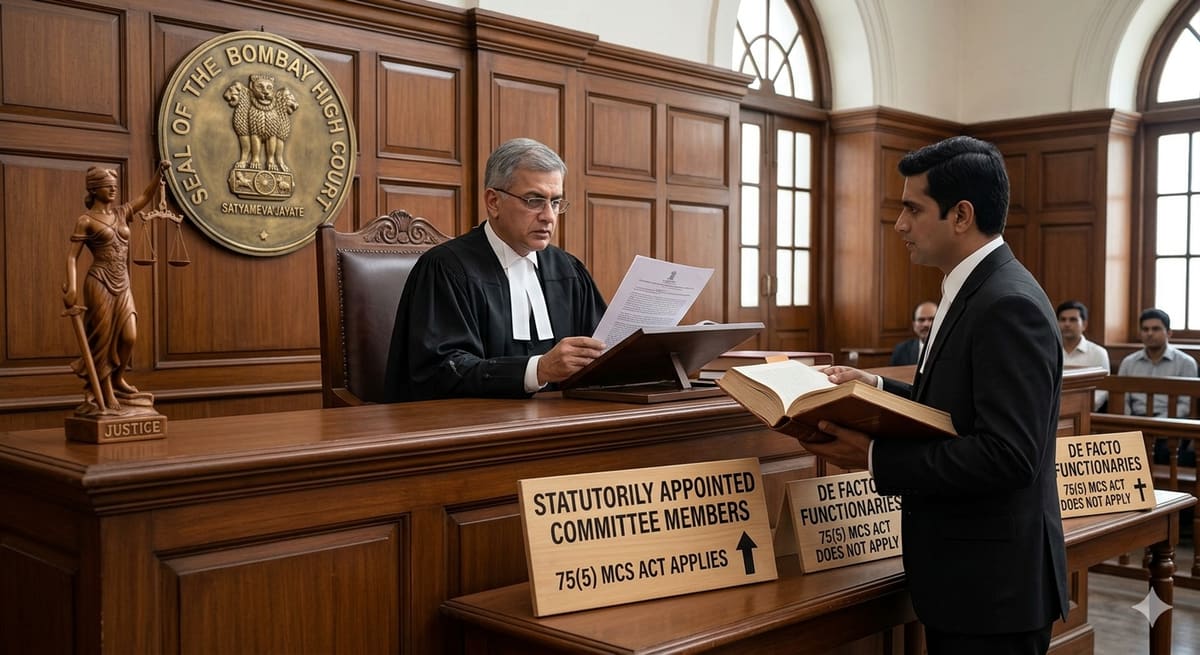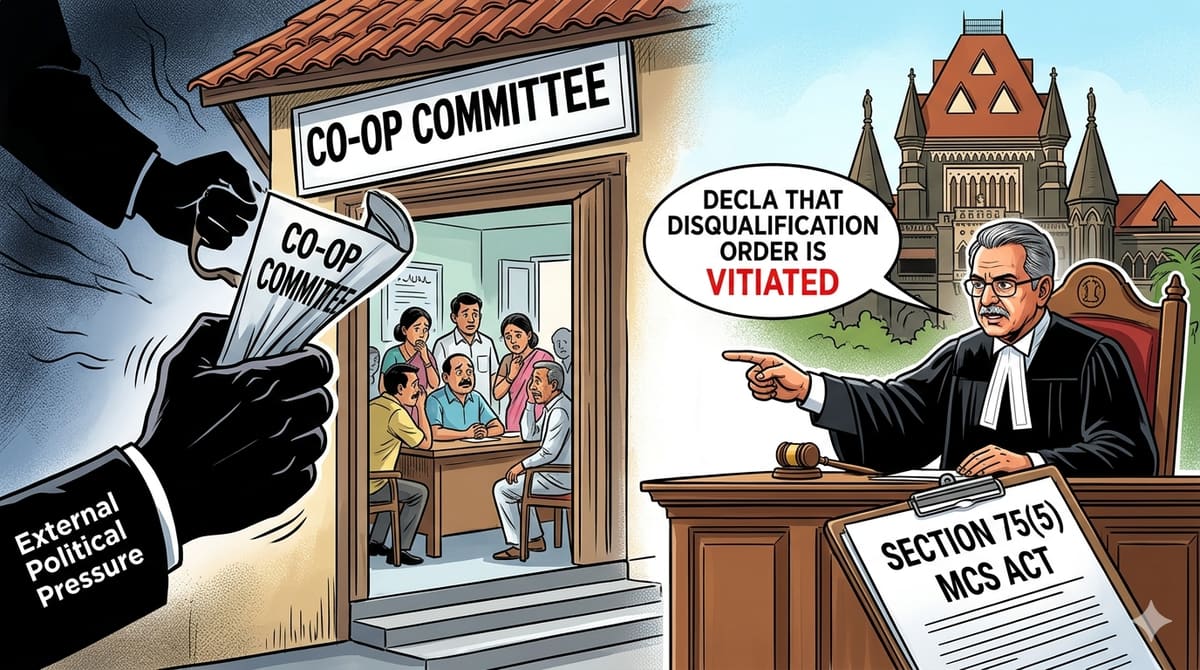
The Bombay High Court has set aside the disqualification of managing committee members of a co-operative society, holding that statutory action initiated under external political pressure violates the principle of independent decision-making. The judgment reinforces that statutory authorities must act free from extraneous influence, especially when their orders carry severe civil consequences.
Background & Facts
The Dispute
The dispute arose from a proposed redevelopment of the Nensey Cottage Co-operative Housing Society Ltd, Mumbai. The Managing Committee, comprising the Petitioners, secured approval from 85% of members for redevelopment. A faction of members, dissatisfied with the process, approached MLC Sudhir Hattangadi, a local Member of Legislative Council, seeking intervention. This led to a chain of statutory actions against the Managing Committee.
Key Facts
The Managing Committee was elected and in office as of July 2025
Redevelopment plan approved by 85% of members by July 2025
Complaint dated 2 July 2025 addressed to MLC Sudhir Hattangadi
MLC sent communication dated 26 August 2025 to Deputy Registrar, Co-operative Societies, R-North Ward
On the same day, 26 August 2025, Deputy Registrar issued show cause notice under Section 77A(1)(b-1)
Complaint No. 6826 dated 26 August 2025 filed by MLC with Divisional Joint Registrar
Deputy Registrar passed order dated 27 November 2025 under Section 75(5) disqualifying Petitioners Nos. 1 to 4 for two years
Show cause notice dated 18 December 2025 issued under Section 77A(1)(b-1)
Petitioners submitted detailed reply on 30 December 2025
Order dated 20 January 2026 appointed Board of Administrators under Section 77A(1)(b-1)
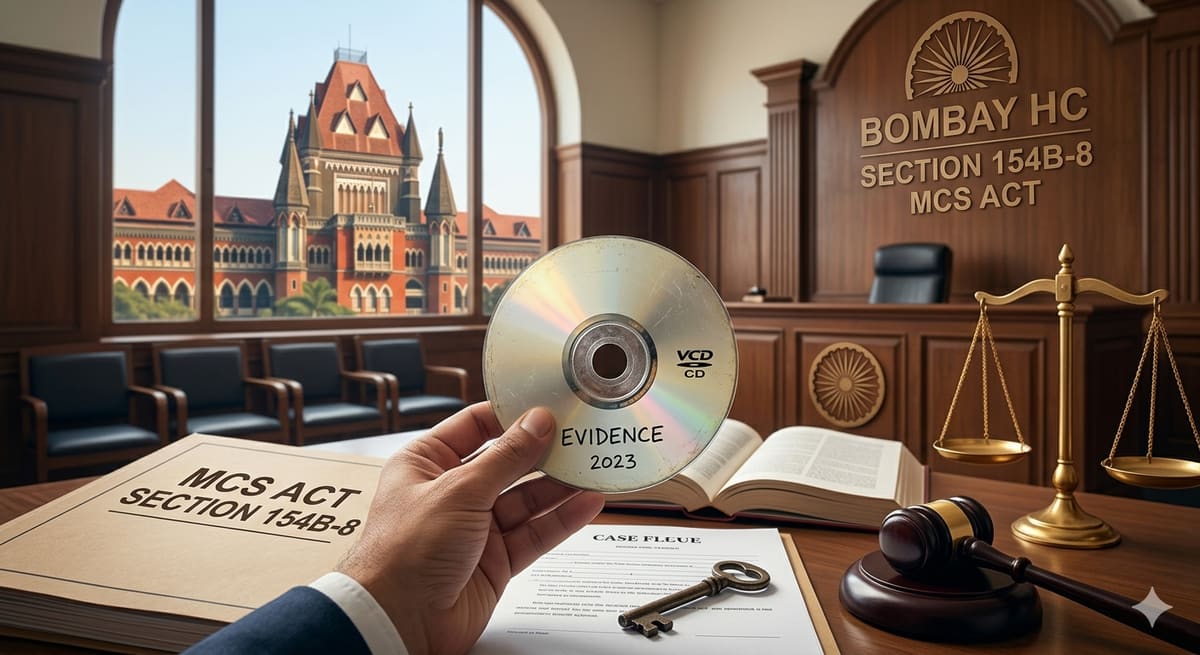
Accounts for FY 2022-23 approved in AGM on 24 September 2023; Audit Rectification Report submitted to Deputy Registrar on 20 October 2023 with official acknowledgement
Accounts for FY 2023-24 approved in AGM on 29 September 2024; Audit Rectification Report submitted on 28 October 2024 with official acknowledgement
Divisional Joint Registrar passed common order dated 15 April 2026, reducing disqualification period to six months but upholding both orders
Procedural History
26 August 2025: MLC communication sent to Deputy Registrar; same day, show cause notice issued
27 November 2025: Deputy Registrar passes order under Section 75(5) disqualifying Petitioners for two years
18 December 2025: Show cause notice issued under Section 77A(1)(b-1)
30 December 2025: Petitioners submit detailed reply with supporting documents
20 January 2026: Deputy Registrar appoints Board of Administrators under Section 77A(1)(b-1)
15 April 2026: Divisional Joint Registrar upholds disqualification (reduced to six months) and confirms appointment of Administrator
4 February 2026: Bombay HC grants liberty to pursue statutory remedies in Writ Petition (L) No. 2251 of 2026
April 2026: Petitioners file Revision Application No. 65 of 2026 and Appeal No. 33 of 2026
7 May 2026: Present writ petition decided by Bombay HC
The Parties' Positions
Petitioners: Argued that the disqualification and appointment of Administrator were triggered by political interference via MLC, not independent statutory assessment. Contended that audit reports and accounts were duly submitted and approved, with official acknowledgements dated 20 October 2023 and 28 October 2024. Asserted that the authority failed to consider these documents and acted under external pressure.
Respondents: Contended that the Managing Committee failed to place Audit Rectification Reports and annual budgets before the General Body, violating Bye-law No. 95 and Sections 75(2)(vii), 75(2)(viii), and 75(4) of the Maharashtra Co-operative Societies Act, 1960. Argued that disqualification was justified and appointment of Administrator was necessary due to vacuum in the Managing Committee.
Relief Sought
The Petitioners sought quashing of the orders dated 27 November 2025, 20 January 2026, and 15 April 2026; restoration of the Managing Committee; release of the frozen bank account; and directions to prevent future political interference in co-operative society governance.
The Legal Issue
The central question was whether a statutory order disqualifying members of a co-operative society’s managing committee under Section 75(5) of the Maharashtra Co-operative Societies Act, 1960, is valid when initiated due to external political influence and without independent evaluation of documentary evidence submitted by the affected parties.
Arguments Presented
For the Petitioner
Learned counsel argued that the proceedings were triggered not by independent statutory concern but by a political communication from an MLC, followed by immediate action. They relied on the official acknowledgements dated 20 October 2023 and 28 October 2024 to prove that audit reports were submitted and received. They cited State of M.P. v. Sanjay Nagayach to assert that statutory authorities must act independently and cannot be influenced by external actors. They emphasized that the Divisional Joint Registrar failed to examine the documents and merely observed that it "appears" reports were not placed, which is legally insufficient.
For the Respondent
The State and Respondent No. 12 contended that the Managing Committee failed to comply with mandatory requirements under Bye-law No. 95 and Sections 75(2)(vii) and 75(4) by not placing audit rectification reports and budgets before the General Body. They argued that the disqualification was procedurally valid and the appointment of Administrator was necessary due to the resulting vacuum. They claimed that the involvement of the MLC was merely a complaint mechanism and did not affect the legality of the orders.
The Court's Analysis
The Court undertook a rigorous examination of the sequence of events and the statutory framework. It held that the timing of the MLC’s communication on 26 August 2025 and the immediate issuance of the show cause notice on the same day created a compelling inference of external influence. The Court emphasized that while complaints through elected representatives are not per se illegal, the statutory authority must act on its own satisfaction.
"When events follow in such close sequence, the Court is required to examine whether the authority acted because it was satisfied on record, or because it was prompted to act."
The Court found that the Divisional Joint Registrar’s observation that it "appears" the reports were not placed before the General Body was legally inadequate. The authority had access to the acknowledged submissions dated 20 October 2023 and 28 October 2024 but failed to examine them. The Court held that such a conclusion, devoid of reasoning, violates the principles of natural justice and the requirement of independent application of mind.
The Court further relied on State of M.P. v. Sanjay Nagayach to reinforce that statutory functionaries must be above suspicion and must not act under external pressure. The judgment noted that disqualification under Section 75(5) carries grave consequences, including barring members from contesting future elections, and therefore demands heightened scrutiny.
Regarding the appointment of Administrators under Section 77A(1)(b-1), the Court held that the order was entirely dependent on the disqualification. Since the disqualification was vitiated, the basis for the Administrator’s appointment collapsed. The Court also found that the use of the proviso to Section 77A - allowing non-notice in cases of urgency - was unjustified, as no reasons for urgency were recorded. The appointment of a complainant as Administrator further undermined the neutrality of the process.
The Court concluded that the cumulative effect of political involvement, immediate action, failure to consider documentary evidence, and lack of reasoned order amounted to a colorable exercise of power, rendering the impugned orders invalid.
The Verdict
The Petitioners succeeded. The Court quashed the orders dated 27 November 2025, 20 January 2026, and 15 April 2026. The disqualification of the Petitioners stands set aside. The Managing Committee of the Society is restored to its original position. Any Administrator or Board of Administrators must forthwith hand over all records, documents, and accounts to the restored Managing Committee. The operation of the Society’s bank account, if restricted, shall be restored. The State Government shall examine the conduct of Respondents No. 1 and 2 within three months and file a compliance affidavit.
What This Means For Similar Cases
Statutory Authorities Must Act Independently
Practitioners must challenge any co-operative society order initiated after political intervention by establishing a temporal and causal link between external communication and statutory action
Authorities must record specific findings based on documentary evidence, not vague observations like "it appears"
Failure to examine submitted documents constitutes a violation of natural justice
Disqualification Orders Require Rigorous Scrutiny
Disqualification under Section 75(5) is a severe penalty affecting democratic rights; courts will apply heightened scrutiny
The burden shifts to the authority to prove independent application of mind, especially when external influence is alleged
Mere procedural compliance without substantive reasoning is insufficient to uphold disqualification
Appointment of Administrators Is Not Automatic
Appointment under Section 77A(1)(b-1) requires independent justification beyond disqualification of members
Use of the urgency proviso must be supported by concrete reasons, not general assertions
Appointing a complainant or party to the dispute as Administrator raises legitimate concerns of bias and will be invalidated