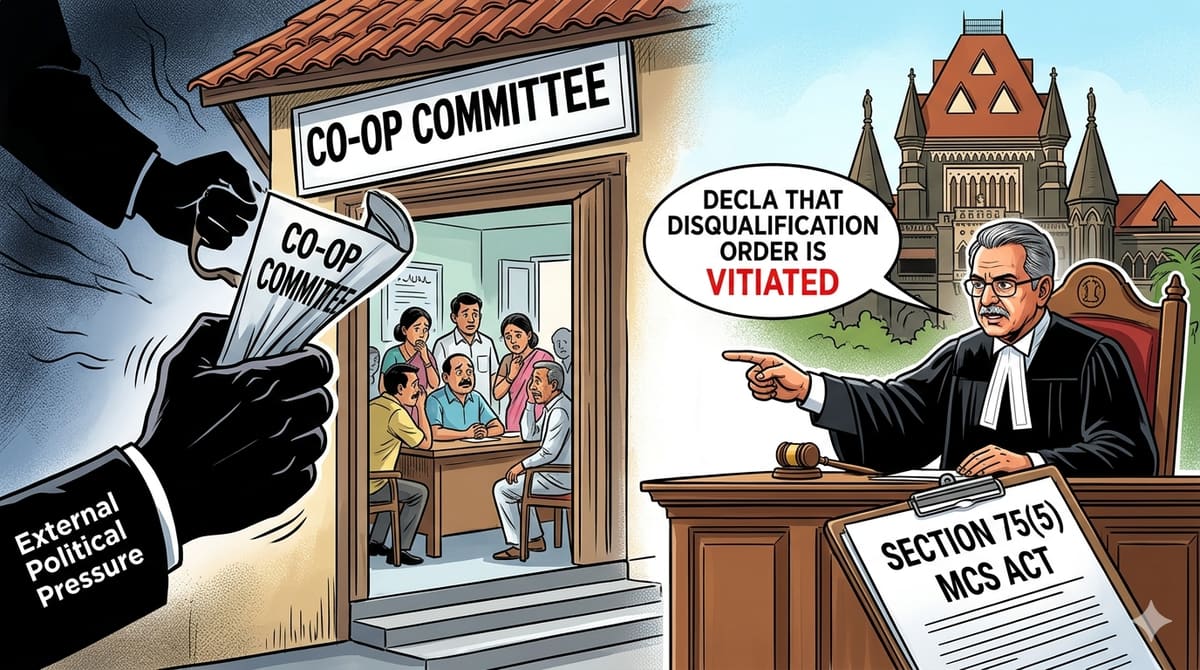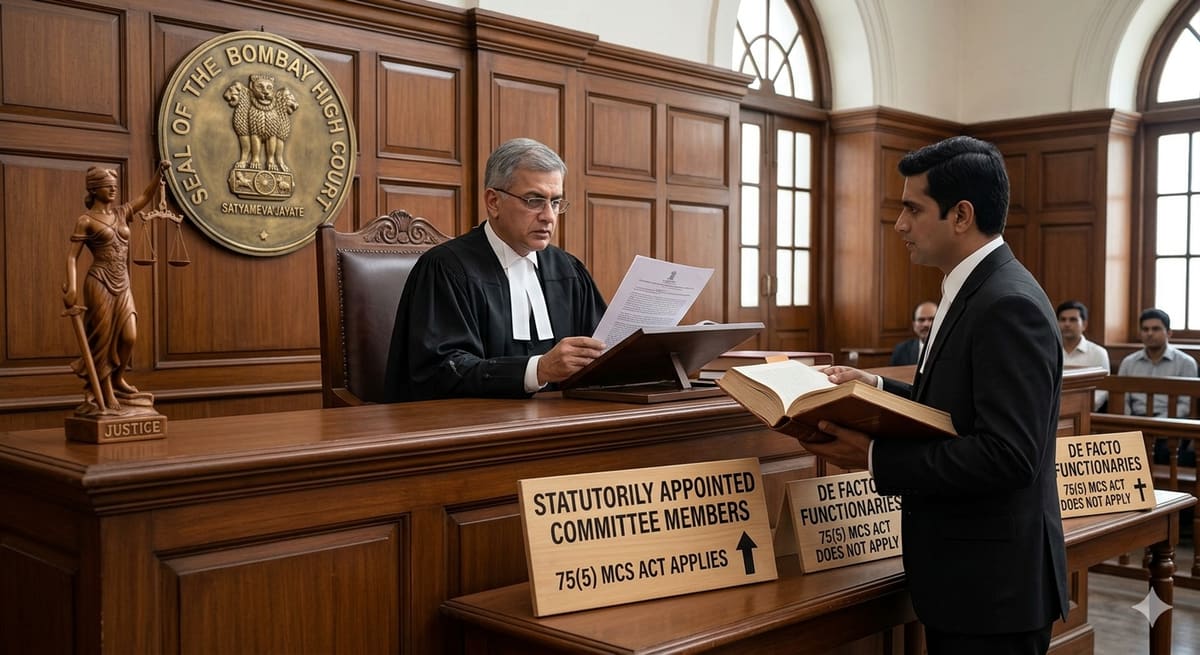
The Bombay High Court has clarified a critical boundary in cooperative governance: statutory disqualification under Section 75(5) of the Maharashtra Cooperative Societies Act, 1960, cannot be invoked against a person who ceased to hold legal office, even if they continued to function in fact. This ruling reinforces the principle that legal status, not factual control, determines statutory liability.
Background & Facts
The Dispute
The petitioner, Gopikrishnan Appadurai Mudaliar, was appointed as a member of the provisional managing committee of a cooperative society. His tenure in this provisional capacity was limited to one year, as per the statutory framework under the Maharashtra Cooperative Societies Act, 1960. This tenure expired in July 2019. Despite the expiry, the petitioner continued to participate in the society’s affairs, including financial and administrative functions, until the Registrar invoked Section 75(5) of the MCS Act to disqualify him for failure to place the society’s accounts before the General Body for the financial years 2018-2019 to 2022-2023.
Key Facts
The petitioner was appointed to the provisional managing committee on an interim basis, with a fixed tenure of one year
The provisional committee’s term expired on 31.07.2019
No elections were conducted before or after the expiry of the term
No statutory extension or deeming provision was invoked to continue the committee’s authority
The petitioner remained physically present and active in society affairs from August 2019 to at least 2023
The Registrar issued a notice of disqualification under Section 75(5) on grounds of non-submission of accounts for FY 2018-19 to 2022-23
The disqualification order was passed on 15.02.2026
Procedural History
31.07.2019: Expiry of provisional managing committee’s tenure
2018-2019 to 2022-2023: Financial years during which accounts were not placed before the General Body
15.02.2026: Registrar issued order disqualifying petitioner under Section 75(5) of the MCS Act
10.03.2026: Petitioner filed Writ Petition No. 5162 of 2026 before the Bombay High Court
05.05.2026: Judgment delivered by Justice Amit Borkar
The Parties' Positions
For the Petitioner: Argued that he was never a legally constituted member of the managing committee after July 2019. His role after that date was purely de facto, and Section 75(5) applies only to persons holding office in law. The statutory obligation to place accounts is tied to the office, not the individual.
For the Respondents (Registrar and Society): Contended that the petitioner continued to exercise powers and perform duties of a managing committee member even after July 2019. His active participation in financial decisions and governance rendered him liable under Section 75(5), regardless of formal tenure.
Relief Sought
The petitioner sought quashing of the disqualification order dated 15.02.2026, declaration that he was not liable under Section 75(5), and directions to remove the disqualification from his record.
The Legal Issue
The central question was whether Section 75(5) of the Maharashtra Cooperative Societies Act, 1960 can be invoked to disqualify a person who was not a legally recognized member of the managing committee during the period in which the accounts were not placed, merely because he continued to function in a de facto capacity after the statutory tenure expired.
Arguments Presented
For the Petitioner
The petitioner relied on the statutory scheme of the MCS Act, particularly Section 73-I, which mandates that a managing committee’s term ends automatically upon expiry, with no deeming provision for continuation. He argued that Section 75(5) imposes obligations only on persons who are legally holding office. Mere factual control or continued participation cannot transform a de facto actor into a statutory office-holder. He cited State of Maharashtra v. Rameshwar to support the principle that statutory liability cannot be imposed without legal status.
For the Respondent
The Respondent contended that the petitioner, by continuing to manage the society’s affairs, assumed the responsibilities of a managing committee member. The Registrar’s power under Section 75(5) is remedial and must be interpreted purposively to ensure accountability. The petitioner’s conduct, they argued, amounted to holding office by estoppel, and allowing him to evade liability would defeat the object of the Act.
The Court's Analysis
The Court undertook a detailed examination of the statutory structure under the MCS Act, particularly Section 73-I, which imposes a mandatory duty on the managing committee to initiate elections before expiry of its term. The Court observed:
"The language used shows that the Legislature intended that there should be no vacuum in management and no uncertainty in democratic functioning of the society."
It held that upon expiry of the term, the committee’s authority ceases automatically. No further declaration is required. The Court emphasized:
"Mere continuation in office or performance of day to day business cannot, by itself, clothe such person with legal status of a managing committee member for all purposes."
The Court distinguished between de jure and de facto authority. While the petitioner may have performed administrative functions after July 2019, these acts were not legally sanctioned. The obligation to place accounts under Section 75(2), (2A), (3), and (4) is attached to the office, not the person. Once the office ceases to exist legally, the obligation cannot be transferred to a former member acting without authority.
The Court further noted that the Registrar, under Section 77A, has a statutory duty to step in and appoint an authorized officer when a committee’s term expires. Failure to do so cannot be used to impose liability on individuals who are no longer legally empowered. The Court stated:
"The responsibility in such situation shifts upon the statutory authorities, more particularly the Registrar, who is expected to take timely steps to prevent such vacuum... Failure of such mechanism cannot be used to impose disqualification or liability upon persons who are no longer holding office in the legal sense."
The Court rejected the argument that the petitioner’s conduct amounted to holding office by estoppel, holding that statutory disqualification cannot be expanded beyond its textual and structural limits.
The Verdict
The writ petition succeeded. The Court quashed the disqualification order dated 15.02.2026 against the petitioner. The Court held that Section 75(5) of the MCS Act does not apply to persons who ceased to hold legal office upon expiry of their tenure. The disqualification was set aside in its entirety. There shall be no order as to costs.
What This Means For Similar Cases
Legal Office Holdership Is a Prerequisite for Disqualification
Practitioners must now establish that the person was a legally constituted member of the managing committee during the relevant financial period before invoking Section 75(5)
Merely showing that a person performed duties after tenure expiry is insufficient to attract disqualification
Any disqualification order based on de facto control must be challenged on grounds of lack of legal standing
Registrar’s Duty to Prevent Governance Vacuum Is Non-Delegable
Cooperative societies and their members cannot be held liable for statutory defaults arising from Registrar’s inaction
If elections are not held after term expiry, the Registrar must appoint an authorized officer under Section 77A
Failure to do so renders subsequent accountability measures against individuals legally untenable
Statutory Obligations Are Tied to Office, Not Individuals
The duty to submit accounts is a function of the legally constituted committee, not any individual member
After expiry of term, the society’s accounts must be placed by the Registrar or an authorized officer, not former members
Practitioners should advise societies to immediately notify the Registrar upon committee expiry to avoid liability traps