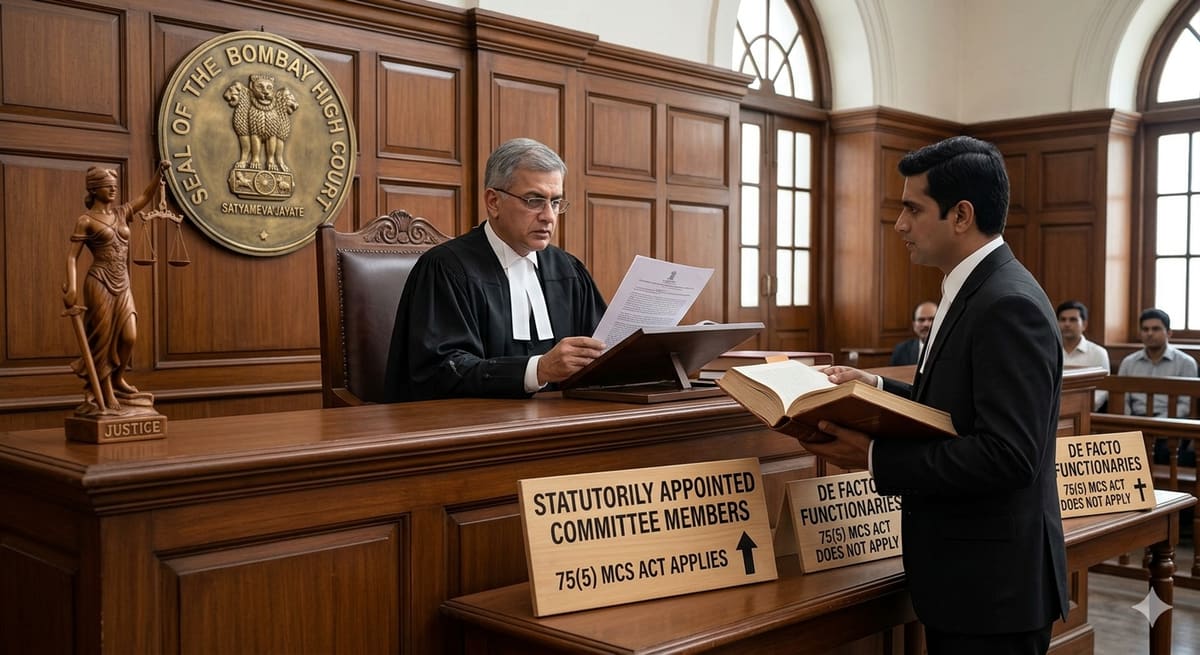
The Bombay High Court has clarified that disqualification of elected office bearers in co-operative societies under Section 82(4) of the Maharashtra Co-operative Societies Act, 1960 cannot be triggered by mere non-submission of a rectification report. The judgment underscores that statutory disqualification demands proof of actual audit-identified irregularities, not procedural formalities.
Background & Facts
The Dispute
The petitioner, Prem Sinha, was serving as Secretary of a co-operative society when the Divisional Joint Registrar, Co-operative Societies, Konkan Division, passed an order on 10.01.2026 disqualifying him, along with the Chairman and Treasurer, under Section 82(4) of the Maharashtra Co-operative Societies Act, 1960. The disqualification was based on the society’s failure to submit an audit rectification report within three months of the audit report for the financial year 2022-2023.
Key Facts
- The audit report for FY 2022-2023 was submitted under Section 81 of the Act on 15.11.2023.
- The audit report contained no specific findings of irregularity, defect, financial impropriety, or lapse in the society’s functioning.
- The audit report merely stated, in generic terms, that a rectification report should be submitted within three months.
- No recommendation under clauses (i) to (ix) of Section 82 was made in the audit report.
- The petitioner and other office bearers did not receive any notice identifying specific defects requiring rectification.
- The disqualification order was passed on 10.01.2026, without any independent inquiry into whether any actionable irregularity existed.
Procedural History
- 15.11.2023: Audit report under Section 81 submitted by the auditor.
- 15.02.2024: Deadline for submission of rectification report expired.
- 05.03.2024: Registrar issued a notice to the society for non-submission of rectification report.
- 10.01.2026: Authority passed disqualification order under Section 82(4) against the petitioner and other office bearers.
- 15.01.2026: Petitioner filed a representation challenging the order, which was rejected on 20.01.2026.
- 28.02.2026: Writ Petition No. 3388 of 2026 filed before the Bombay High Court.
- 18.03.2026: Judgment delivered by Justice Amit Borkar.
The Parties' Positions
For the Petitioner: Argued that the disqualification order was illegal because the audit report contained no findings of irregularity, and therefore, no statutory default under Section 82 existed. Relied on the principle that punitive action must follow established procedural and substantive conditions.
For the Respondents: Contended that non-submission of the rectification report within the stipulated period was a statutory default under Section 82(4), irrespective of whether the audit report identified any specific defect. Argued that the requirement was procedural and mandatory.
Relief Sought
The petitioner sought quashing of the disqualification order dated 10.01.2026, restoration of his position as Secretary, and a declaration that no disqualification could be imposed without a finding of actual irregularity under Section 82.
The Legal Issue
The central question was whether Section 82(4) of the Maharashtra Co-operative Societies Act, 1960 permits disqualification of office bearers solely on the ground of non-submission of a rectification report, even in the absence of any recorded irregularity or defect in the audit report under Section 81.
Arguments Presented
For the Petitioner
The petitioner relied on the statutory scheme of Sections 81 and 82, arguing that they operate as an integrated process: Section 81 mandates the identification of defects, and Section 82 mandates rectification only of those identified defects. The absence of any finding of irregularity in the audit report rendered the direction to submit a rectification report a mere formality. Disqualification under Section 82(4) requires a substantive default, not a procedural lapse. The petitioner cited State of Maharashtra v. Rameshwar Rao to emphasize that punitive measures affecting democratic rights must be strictly construed.
For the Respondent
The State contended that Section 82(4) imposes a strict timeline for submission of rectification reports, and failure to comply within three months is itself a default attracting disqualification. The argument was that the audit report’s directive to submit a rectification report was sufficient to trigger the provision, regardless of whether specific irregularities were recorded. The State relied on administrative convenience and the need for compliance with statutory timelines.
The Court's Analysis
The Court undertook a detailed textual and structural analysis of Sections 81 and 82. It observed that Section 81 requires the auditor to examine the society’s accounts and record any defects, irregularities, or lapses. Only if such findings are made does Section 82 impose a duty to rectify and report. The Court emphasized that the statutory language of Section 82(4) - which refers to "failure to rectify any defect or irregularity" - presupposes the existence of such a defect.
"The scheme of Sections 81 and 82 indicates that these provisions operate together as a structured process. First, the audit under Section 81 must identify specific irregularities or defects in the working of the society. Thereafter, under Section 82, the society is required to take steps for rectification of those defects and submit a report regarding compliance."
The Court held that treating a generic directive in the audit report as equivalent to a finding of irregularity would render the statutory framework meaningless. The authority had not examined whether the audit report contained any of the nine categories of irregularities listed under Section 82. Disqualification, the Court noted, is a severe penalty affecting democratic rights and must be grounded in substantive non-compliance, not procedural delay.
The Court further observed that if mere non-filing of a rectification report were sufficient for disqualification, it would lead to arbitrary outcomes where societies with clean accounts could be punished for administrative oversight, while those with actual financial misconduct might escape accountability.
The Verdict
The writ petition was allowed. The Court set aside the disqualification order dated 10.01.2026 against the petitioner, Prem Sinha, and restored him to the position of Secretary of the society. The Court directed that the disqualification of the Chairman and Treasurer be examined separately, but held that no disqualification under Section 82(4) can be sustained without a prior finding of irregularity under Section 81. The authority was directed to reconsider the matter only if a valid audit defect is established.
What This Means For Similar Cases
Disqualification Requires Substantive Default, Not Procedural Non-Compliance
- Practitioners must now challenge disqualification orders where the audit report lacks specific findings under Section 82(1) to (9).
- A mere directive to submit a rectification report, without identifying defects, cannot be the basis for disqualification.
- Any order passed under Section 82(4) without referencing a specific irregularity is liable to be quashed.
Audit Reports Must Be Specific to Trigger Statutory Consequences
- Co-operative societies should ensure that audit reports clearly identify defects under the nine categories listed in Section 82.
- Office bearers may rely on this judgment to contest disqualification where the audit report is generic or non-specific.
- Authorities must record independent findings before invoking Section 82(4); blind reliance on audit directives is legally unsustainable.
Democratic Rights of Elected Members Are Protected
- Disqualification under the Act is not an administrative sanction but a deprivation of democratic mandate.
- Courts will strictly interpret punitive provisions affecting elected representatives.
- Future disqualification proceedings must be preceded by a reasoned determination of actual non-compliance, not administrative convenience.