Topic

cooperative law

Cooperative law in India governs the formation, regulation, and dissolution of cooperative societies under state-specific acts and the Multi-State Cooperative Societies Act, 2002.

36 articlesLatest September 2026
MCS Rules 2014 | Quorum for Cooperative Society Resolutions Based on Functional Members, Not Total Seats : Bombay HC Aurangabad Bench
Case Law Analysis
|Bombay High Court

MCS Rules 2014 | Quorum for Cooperative Society Resolutions Based on Functional Members, Not Total Seats : Bombay HC Aurangabad Bench

Bombay High Court clarifies that quorum for cooperative society resolutions under Maharashtra Cooperative Societies Rules 2014 must be calculated on the basis of functional members present, not total seats or vacant positions. Election officers cannot unilaterally invalidate internal resolutions without a court order, reinforcing procedural fairness for managing committees.

Section 103 Maharashtra Cooperative Societies Act | Interim Liquidation Does Not Terminate Voting Rights in Federal Cooperative Elections : Bombay HC
Case Law Analysis
|Bombay High Court

Section 103 Maharashtra Cooperative Societies Act | Interim Liquidation Does Not Terminate Voting Rights in Federal Cooperative Elections : Bombay HC

The Bombay High Court has ruled that an interim liquidation order under Section 103 of the Maharashtra Cooperative Societies Act does not extinguish a cooperative society’s right to vote in federal cooperative elections. This protects the democratic participation of member societies until a final winding-up order is passed, reinforcing that legal status and electoral rights remain intact during provisional proceedings. The decision upholds natural justice and the continuity of cooperative governance structures.

Rule 76 Maharashtra Cooperative Society Election Rules | Membership Register is Sole Determinant of Voter Eligibility : Bombay HC
Case Law Analysis
|Bombay High Court

Rule 76 Maharashtra Cooperative Society Election Rules | Membership Register is Sole Determinant of Voter Eligibility : Bombay HC

Bombay HC quashes electoral orders that exceeded statutory scrutiny limits under Rule 76, reaffirming that only names in the official membership register qualify for voting rights. The ruling bars authorities from adjudicating eligibility beyond the register, ensuring strict compliance with election rules for cooperative societies.

Section 77A Maharashtra Cooperative Societies Act | Vacant Reserved Seats Excluded from Two-Third Majority Calculation for Committee Supersession : Bombay HC
Case Law Analysis
|Bombay High Court

Section 77A Maharashtra Cooperative Societies Act | Vacant Reserved Seats Excluded from Two-Third Majority Calculation for Committee Supersession : Bombay HC

The Bombay High Court has ruled that vacant seats reserved under the Maharashtra Cooperative Societies Act must be excluded when determining the effective strength of a managing committee for the purpose of Section 77A supersession. This clarifies that only elected and filled positions count toward the two-thirds majority threshold, protecting cooperative societies from arbitrary state intervention when reserved seats remain unfilled due to lack of eligible candidates.

Central Registrar May Impose Deposit Freeze on Cooperative Society Amid Prima Facie Fraud Under MSCS Act, 2002 | Bombay HC
Case Law Analysis
|Bombay High Court

Central Registrar May Impose Deposit Freeze on Cooperative Society Amid Prima Facie Fraud Under MSCS Act, 2002 | Bombay HC

The Bombay High Court has affirmed that the Central Registrar of Cooperative Societies can issue an interim order to halt new deposits in a multi-state cooperative society when there is prima facie evidence of fund diversion and financial misconduct. This sets a critical precedent for deposit protection, empowering regulators to act swiftly before final adjudication to safeguard vulnerable members from systemic collapse.

Section 73-AAA(3) Maharashtra Cooperative Societies Act | Term Expiry Voids Committee Continuity, Validates Authorized Officer Appointment : Bombay HC Aurangabad Bench
Case Law Analysis
|Bombay High Court

Section 73-AAA(3) Maharashtra Cooperative Societies Act | Term Expiry Voids Committee Continuity, Validates Authorized Officer Appointment : Bombay HC Aurangabad Bench

Bombay High Court rules that the 2025 amendment to Section 73-AAA(3) of the Maharashtra Cooperative Societies Act removes statutory protection for Type 'A' societies post-term expiry, empowering the Registrar to appoint an Authorized Officer. This ruling impacts all cooperative societies failing to conduct timely elections, stripping outgoing committees of authority.

Cooperative Societies Act | Execution Notices & Auction Intimations Are Procedural Steps, Not Appealable Orders Under Revisional Jurisdiction : Bombay HC
Case Law Analysis
|Bombay High Court

Cooperative Societies Act | Execution Notices & Auction Intimations Are Procedural Steps, Not Appealable Orders Under Revisional Jurisdiction : Bombay HC

Bombay HC holds that execution notices and auction intimations under the Cooperative Societies Act are procedural steps, not substantive orders, limiting revisional jurisdiction to final decisions. The ruling clarifies that aggrieved parties must challenge substantive orders, not interim procedural actions, ensuring judicial efficiency in recovery proceedings.

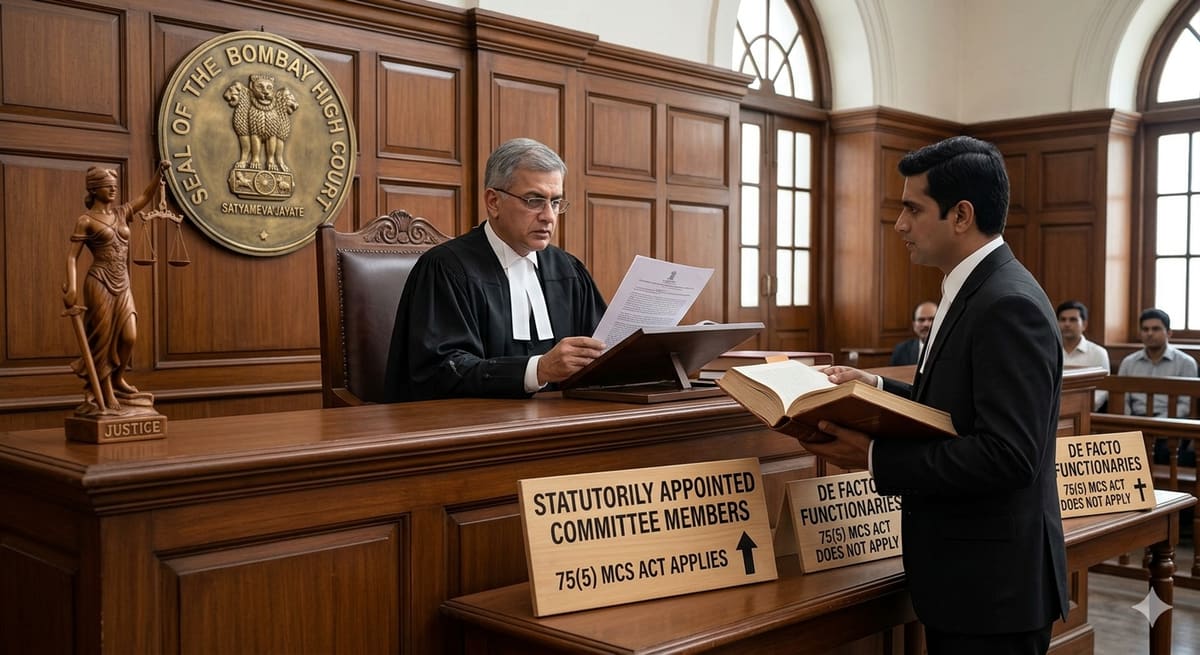
Section 75(5) MCS Act | Disqualification Applies Only to Statutorily Appointed Committee Members, Not De Facto Functionaries : Bombay HC
Case Law Analysis
|Bombay High Court

Section 75(5) MCS Act | Disqualification Applies Only to Statutorily Appointed Committee Members, Not De Facto Functionaries : Bombay HC

The Bombay High Court has ruled that disqualification under Section 75(5) of the Maharashtra Cooperative Societies Act requires formal legal office-holding, not mere de facto control after tenure expiry. This sets a vital precedent for cooperative societies, protecting former members from retrospective liability and reinforcing statutory compliance over functional continuity.

Section 154B(27) MCoS Act | Cooperative Court Retains Jurisdiction Over Lease Deed Disputes When Society Recognizes Associate Membership, Even Amid Contested Family Arrangement : Bombay HC
Case Law Analysis
|Bombay High Court

Section 154B(27) MCoS Act | Cooperative Court Retains Jurisdiction Over Lease Deed Disputes When Society Recognizes Associate Membership, Even Amid Contested Family Arrangement : Bombay HC

The Bombay High Court has ruled that a cooperative society’s recognition of a deceased member’s associate membership vests the Cooperative Court with jurisdiction to adjudicate disputes over lease deed execution, regardless of whether a family arrangement is later contested. This affirms that procedural recognition by the society, not private familial agreements, determines the forum for property disputes under the Maharashtra Cooperative Societies Act - a critical precedent for housing societies and heirs navigating succession and tenancy rights.

Section 73-CB Maharashtra Cooperative Societies Act | Statutory Election Procedure Mandatory for Managing Committee Validity: Bombay HC
Case Law Analysis
|Bombay High Court

Section 73-CB Maharashtra Cooperative Societies Act | Statutory Election Procedure Mandatory for Managing Committee Validity: Bombay HC

Bombay High Court rules that cooperative society elections conducted without adhering to the statutory procedure under Section 73-CB of the Maharashtra Cooperative Societies Act, 1960 and the 2014 Rules are legally void. The court mandates strict compliance with notification, eligibility scrutiny, and nomination processes, even for unanimous elections, to prevent bypassing statutory mandates.

Section 49(8) Chhattisgarh Co-op Act | President of Cooperative Society Must Be Elected, Not Nominated; Nomination Violates Democratic Mandate : CGHC
Case Law Analysis
|Chhattisgarh High Court

Section 49(8) Chhattisgarh Co-op Act | President of Cooperative Society Must Be Elected, Not Nominated; Nomination Violates Democratic Mandate : CGHC

The Chhattisgarh High Court has ruled that appointing a cooperative society president through nomination instead of election violates Section 49(8), which mandates a democratic process. This decision binds all cooperative societies in the state to conduct transparent elections within 90 days, reinforcing member rights and administrative accountability under cooperative law.

Section 154B-27 MCS Act | Registrar Cannot Enforce Developer’s Contractual Claims - Only Statutory Obligations Fall Within Jurisdiction : Bombay HC
Case Law Analysis
|Bombay High Court

Section 154B-27 MCS Act | Registrar Cannot Enforce Developer’s Contractual Claims - Only Statutory Obligations Fall Within Jurisdiction : Bombay HC

The Bombay High Court has ruled that the Registrar under the Maharashtra Cooperative Societies Act lacks authority to enforce developmental or contractual rights claimed by a developer, limiting intervention strictly to statutory duties under the Act or bye-laws. This sets a vital precedent for cooperative societies resisting undue interference in private agreements, reinforcing the boundary between administrative oversight and civil contract enforcement.

MSCS Act Section 12(1)(a) | Resolution Plan Eligibility Under IBC Restricted to Bye-Law Objects: Supreme Court
Case Law Analysis
|Supreme Court of India

MSCS Act Section 12(1)(a) | Resolution Plan Eligibility Under IBC Restricted to Bye-Law Objects: Supreme Court

The Supreme Court has ruled that a Multi-State Co-operative Society cannot submit a resolution plan under the IBC unless its bye-laws explicitly permit activities substantially similar to the corporate debtor’s business. This clarifies that object clauses-not general investment powers-define the legal line of business, directly impacting cooperative societies seeking to participate in corporate insolvency resolutions.