Tribunals and Commissions judgments

1770 Tribunals and Commissions judgments explained in plain English: what was decided, the law applied and why it matters. Page 40 of 74.

CESTAT Hyderabad | Waste Mud from Bleaching Not 'Manufactured Goods' Under Central Excise Act : No Duty Liability on Spent Earth
Case Law Analysis
|Custom, Excise & Service Tax Tribunal

CESTAT Hyderabad | Waste Mud from Bleaching Not 'Manufactured Goods' Under Central Excise Act : No Duty Liability on Spent Earth

CESTAT Hyderabad ruled that waste mud generated from crude palm oil bleaching is non-excisable waste, not manufactured goods, following the withdrawal of CBIC circulars and exemption notifications. The decision clarifies that spent earth lacks marketability and cannot be classified as excisable goods, relieving manufacturers from duty liability on such by-products.


GRI 1 & Eo Nomine Rule | Bluetooth Earphones Classifiable as Audio Devices (CTI 8518), Not Data Transmission (CTI 8517) : CESTAT
Case Law Analysis
|Custom, Excise & Service Tax Tribunal

GRI 1 & Eo Nomine Rule | Bluetooth Earphones Classifiable as Audio Devices (CTI 8518), Not Data Transmission (CTI 8517) : CESTAT

CESTAT rules that Bluetooth earphones' primary function is sound reproduction, not data transmission, classifying them under CTI 8518 (15% duty) instead of CTI 8517 (10% duty). The decision clarifies classification disputes under General Interpretative Rule 1 and the eo nomine provision, impacting importers of wireless audio devices.

General Rules of Interpretation | Curved Molybdenum Mirrors/Shields Classifiable as 'Other Articles' Under CTH 81029900, Not Flat Sheets : CESTAT
Case Law Analysis
|Custom, Excise & Service Tax Tribunal

General Rules of Interpretation | Curved Molybdenum Mirrors/Shields Classifiable as 'Other Articles' Under CTH 81029900, Not Flat Sheets : CESTAT

CESTAT rules that curved molybdenum mirrors/shields, despite being made from sheets, acquire a distinct functional identity and must be classified under CTH 81029900 at 10% BCD, not as flat sheets under CTH 810295. The decision underscores the application of the General Rules of Interpretation in customs law, impacting importers and tax authorities in tariff disputes.

Rule 26 Central Excise Rules | Penalty Imposition Void Without Prior Confiscation Finding : CESTAT Principal Bench
Case Law Analysis
|Custom, Excise & Service Tax Tribunal

Rule 26 Central Excise Rules | Penalty Imposition Void Without Prior Confiscation Finding : CESTAT Principal Bench

CESTAT rules that penalties under Rule 26 of the Central Excise Rules cannot be imposed unless there is a prior finding that the goods are liable to confiscation. The tribunal invalidated penalties where the adjudicating authority failed to establish confiscation liability, setting a precedent for procedural compliance in excise penalty cases.

Service Tax Exemption for Residential Construction Under Nitesh Estates Doctrine; Extended Period Invocation Requires Proof of Suppression : CAT Allahabad
Case Law Analysis
|Custom, Excise & Service Tax Tribunal

Service Tax Exemption for Residential Construction Under Nitesh Estates Doctrine; Extended Period Invocation Requires Proof of Suppression : CAT Allahabad

CAT Allahabad rules that construction of residential quarters for non-commercial use qualifies for service tax exemption under the Nitesh Estates doctrine. The tribunal further holds that the extended period of limitation cannot be invoked without concrete proof of intentional suppression of facts, setting a precedent for tax disputes involving residential projects.

Rule 6(3A) CENVAT Credit Rules | Reimbursement of Material Costs in BOOT Contracts Not 'Trading' or 'Exempt Service' : CESTAT Chennai
|Custom, Excise & Service Tax Tribunal

Rule 6(3A) CENVAT Credit Rules | Reimbursement of Material Costs in BOOT Contracts Not 'Trading' or 'Exempt Service' : CESTAT Chennai

CESTAT Chennai rules that reimbursement of material costs in a BOOT works contract does not constitute 'trading' or 'exempt service', invalidating mandatory CENVAT credit reversal under Rule 6(3A). The decision clarifies that input service credits can be availed without separate accounts, impacting infrastructure and service contractors under tax law.

Section 40(a)(ia) IT Act | Disallowance Applies Only to P&L Expenditure, Not Capitalized WIP : ITAT Mumbai
Case Law Analysis
|Income Tax Appellate Tribunal

Section 40(a)(ia) IT Act | Disallowance Applies Only to P&L Expenditure, Not Capitalized WIP : ITAT Mumbai

ITAT Mumbai rules that disallowance under Section 40(a)(ia) of the Income Tax Act is limited to expenditures claimed in the profit and loss account and does not extend to amounts capitalized as work-in-progress (WIP). This holding clarifies TDS compliance obligations for taxpayers using different accounting methods, ensuring capitalized expenditures remain unaffected by the disallowance provision.

Central Excise Valuation | Trade Discounts Without Indirect Consideration Cannot Be Added to Assessable Value : CESTAT Mumbai
Case Law Analysis
|Custom, Excise & Service Tax Tribunal

Central Excise Valuation | Trade Discounts Without Indirect Consideration Cannot Be Added to Assessable Value : CESTAT Mumbai

CESTAT Mumbai rules that trade discounts extended to bulk buyers like NMMT cannot be treated as 'additional consideration' for excise valuation unless there is evidence of indirect benefit flowing from the buyer to the seller. The ruling clarifies that Rule 6 of the Central Excise Valuation Rules requires tangible proof of consideration beyond mere discounts to adjust assessable value, offering relief to suppliers in similar arrangements.

Finance Act, 1994 | Job Work Amounting to Manufacture Exempt from Service Tax Even If Expenses Reimbursed: CESTAT Hyderabad
Case Law Analysis
|Custom, Excise & Service Tax Tribunal

Finance Act, 1994 | Job Work Amounting to Manufacture Exempt from Service Tax Even If Expenses Reimbursed: CESTAT Hyderabad

CESTAT Hyderabad rules that job work constituting manufacture of excisable goods under the Finance Act, 1994, is exempt from service tax, even if the principal reimburses expenses. The ruling clarifies that the nature of the activity-not the reimbursement mechanism-determines tax liability, providing relief to manufacturers engaged in job work agreements.

Section 12A(1)(ac)(iii) IT Act | Irrevocable Clause Must Exist at Time of Form 10AB Application : ITAT Delhi Allows Fresh Consideration Post-Amendment
Case Law Analysis
|Income Tax Appellate Tribunal

Section 12A(1)(ac)(iii) IT Act | Irrevocable Clause Must Exist at Time of Form 10AB Application : ITAT Delhi Allows Fresh Consideration Post-Amendment

ITAT Delhi rules that the absence of an irrevocable clause in a trust deed at the time of Form 10AB application justifies rejection of registration under Section 12A, but permits fresh consideration if the deed is amended post-application. The ruling underscores strict compliance with procedural requirements for charitable trust registrations, impacting trusts seeking tax exemptions.

Section 147 ITA | Reassessment Under Section 148 Requires Independent 'Reason to Believe' Based on Tangible Evidence : ITAT Ahmedabad
Case Law Analysis
|Income Tax Appellate Tribunal

Section 147 ITA | Reassessment Under Section 148 Requires Independent 'Reason to Believe' Based on Tangible Evidence : ITAT Ahmedabad

ITAT Ahmedabad quashed a reassessment notice under Section 147/148 of the Income Tax Act, ruling that the Assessing Officer’s satisfaction must be based on independent application of mind and tangible evidence linking the assessee to escaped income. The Tribunal emphasized that borrowed satisfaction or conjectural reasoning violates natural justice and renders the reassessment void.

India-US DTAA Service PE | Solar Days, Not Cumulative Man-Days, Determine 90-Day Threshold : ITAT Delhi
Case Law Analysis
|Income Tax Appellate Tribunal

India-US DTAA Service PE | Solar Days, Not Cumulative Man-Days, Determine 90-Day Threshold : ITAT Delhi

ITAT Delhi clarifies that only unique solar days of employee presence in India count toward the 90-day threshold for Service Permanent Establishment under Article 5(2)(l) of the India-US DTAA, rejecting the Revenue’s cumulative man-day approach. This ruling impacts foreign companies providing services in India, ensuring tax liability is determined by actual presence rather than aggregated workdays.

Section 45 & 56 IT Act | Surrender of Tenancy Rights Not Taxable as 'Income from Other Sources' Without Proven Cost of Acquisition : ITAT Mumbai
Case Law Analysis
|Income Tax Appellate Tribunal

Section 45 & 56 IT Act | Surrender of Tenancy Rights Not Taxable as 'Income from Other Sources' Without Proven Cost of Acquisition : ITAT Mumbai

ITAT Mumbai rules that surrender of tenancy rights qualifies as a capital receipt, not taxable under 'Income from Other Sources' if the assessee fails to prove the cost of acquisition. The ruling reinforces that capital gains computation must precede taxation under Section 56, impacting property owners and tax practitioners dealing with tenancy rights transactions.

Section 36(1)(vii) & (viia) IT Act | Bad Debt Deduction Allowed Without Credit Balance Restriction : ITAT Mumbai
Case Law Analysis
|Income Tax Appellate Tribunal

Section 36(1)(vii) & (viia) IT Act | Bad Debt Deduction Allowed Without Credit Balance Restriction : ITAT Mumbai

ITAT Mumbai rules that banks can claim bad debt deductions under Section 36(1)(vii) of the Income Tax Act without requiring a credit balance in the provision account under Section 36(1)(viia). The decision clarifies that double deduction is impermissible only if a provision credit balance exists, offering relief to financial institutions on tax treatment of written-off debts.

Section 250(6) IT Act | Appellate Authority Must Pass Speaking Order on Merits, Not Dismiss Ex-Parte for Non-Compliance : ITAT Delhi
Case Law Analysis
|Income Tax Appellate Tribunal

Section 250(6) IT Act | Appellate Authority Must Pass Speaking Order on Merits, Not Dismiss Ex-Parte for Non-Compliance : ITAT Delhi

ITAT Delhi holds that appellate authorities under Section 250(6) of the Income Tax Act must adjudicate appeals on merits and cannot dismiss them ex-parte merely for procedural non-compliance. The ruling reinforces natural justice principles, mandating a reasoned order even in cases of default, and remands the matter for fresh adjudication with an opportunity for the assessee to present evidence.

Section 151(ii) Income Tax Act | Approval Beyond Three Years Must Come from Principal Chief Commissioner : ITAT Delhi Quashes Reassessment
Case Law Analysis
|Income Tax Appellate Tribunal

Section 151(ii) Income Tax Act | Approval Beyond Three Years Must Come from Principal Chief Commissioner : ITAT Delhi Quashes Reassessment

ITAT Delhi sets aside a reassessment order for AY 2017-18, ruling that if more than three years have elapsed since the original assessment, approval under Section 151(ii) must be granted by the Principal Chief Commissioner-not the Principal Commissioner-to validate proceedings. The decision reinforces strict compliance with statutory approval hierarchies in tax reassessment cases.

Contempt Jurisdiction | Substantial Compliance Suffices; CAT Bars Merits Review of Compliance Orders : Central Administrative Tribunal
Case Law Analysis
|Central Administrative Tribunal

Contempt Jurisdiction | Substantial Compliance Suffices; CAT Bars Merits Review of Compliance Orders : Central Administrative Tribunal

The Central Administrative Tribunal ruled that contempt jurisdiction is limited to examining willful disobedience, not the merits of compliance orders. Contractual employees' substantial compliance with tribunal directions discharges contempt liability, reinforcing procedural fairness over substantive scrutiny.

Mutual Undertaking Principle | Cooperative Housing Societies Exempt from Section 40(a)(ia) TDS Disallowance : ITAT Mumbai
Case Law Analysis
|Income Tax Appellate Tribunal

Mutual Undertaking Principle | Cooperative Housing Societies Exempt from Section 40(a)(ia) TDS Disallowance : ITAT Mumbai

ITAT Mumbai reaffirms that cooperative housing societies, as mutual undertakings, are not liable for disallowance under Section 40(a)(ia) of the Income Tax Act for non-deduction of TDS. The ruling clarifies that mutual associations' income remains exempt from tax, shielding them from penal disallowances on payments to members.

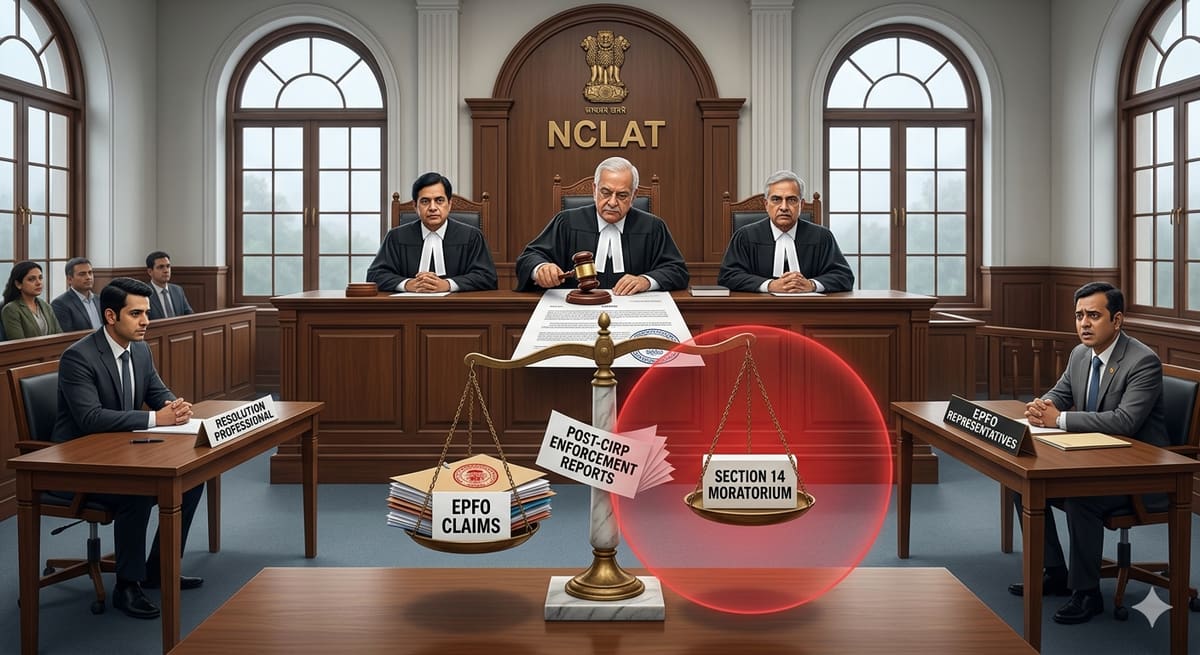
Section 14 IBC Moratorium Bars EPFO Claims Based on Post-CIRP Enforcement Reports : NCLAT
Case Law Analysis
|National Company Law Appellate Tribunal

Section 14 IBC Moratorium Bars EPFO Claims Based on Post-CIRP Enforcement Reports : NCLAT

NCLAT rules that EPFO cannot file claims during Corporate Insolvency Resolution Process (CIRP) based on enforcement reports prepared after the moratorium under Section 14 of the Insolvency and Bankruptcy Code (IBC) commences. The decision reinforces that statutory creditors like EPFO must initiate assessment proceedings before CIRP begins to be admissible.

'Nemo Judex in Causa Sua' | ICC Chairperson as Disciplinary Inquiry Officer Violates Natural Justice: CAT Cuttack Quashes Termination
Case Law Analysis
|Central Administrative Tribunal

'Nemo Judex in Causa Sua' | ICC Chairperson as Disciplinary Inquiry Officer Violates Natural Justice: CAT Cuttack Quashes Termination

CAT Cuttack ruled that appointing an Internal Complaints Committee (ICC) chairperson as the disciplinary inquiry officer in a sexual harassment case breaches the principle of natural justice. The tribunal quashed the termination order of a Gramin Dak Sevak and awarded 50% terminal retirement compensation, reinforcing bias-free administrative proceedings under service law.