Supreme Court of India judgments

498 Supreme Court of India judgments explained in plain English: what was decided, the law applied and why it matters. Page 13 of 21.

Karnataka Stamp Act | Guideline Value for Converted Urban Industrial Land Must Follow Statutory Rates, Not Judicial Discretion: SC
Case Law Analysis
|Supreme Court of India

Karnataka Stamp Act | Guideline Value for Converted Urban Industrial Land Must Follow Statutory Rates, Not Judicial Discretion: SC

The Supreme Court ruled that guideline values under the Karnataka Stamp Act for converted urban industrial land must be determined strictly as per statutory rates, setting aside the High Court's interference in execution proceedings. This decision reinforces the binding nature of guideline values in property valuation disputes, impacting stakeholders in land transactions and execution cases.
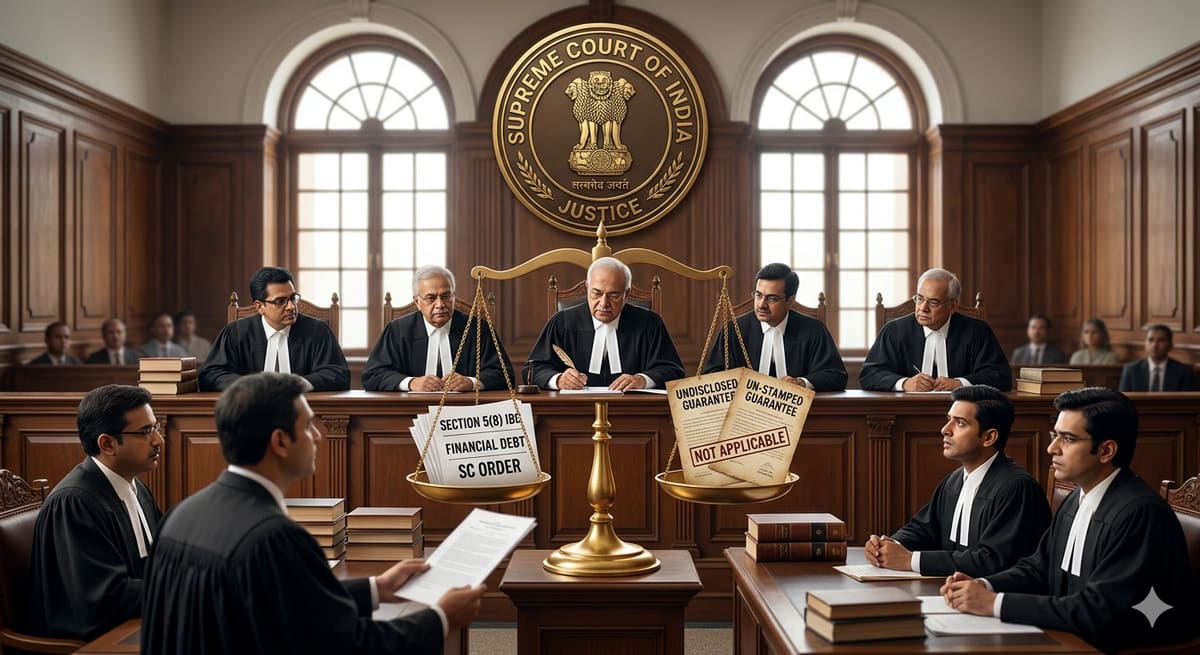

Section 5(8) IBC | Corporate Guarantees Constitute Financial Debt Even Without Disclosure or Proper Stamping: SC
Case Law Analysis
|Supreme Court of India

Section 5(8) IBC | Corporate Guarantees Constitute Financial Debt Even Without Disclosure or Proper Stamping: SC

The Supreme Court has ruled that corporate guarantees qualify as financial debt under Section 5(8) of the IBC irrespective of non-disclosure in financial statements or stamping irregularities, affirming that procedural defects cannot override substantive creditor rights. This strengthens the position of financial creditors in CIRP and curbs reliance on technicalities to defeat claims.

Section 12(1)(c) RTE Act | Neighbourhood Schools Cannot Delay Admission After State Allotment; No Post-Allocation Eligibility Scrutiny Permitted : SC
Case Law Analysis
|Supreme Court of India

Section 12(1)(c) RTE Act | Neighbourhood Schools Cannot Delay Admission After State Allotment; No Post-Allocation Eligibility Scrutiny Permitted : SC

The Supreme Court has ruled that neighbourhood schools under the RTE Act must admit children immediately upon state allocation, with no authority to re-verify eligibility or impose procedural delays. This upholds Section 12(1)(c) as a non-negotiable statutory right, ensuring social integration and eliminating institutional gatekeeping that undermines Article 21A.

Wildlife Translocation Mandate | SC Upholds Scientific Carrying Capacity Over Zoo Retention Under CZA & IUCN Guidelines : SC
Case Law Analysis
|Supreme Court of India

Wildlife Translocation Mandate | SC Upholds Scientific Carrying Capacity Over Zoo Retention Under CZA & IUCN Guidelines : SC

Supreme Court affirms that wildlife translocation must prioritize ecological carrying capacity, mandating compliance with Central Zoo Authority (CZA) and IUCN standards. The ruling sets a precedent for humane and sustainable captive wildlife management, requiring surplus animals to be relocated to suitable habitats with post-release monitoring.

State Reorganization Act | Pre-Reorganization Cadre Option Binds Successor State; 29-Year Delay in Posting Violates Service Justice : SC
Case Law Analysis
|Supreme Court of India

State Reorganization Act | Pre-Reorganization Cadre Option Binds Successor State; 29-Year Delay in Posting Violates Service Justice : SC

The Supreme Court ruled that an employee’s pre-reorganization option for a hill cadre posting must be honored by the successor state (Uttarakhand), entitling him to reallocation despite a 29-year delay. The judgment underscores that administrative inaction cannot defeat vested service rights, awarding costs for the protracted injustice.

Section 34 Arbitration Act | Legal Representatives of Deceased Party Can Challenge Arbitral Award; Article 227 Remedy Barred : SC
Case Law Analysis
|Supreme Court of India

Section 34 Arbitration Act | Legal Representatives of Deceased Party Can Challenge Arbitral Award; Article 227 Remedy Barred : SC

The Supreme Court ruled that legal representatives of a deceased party to an arbitration agreement can challenge an arbitral award under Section 34 of the Arbitration Act, 1996, but cannot invoke Article 227 of the Constitution. This clarifies the exclusive remedy available to successors in interest, reinforcing the 'complete code' nature of the Arbitration Act.

Civil Decree Finality Overrides Municipal Title Disputes | Layout Plan Incorporation Cannot Be Blocked by Reopening Settled Property Rights : SC
Case Law Analysis
|Supreme Court of India

Civil Decree Finality Overrides Municipal Title Disputes | Layout Plan Incorporation Cannot Be Blocked by Reopening Settled Property Rights : SC

The Supreme Court has ruled that once a civil decree conclusively establishes property title, municipal authorities cannot revive title disputes to block layout plan incorporation. Mere revenue records or registry entries cannot override registered conveyances or judicial findings, reinforcing that final civil judgments bind administrative bodies in land use matters.

Fraud in Medical Disclosure Vitiates Public Appointment Even After Reinstatement | Service Dues with 6% Interest Mandated : Supreme Court
Case Law Analysis
|Supreme Court of India

Fraud in Medical Disclosure Vitiates Public Appointment Even After Reinstatement | Service Dues with 6% Interest Mandated : Supreme Court

The Supreme Court has ruled that concealing medical unfitness during reinstatement invalidates a public appointment, regardless of administrative oversight failures. The termination is upheld, but the employee is entitled to full service dues for actual tenure rendered, with 6% interest from the date of reinstatement - reinforcing that fraud nullifies legitimacy, not just eligibility.

RPwD Act, 2016 Section 89 | All Prisons Must Provide Assistive Devices, Inclusive Education & Independent Grievance Mechanisms for Disabled Prisoners : SC
Case Law Analysis
|Supreme Court of India

RPwD Act, 2016 Section 89 | All Prisons Must Provide Assistive Devices, Inclusive Education & Independent Grievance Mechanisms for Disabled Prisoners : SC

The Supreme Court has mandated that every prison in India must implement accessible infrastructure, provide assistive devices, and ensure inclusive education for prisoners with benchmark disabilities under Section 89 of the RPwD Act, 2016. It also requires independent, accessible grievance redressal systems and enhanced visitation rights, transforming custodial rights from aspirational to enforceable constitutional obligations.

Section 132 U.P. Zamindari Abolition Act | Sub-Divisional Officers Cannot Reclassify Public Utility Land as Cultivable: SC
Case Law Analysis
|Supreme Court of India

Section 132 U.P. Zamindari Abolition Act | Sub-Divisional Officers Cannot Reclassify Public Utility Land as Cultivable: SC

The Supreme Court has ruled that Sub-Divisional Officers lack statutory authority under Section 132 to reclassify public utility land-such as roads, water bodies, or non-agricultural sites-from Category-6 to cultivable Category-5. Pattas granted on such reclassified land are void ab initio, invalidating decades of revenue records and exposing thousands of landholders to title challenges across Uttar Pradesh.

Section 7 Arbitration Act | Use of 'Can' in Arbitration Clause Indicates Permissive, Not Mandatory, Dispute Resolution : SC
Case Law Analysis
|Supreme Court of India

Section 7 Arbitration Act | Use of 'Can' in Arbitration Clause Indicates Permissive, Not Mandatory, Dispute Resolution : SC

The Supreme Court holds that arbitration clauses using the word 'can' express possibility, not obligation, and therefore fail to satisfy the mandatory language required under Section 7 of the Arbitration and Conciliation Act, 1996. This clarifies that party autonomy demands unequivocal intent - businesses must draft arbitration clauses with 'shall' or 'must' to ensure enforceability, affecting thousands of commercial contracts with ambiguous dispute resolution language.

Article 142 & Polluter Pays Principle | SC Directs Immediate Surveillance & Prosecution for Illegal Sand Mining in Chambal Sanctuary
Case Law Analysis
|Supreme Court of India

Article 142 & Polluter Pays Principle | SC Directs Immediate Surveillance & Prosecution for Illegal Sand Mining in Chambal Sanctuary

Supreme Court invokes Article 142 to mandate real-time surveillance, enforcement team equipping, and prosecution of illegal sand miners in the National Chambal Sanctuary, reinforcing constitutional duty to protect endangered species and habitats. States must comply within strict timelines or face contempt proceedings.

Capital Investment Subsidy | Delay in Re-inspection Does Not Void Eligibility If Applicant Demonstrated Sustained Efforts: SC
Case Law Analysis
|Supreme Court of India

Capital Investment Subsidy | Delay in Re-inspection Does Not Void Eligibility If Applicant Demonstrated Sustained Efforts: SC

The Supreme Court has ruled that administrative delays in re-inspection cannot forfeit a subsidy claim when the applicant has consistently pursued compliance and fulfilled all substantive requirements. This reinforces the principle that procedural lapses by government bodies cannot penalize bona fide beneficiaries of public funding schemes, especially in rural infrastructure development.

Bonafide Need in Eviction | Subsequent Events Must Materially Overshadow Original Ground as of Filing Date: SC
Case Law Analysis
|Supreme Court of India

Bonafide Need in Eviction | Subsequent Events Must Materially Overshadow Original Ground as of Filing Date: SC

The Supreme Court clarifies that a landlord's bonafide need for eviction under rent control laws is fixed at the time of filing the suit. Later events - such as the death of the intended occupant or leasing out alternative premises - do not automatically extinguish this need unless they completely eclipse the original justification. This ruling reinforces legal certainty for landlords and requires courts to assess need prospectively, not retrospectively.

CPC Order XX Rule 4 | Ex Parte Decrees Must Frame Issues Even Without Defendant: SC Mandates Procedural Fairness
Case Law Analysis
|Supreme Court of India

CPC Order XX Rule 4 | Ex Parte Decrees Must Frame Issues Even Without Defendant: SC Mandates Procedural Fairness

The Supreme Court ruled that ex parte judgments under CPC Order XX Rule 4 must explicitly state points for determination, failing which the decree is vitiated. The trial court’s dismissal of a specific performance suit on unpleaded title grounds-without framing issues-was held procedurally flawed, reinforcing judicial discipline even in uncontested proceedings.

BNSS Section 144 | Voluntary Loan Repayments for Asset Acquisition Cannot Reduce Spousal Maintenance Obligation : SC
Case Law Analysis
|Supreme Court of India

BNSS Section 144 | Voluntary Loan Repayments for Asset Acquisition Cannot Reduce Spousal Maintenance Obligation : SC

The Supreme Court ruled that a husband’s voluntary repayment of loans used to acquire assets cannot be counted as a reduction in his disposable income when calculating spousal maintenance under BNSS Section 144. This reinforces that maintenance must reflect true earning capacity and uphold the wife’s dignity, not shield assets through financial engineering.

Order VII Rule 11(d) CPC | Distinct Cause of Action Based on Newly Discovered Fraud Permits Separate Suit Despite Same Transaction : SC
Case Law Analysis
|Supreme Court of India

Order VII Rule 11(d) CPC | Distinct Cause of Action Based on Newly Discovered Fraud Permits Separate Suit Despite Same Transaction : SC

The Supreme Court ruled that a plaint cannot be rejected under Order VII Rule 11(d) CPC merely because the cause of action arises from the same transaction, if it is based on newly discovered fraud. This holding clarifies that Order II Rule 2 CPC does not bar a separate suit where the cause of action is distinct, offering relief to plaintiffs alleging fraud in property disputes.