The Supreme Court has affirmed that the ecological carrying capacity of an urban deer park, as determined by scientific assessment, overrides emotional or aesthetic claims to retain captive wildlife. In a landmark ruling, the Court endorsed the translocation of surplus deer to tiger reserves, establishing that statutory compliance and conservation science must prevail over ad hoc urban management.
Background & Facts
The Dispute
The dispute centers on the management and future of approximately 200 spotted deer (Axis axis) housed in A.N. Jha Deer Park, Hauz Khas, New Delhi. Originally established as a mini-zoo, the park had become overcrowded due to unregulated breeding and lack of population control. The Central Zoo Authority (CZA) cancelled the park’s recognition as a licensed zoo in August 2021 due to persistent non-compliance with management norms, expired licensing, and failure to maintain veterinary and habitat standards. The Delhi Development Authority (DDA) proposed retaining about two dozen deer and translocating the rest to tiger reserves in Rajasthan, a plan initially approved by the Delhi High Court on 19.07.2024.
Key Facts
- The deer population at A.N. Jha Deer Park had grown to approximately 200 individuals by 2025, far exceeding sustainable limits.
- The park’s total enclosure area is 10.26 acres (41,500 sq. metres), with an estimated 70% usable open space (29,000 sq. metres).
- Under CZA Guidelines (2008), each pair of spotted deer requires a minimum of 1,500 sq. metres of outdoor space, leading to a scientifically calculated carrying capacity of 38 deer (15 males, 23 females).
- The park lacked functional veterinary infrastructure, adequate night shelters, operational water troughs, and trained staff, including a Veterinary Officer and Wildlife Biologist.
- The CZA had revoked the park’s recognition due to non-compliance with statutory norms under Section 38H(6) of the Wild Life (Protection) Act, 1972.
- The DDA had permitted commercial events and private gatherings within the park, violating its designation as an ecological zone.
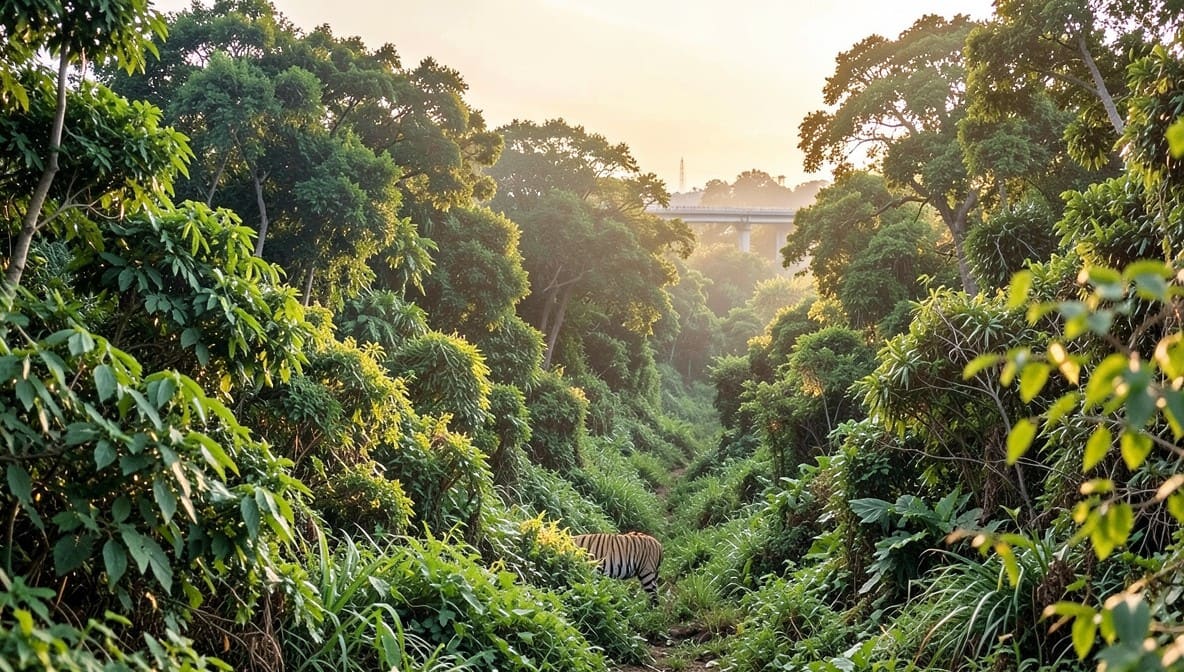
- In 2024, approximately two dozen deer were translocated to Mukundra Hills Tiger Reserve (MHTR) and Ramgarh Vishdhari Tiger Reserve (RVTR) without adherence to soft-release protocols or telemetry monitoring.
- The Central Empowered Committee (CEC) conducted a comprehensive survey and submitted a 428-page report on 06.03.2026, detailing ecological, welfare, and procedural deficiencies.
Procedural History
- 2021: CZA cancelled recognition of A.N. Jha Deer Park as a mini-zoo due to non-compliance and expired licence.
- 18.07.2024: DDA filed an affidavit proposing retention of 24 deer and translocation of the rest, subject to CZA renewal.
- 19.07.2024: Delhi High Court disposed of the writ petition, accepting the DDA’s affidavit and permitting translocation.
- 24.01.2025: Application to recall the 19.07.2024 order was dismissed by the Delhi High Court.
- 26.11.2025: Supreme Court issued interim directions mandating CEC to conduct a detailed survey and submit a report within eight weeks.
- 06.03.2026: CEC submitted its comprehensive report with scientific findings and translocation guidelines.
- 27.04.2026: Supreme Court delivered final judgment.
Relief Sought
The petitioner sought to halt translocation and expand the deer park’s enclosure to accommodate the entire population. The respondents sought to proceed with translocation in accordance with scientific and statutory norms.
The Legal Issue
The central question was whether the retention of a captive deer population in an urban park, without statutory recognition or scientific carrying capacity compliance, is lawful under the Wild Life (Protection) Act, 1972, and whether translocation to ecologically suitable reserves constitutes a legally and ethically valid conservation measure.
Arguments Presented
For the Petitioner
The petitioner argued that the deer, having been bred in captivity for decades, lack survival skills and would face high mortality if translocated. Counsel contended that contiguous land within Hauz Khas could be utilized to expand the enclosure, making translocation unnecessary. Reliance was placed on animal welfare principles and the moral obligation to preserve a long-standing urban ecological landmark. It was submitted that translocation amounted to abandonment and violated the duty of care owed to captive animals.
For the Respondent
The respondents, supported by the CEC report, argued that the park lacked the statutory recognition, infrastructure, and human resources to sustain the population. The CZA’s cancellation of recognition rendered continued retention unlawful. The DDA emphasized that the park’s designation as a protected forest precluded commercial use and that the deer population had become an ecological burden. The translocation plan, they argued, was aligned with IUCN guidelines and national conservation policy.
The Court's Analysis
The Court conducted a rigorous analysis of the CEC’s scientific findings, statutory obligations under the Wild Life (Protection) Act, 1972, and international conservation norms. It emphasized that wildlife, even when captive, must not be confined indefinitely in inadequate enclosures. The Court noted that the CZA’s cancellation of recognition was not merely procedural but substantive, indicating systemic failure to meet mandatory zoo standards.
"The continued retention of the deer at the said park is impermissible in law, there being no duly recognised statutory authority to ensure their proper management."
The Court rejected the argument that habitat expansion within Delhi was viable, holding that intra-park or inter-park relocation without addressing core deficiencies in staffing, veterinary care, and population regulation merely "shifts, rather than resolves, the existing management concerns." It affirmed that the CEC’s assessment of carrying capacity - based on space, fodder, infrastructure, and sex ratio - was methodologically sound and grounded in CZA Guidelines.
The Court further held that translocation, when conducted under soft-release protocols with telemetry monitoring and post-release surveillance, is not only lawful but a responsible conservation tool. It distinguished between "captive confinement" and "ecological reintegration," noting that natural predation in tiger reserves is a sign of ecological health, not failure.
"Natural predation upon translocated prey species represents successful ecological integration into the wild and contributes to population regulation, enhancement of genetic fitness, and maintenance of trophic balance."
The Court also underscored the absence of a national legal framework for invasive species management and the degradation of river systems in tiger reserves, calling for systemic policy intervention.
The Verdict
The Supreme Court dismissed the special leave petitions and upheld the translocation plan. It directed that: (1) up to 38 spotted deer (15 males and 23 females) may be retained at A.N. Jha Deer Park only upon formal recognition by the CZA and full compliance with its 2025 inspection report; (2) all surplus deer must be translocated in phases to MHTR and RVTR under CEC supervision; (3) all future translocations must follow the CEC’s draft guidelines, including soft-release protocols and telemetry tagging; (4) the DDA must repair water troughs, construct night shelters, plant native vegetation, and fill all vacant posts by 01.06.2026; (5) the Ministry of Environment, Forest and Climate Change shall adopt the CEC’s comprehensive translocation guidelines as statutory policy within six months; and (6) the area shall remain a protected forest with no alteration of its status. The matter is listed for compliance review on 19.01.2027.
What This Means For Similar Cases
Scientific Carrying Capacity Is Binding
- Practitioners must now treat CZA and IUCN-derived carrying capacity calculations as legally enforceable limits, not advisory suggestions.
- Any petition seeking to retain captive wildlife beyond scientifically assessed limits must overcome a high burden of proof demonstrating viable, lawful alternatives.
Translocation Is a Legally Valid Conservation Tool
- Translocation of captive animals to protected areas is no longer viewed as abandonment but as ecological restoration, provided it follows soft-release protocols and monitoring.
- Courts will favor translocation over indefinite captivity when statutory recognition is revoked and infrastructure is inadequate.
Statutory Recognition Is Non-Negotiable
- Institutions operating as zoos or wildlife enclosures must maintain active CZA recognition; failure to do so renders continued holding unlawful.
- Municipal bodies like DDA cannot unilaterally decide to retain wildlife without statutory clearance.
Policy Frameworks Must Be Institutionalized
- The judgment mandates that the CEC’s translocation guidelines be converted into statutory rules within six months, setting a precedent for future wildlife management policy.
- Environmental litigation must now include demands for systemic legal reform, not just case-specific remedies.
Invasive Species and River Degradation Are National Concerns
- The Court’s recognition of invasive species (Lantana, Parthenium) and river degradation as threats to biodiversity opens new avenues for PILs targeting ecological security.
- Advocates may now cite this judgment to demand state-level invasive species control laws.