Karnataka High Court judgments

570 Karnataka High Court judgments explained in plain English: what was decided, the law applied and why it matters. Page 2 of 24.

Higher Pension Under EPS Cannot Be Withdrawn Post-Sanction | Karnataka HC
|Karnataka High Court

Higher Pension Under EPS Cannot Be Withdrawn Post-Sanction | Karnataka HC

Karnataka High Court ruled that the Employees' Pension Scheme (EPS) higher pension benefits, once sanctioned and paid, cannot be withdrawn by EPFO. The judgment reaffirms the R.C. Gupta precedent, limiting the impact of the Sunil Kumar B. ruling on already disbursed benefits. Affected retirees and EPFO officials must note the court's strict stance on vested pension rights.

Statutory Power Under Rule 23 Cannot Be Curtailed by Policy | CL-9 Licence Shifting : Karnataka HC
Case Law Analysis
|Karnataka High Court

Statutory Power Under Rule 23 Cannot Be Curtailed by Policy | CL-9 Licence Shifting : Karnataka HC

The Karnataka High Court ruled that the statutory power to permit shifting of CL-9 licensed premises under Rule 23 of the Karnataka Excise Licences (General Conditions) Rules, 1967 cannot be restricted by government circulars unless expressly incorporated in the Act or Rules. The judgment upholds the licensee's shifting permission and dismisses the State's appeal, reinforcing the primacy of statutory provisions over policy directives.

Contempt of Court Act 1971 | Interim Stay Order Without Explicit Prohibition Does Not Bar Property Transactions: Karnataka HC
Case Law Analysis
|Karnataka High Court

Contempt of Court Act 1971 | Interim Stay Order Without Explicit Prohibition Does Not Bar Property Transactions: Karnataka HC

Karnataka High Court rules that an interim order merely staying a tribunal decision does not implicitly prohibit actions like executing gift deeds unless explicitly directed. The judgment clarifies that contempt proceedings require proof of willful disobedience of specific court directives, not general implications of interim relief.

Order V Rule 20 CPC | Email Service of Summons Valid If Compliant with High Court Circulars: Karnataka HC Directs Reconsideration
Case Law Analysis
|Karnataka High Court

Order V Rule 20 CPC | Email Service of Summons Valid If Compliant with High Court Circulars: Karnataka HC Directs Reconsideration

Karnataka High Court rules that trial courts must consider email service of summons under Order V Rule 20 CPC if compliant with High Court circulars. The judgment mandates reasoned orders and reinforces procedural compliance, impacting civil litigation efficiency and access to justice for parties unable to effect traditional service.

Section 69 BNS | Deceitful Intent Must Be Proven From Inception for 'False Promise of Marriage' Offences: Karnataka HC Refuses Quashing
Case Law Analysis
|Karnataka High Court

Section 69 BNS | Deceitful Intent Must Be Proven From Inception for 'False Promise of Marriage' Offences: Karnataka HC Refuses Quashing

Karnataka High Court rules that allegations of 'false promise of marriage' under Section 69 BNS require proof of deceitful intent from the outset. Mere breach of promise or subsequent withdrawal does not suffice for criminal liability, reinforcing the need for thorough investigation before quashing FIRs in such cases.

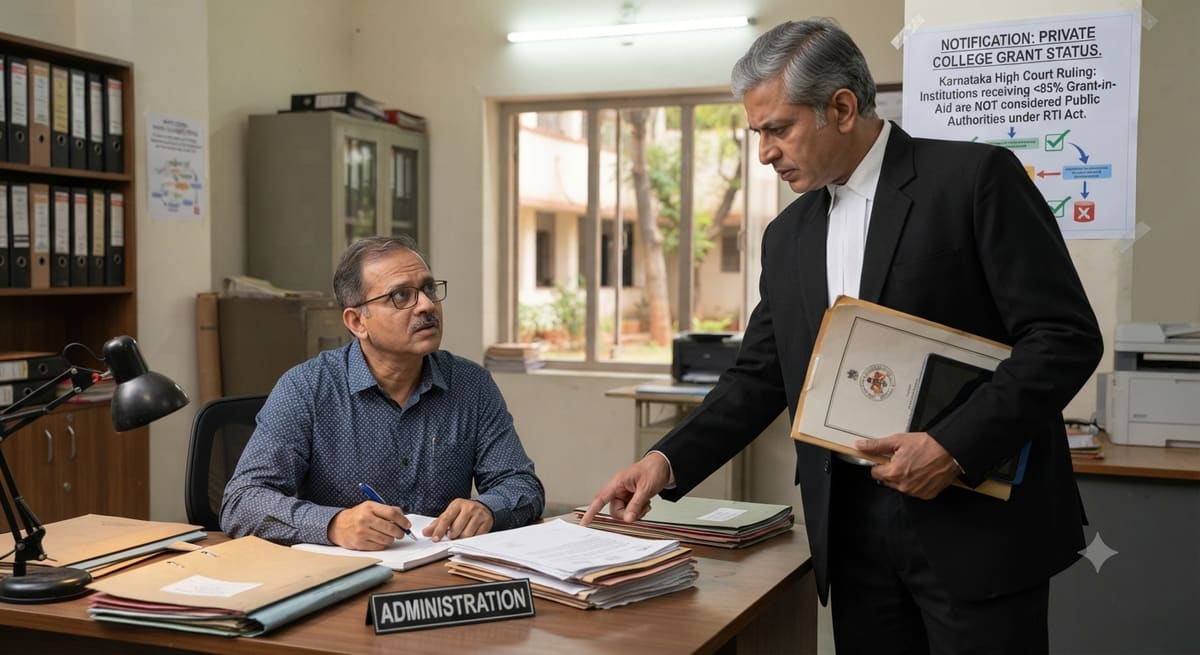
Section 2(h) RTI Act | Private Club on Government-Granted Land is 'Public Authority' Due to Substantial State Financing : Karnataka HC
Case Law Analysis
|Karnataka High Court

Section 2(h) RTI Act | Private Club on Government-Granted Land is 'Public Authority' Due to Substantial State Financing : Karnataka HC

Karnataka High Court holds that Century Club, operating on land granted by the erstwhile Mysuru Maharaja, qualifies as a 'Public Authority' under the RTI Act due to indirect State financing. The ruling expands transparency obligations to private entities benefiting from public resources, setting a precedent for similar cases.

Order XXXIX Rule 2A CPC | MD Personally Liable for Contempt via Willful Injunction Violation : Karnataka HC Reduces Sentence to One-Day Detention with Apology & Costs
|Karnataka High Court

Order XXXIX Rule 2A CPC | MD Personally Liable for Contempt via Willful Injunction Violation : Karnataka HC Reduces Sentence to One-Day Detention with Apology & Costs

The Karnataka High Court held that a Managing Director can be held personally liable under Order XXXIX Rule 2A CPC for willful disobedience of an injunction order, even if the violation stems from corporate actions. The Court modified the punishment to one-day detention, conditional on a public apology and payment of costs, emphasizing the personal accountability of corporate leaders in contempt proceedings.

Section 14(3)(c) Specific Relief Act | Vague Joint Development Agreements Unenforceable : Karnataka HC
Case Law Analysis
|Karnataka High Court

Section 14(3)(c) Specific Relief Act | Vague Joint Development Agreements Unenforceable : Karnataka HC

Karnataka High Court rules that joint development agreements lacking precise specifications fail the 'readiness and willingness' test under Section 14(3)(c) of the Specific Relief Act, rendering them unenforceable. Developers risk forfeiture of security deposits if terms are not clearly defined, reinforcing strict compliance for contract enforcement.

Writ of Mandamus | Non-Compliance with Judicial Orders on Shop Allotment to Street Vendors Violates Constitutional Obligations : Karnataka HC
Case Law Analysis
|Karnataka High Court

Writ of Mandamus | Non-Compliance with Judicial Orders on Shop Allotment to Street Vendors Violates Constitutional Obligations : Karnataka HC

Karnataka High Court reinforces that municipal authorities must comply with judicial orders under Articles 226 and 227 of the Constitution, directing immediate shop allotment to street vendors within 30 days. Failure to adhere to court directives constitutes contempt and violates the rule of law, setting a precedent for enforcing judicial compliance in administrative matters.

Section 528 BNSS | Call Detail Records Alone Insufficient for Quashing Charge Sheet Without Trial Adjudication : Karnataka HC
Case Law Analysis
|Karnataka High Court

Section 528 BNSS | Call Detail Records Alone Insufficient for Quashing Charge Sheet Without Trial Adjudication : Karnataka HC

Karnataka High Court rules that Call Detail Records (CDRs) and prima facie allegations of nexus in organized crime cases demand trial adjudication, rejecting threshold quashing of charge sheets. The judgment reinforces that prosecution must establish complicity beyond reasonable doubt during trial, not at the quashing stage.

Section 11A Industrial Disputes Act | Compensation Over Reinstatement Justified for Unintentional Absenteeism : Karnataka HC Upholds Rs. 1 Lakh Award
Case Law Analysis
|Karnataka High Court

Section 11A Industrial Disputes Act | Compensation Over Reinstatement Justified for Unintentional Absenteeism : Karnataka HC Upholds Rs. 1 Lakh Award

Karnataka High Court affirms that compensation under Section 11A of the Industrial Disputes Act can be awarded even for unintentional absenteeism, prioritizing equitable relief over reinstatement. The ruling underscores courts' discretion to balance employer discipline with employee rights, setting a precedent for similar disputes.

Section 32 Indian Evidence Act | Dying Declaration Without Medical Fitness Certificate Inadmissible: Karnataka HC Acquits in Dowry Death Case
Case Law Analysis
|Karnataka High Court

Section 32 Indian Evidence Act | Dying Declaration Without Medical Fitness Certificate Inadmissible: Karnataka HC Acquits in Dowry Death Case

Karnataka High Court ruled that a dying declaration lacking a medical certificate attesting to the declarant's fitness is inadmissible as substantive evidence. The acquittal in this dowry death case underscores the prosecution's burden to establish the declarant's mental soundness at the time of the statement, reinforcing evidentiary standards under Section 32 of the Indian Evidence Act.

Rule 9 Karnataka Selection Rules | Retrospective Application of Sports Quota Eligibility Mandates Fresh Representation : Karnataka HC
Case Law Analysis
|Karnataka High Court

Rule 9 Karnataka Selection Rules | Retrospective Application of Sports Quota Eligibility Mandates Fresh Representation : Karnataka HC

Karnataka High Court directs fresh consideration for CET-2026 admissions under amended Rule 9, emphasizing natural justice and retrospective effect of sports quota eligibility. The ruling mandates procedural fairness for candidates previously deemed ineligible, impacting UGCET aspirants relying on sports reservations.

Retrospective Jurisdictional Amendments | Legislative Competence Curtailed to Protect Vested Rights : Karnataka HC Reads Down Amendment
Case Law Analysis
|Karnataka High Court

Retrospective Jurisdictional Amendments | Legislative Competence Curtailed to Protect Vested Rights : Karnataka HC Reads Down Amendment

Karnataka High Court upholds the constitutional validity of amendments altering civil courts' appellate jurisdiction but restricts their retrospective effect to exclude concluded proceedings. The ruling ensures pending appeals are transferred to District Courts while safeguarding vested rights, setting a precedent for balancing legislative intent with judicial protection of accrued legal entitlements.