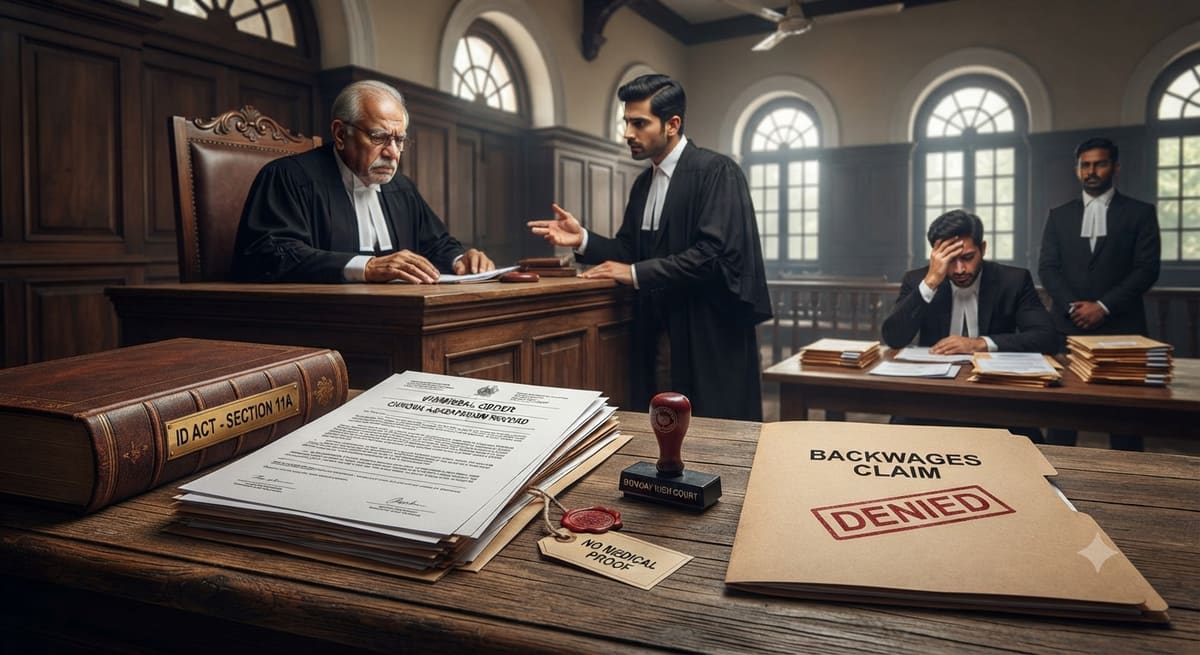
The Karnataka High Court has reaffirmed the discretionary power of Labor Courts under Section 11A of the Industrial Disputes Act to award compensation in lieu of reinstatement, particularly when absenteeism is unintentional and the domestic inquiry is fair. This judgment underscores the equitable balance courts must strike between employer discipline and employee rights, even in cases of temporary employment.
Background & Facts
The Dispute
The respondent, Smt Varalakshmi @ Varalakshmamma, was employed as a Garden Assistant at P.E.S. Engineering College, Mandya, under the management of Janaatha Shikshana Trust. Following disciplinary proceedings for unauthorized absenteeism, she was subjected to punishment. Dissatisfied with the management's decision, she raised an industrial dispute before the Labor Court.
Key Facts
The respondent was a temporary employee engaged as a Garden Assistant
She faced disciplinary action for unauthorized absenteeism
The management conducted a domestic inquiry adhering to principles of natural justice
The respondent contended that her absenteeism was not intentional
The Labor Court found that the severity of misconduct was mitigated due to unintentional absenteeism
Procedural History
Disciplinary Proceedings: Conducted by the management, resulting in punishment for unauthorized absenteeism
15.02.2014: Labor Court passed an award partly allowing the reference, directing payment of Rs. 1,00,000 as compensation instead of reinstatement
WP No. 53126 of 2014: The management filed a writ petition challenging the Labor Court's award
07.07.2026: The High Court delivered the present judgment dismissing the writ petition
The Parties' Positions
For the Petitioners (Management)
Argued that the respondent remained absent without authorization despite repeated warnings
Contended that the Labor Court erred in awarding compensation when reinstatement was declined
Submitted that the award was unsustainable and liable to be set aside
For the Respondent (Employee)
Justified the award on grounds of violation of Section 25(F) of the Industrial Disputes Act
Contended that the writ petition was devoid of merit and liable to be dismissed
Relief Sought
The petitioners sought quashing of the Labor Court's award dated 15.02.2014, which directed payment of Rs. 1,00,000 as compensation instead of reinstatement.
The Legal Issue
The central question was whether the Labor Court's award of compensation under Section 11A of the Industrial Disputes Act, in lieu of reinstatement, was justified when the employee's absenteeism was found to be unintentional and the domestic inquiry was fair.
Arguments Presented
For the Petitioners
The respondent's unauthorized absenteeism warranted strict disciplinary action
The Labor Court erred in awarding compensation when reinstatement was declined
The award was unsustainable and contrary to the principles of employer discipline
For the Respondent
The management violated Section 25(F) of the Industrial Disputes Act
The writ petition was devoid of merit and liable to be dismissed
The Labor Court's discretion under Section 11A was appropriately exercised
The Court's Analysis
The High Court meticulously examined the Labor Court's reasoning and the material on record. Key observations include:
Fairness of Domestic Inquiry: The Court noted that the domestic inquiry conducted by the management was fair and proper, adhering to principles of natural justice.
Unintentional Absenteeism: The Labor Court found that the respondent's absenteeism was not intentional, which mitigated the severity of the misconduct.
Discretion Under Section 11A: The Court emphasized that Section 11A of the Industrial Disputes Act vests Labor Courts with discretionary power to shape relief appropriately. While reinstatement may not always be feasible, particularly in cases of temporary employment or lapse of time, compensation can be awarded as an equitable alternative.
Balancing Equities: The Court held that the Labor Court's decision to award Rs. 1,00,000 as compensation struck a fair balance between the interests of the employer and the employee. The award was not perverse and did not warrant interference under Articles 226 and 227 of the Constitution.
"The Labor Court, having concluded that the domestic inquiry conducted by the management was fair and proper, considered the dispute over whether there was victimization. The first party was a temporary employee. The alleged misconduct was unauthorized absenteeism. Upon careful consideration of the material on record, the Labor Court concluded that the absenteeism of the first party was not intentional. The severity of the misconduct was mitigated. While reinstatement may not be an appropriate relief, considering the lapse of time and attendant circumstances, the Labor Court is vested with discretion under Section 11A of the Industrial Disputes Act to shape the relief suitably. Awarding compensation instead of reinstatement is a fair and equitable decision, balancing the interests of both parties."
The Verdict
The writ petition was dismissed. The High Court upheld the Labor Court's award dated 15.02.2014, directing the petitioners to pay Rs. 1,00,000 as compensation to the respondent. The interim order, if any, stood discharged, and pending interlocutory applications were disposed of.
What This Means For Similar Cases
Discretion Under Section 11A Is Broad and Equitable
Labor Courts have wide discretion under Section 11A of the Industrial Disputes Act to tailor relief based on the facts of each case
Compensation can be awarded even when reinstatement is declined, particularly in cases of temporary employment or lapse of time
The severity of misconduct may be mitigated if the employee's actions are found to be unintentional
Domestic Inquiry Must Adhere to Natural Justice
Employers must ensure that domestic inquiries are conducted fairly and transparently, adhering to principles of natural justice
A flawed inquiry may lead to the Labor Court setting aside the punishment or awarding higher compensation
Temporary Employees Are Entitled to Equitable Relief
Temporary employees are not devoid of legal protections under the Industrial Disputes Act
Courts may award compensation as a practical and equitable remedy, especially when reinstatement is impractical due to the nature of employment or passage of time